Placenta-on-a-chip
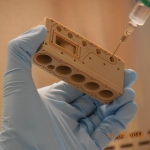
National Institutes of Health (NIH) researchers and their colleagues have developed a "placenta-on-a-chip" to study the inner workings of the human placenta and its role in pregnancy.

National Institutes of Health (NIH) researchers and their colleagues have developed a "placenta-on-a-chip" to study the inner workings of the human placenta and its role in pregnancy.

Researchers in Canada and the U.K. have for the first time sequenced and assembled de novo the full genome of a living organism, the bacteria Escherichia Coli, using Oxford Nanopore's MinIONTM device, a genome sequencer that can fit in the palm of your hand.

Mutations in ARID1a, which are common in many cancer types, disrupt DNA damage repair in cancer cells, allowing the cancer to progress. This gene may also be an Achilles' heel when treating certain tumors, according to a team of researchers at The University of Texas MD Anderson Cancer Center.

A new imaging technique can identify the specific changes in neural communication that can disrupt functional connectivity across the brain as a result of mild traumatic brain injury (mTBI).

The results of a study presented today at the European League Against Rheumatism Annual Congress (EULAR 2015) Press Conference showed that people with systemic sclerosis (SSc) have a unique bacterial signature in their colon, when compared with healthy people.

The ESCMID Study Group for Forensic and Postmortem Microbiology will create a new network of microbiologists, virologists, anthropologists and archaeologists working in the field of forensic medicine. Professor Amparo Fernandez-Rodriguez, from the National Institute of Toxicology and Forensic Sciences, Madrid, is the head of ESGFOR and stresses the importance of this group in facilitating…

In collaboration with colleagues from California and New York, researchers of the Paul-Ehrlich-Institut have identified a cytosolic receptor which enables cells of the immune system to recognize HIV and to trigger an immune response. The findings of the researchers may be a useful tool for creating an effective endogenous immune response against HIV and helpful to boost vaccine responses.

Non-calcified arterial plaque is associated with diabetes, high systolic blood pressure and elevated 'bad' cholesterol levels in asymptomatic individuals, according to a new study published online in the journal Radiology.

A single dose of an FDA-approved intravenous nutrition source may be able to significantly reduce the toxicity and increase the bioavailability of platinum-based cancer drugs, according to a study by Carnegie Mellon University biologists published in Scientific Reports.

Can a routine hospital stay upset the balance of microbes in our bodies so much that it sets some older people up for a life-threatening health crisis called sepsis? A new University of Michigan and VA study suggests this may be the case.

Do microbes grow differently on the International Space Station than they do on Earth? Results from the growth of microbes collected by citizen scientists in Project MERCCURI indicate that most behave similarly in both places.

Unstable funding is threatening the viability of academic biomedical research, according to a new paper published this week in the journal Science Translational Medicine. The paper was written jointly by the deans of 19 prominent medical schools around the USA. Among this group is University of Maryland School of Medicine Dean E. Albert Reece.

Several EPFL laboratories are working on devices allowing constant analysis over as long a period as possible. The latest development is the biosensor chip, created by researchers in the Integrated Systems Laboratory working together with the Radio Frequency Integrated Circuit Group. Sandro Carrara is unveiling it today at the International Symposium on Circuits and Systems (ISCAS) in Lisbon.

Degeneration of the white matter of the brain may be an early marker of specific types of Alzheimer's disease (AD), including early-onset AD, according to results of a new study published in the journal Radiology.

Researchers at the University of Toronto design diagnostic chip to reduce testing time from days to one hour, allowing doctors to pick the right antibiotic the first time.

Scientists who use synchrotron light sources are welcoming an era of "on-demand" X-rays, in which they have access to the light beams they want thanks to a technique developed at the U.S. Department of Energy (DOE)'s Lawrence Berkeley National Laboratory (Berkeley Lab).

Patience and persistence are beginning to pay off for University of Montana Professor Mark Grimes, whose research about the behavior of cell proteins in childhood cancer recently was published by the Public Library of Science Computational Biology.

LMU researchers demonstrate for the first time that bacteriophages (bacterial viruses) carry genetic instructions for proteins that mediate the transport of their DNA to specialized replication sites in the host cell.

Research published in the Proceedings of the National Academy of Sciences (PNAS) demonstrates that technology invented by researchers at Oregon Health & Science University’s Casey Eye Institute can improve the clinical management of the leading causes of blindness. Optical coherence tomography (OCT) angiography could largely replace current dye-based angiography in the management of these…

People waiting for organ transplants may soon have higher hopes of getting the help that they need in time. Researchers at the RIKEN Center for Developmental Biology have developed a new technique that extends the time that donor organs last and can also resuscitate organs obtained after cardiac arrest.

Blocked blood vessels can quickly become dangerous. It is often necessary to replace a blood vessel – either by another vessel taken from the body or even by artificial vascular prostheses. Together, Vienna University of Technology and Vienna Medical University have developed artificial blood vessels made from a special elastomer material, which has excellent mechanical properties. Over time,…

Genetically engineered fibers of the protein spidroin, which is the construction material for spider webs, has proven to be a perfect substrate for cultivating heart tissue cells, MIPT researchers found. They discuss their findings in an article that has recently come out in the journal PLOS ONE.

Knee injuries are the bane of athletes everywhere, from professionals and college stars to weekend warriors. Current surgical options for repairing damaged cartilage caused by knee injuries are costly, can have complications, and often are not very effective in the long run. Even after surgery, cartilage degeneration can progress leading to painful arthritis. But a University of Iowa orthopedics…

Scientists from the Hubrecht Institute and the University Medical Center Utrecht (UMC Utrecht) have developed a cell culture model of human colon cancer progression. This model mimics the situation in patients more closely than any other colon cancer model so far. It enables researchers to study processes involved in colon cancer development and find new cancer drugs.

A multi-year study led by researchers from the Simons Center for Data Analysis (SCDA) and major universities and medical schools has broken substantial new ground, establishing how genes work together within 144 different human tissues and cell types in carrying out those tissues' functions.