

The first cross-border European University Hospital
During the MCC Hospital World 2008 congress, held in Berlin this September, speakers from international firms and hospital chains discussed the demands and necessities for future healthcare.

During the MCC Hospital World 2008 congress, held in Berlin this September, speakers from international firms and hospital chains discussed the demands and necessities for future healthcare.
UBIFRANCE and the network of Trade Commissions together constitute the French government's corporate international expansion support framework. Every year they help over 13,000 companies of all sizes, and from all sectors, to develop their activities worldwide, thanks to the expertise of 2,500 staff based in France and in 120 countries, who operate through the Trade Commissions of the French…

"Children are no small adults. That remains true no matter how often it is repeated. And it is particularly true in paediatric nursing," says Andreas Wachtel, vice chairman of the GkinD (Germany's association of children's hospitals and paediatric departments, and Elfriede Zoller, chairwoman of the BeKD (the country's professional association of paediatric nurses).
The IHE Connectathon (IHE = Integrating the Healthcare Enterprise) is a joint initiative of healthcare professionals and industry to improve the way computer systems in healthcare share information.

BEO MedConsulting BERLIN GmbH, founded in 2000 and headquartered in Berlin since 2005, advises manufacturers on all issues concerning testing and approval of medical devices.
There's little evidence that newer, more expensive drugs work any better than older, cheaper medications. Diabetes, which came 7th in the list of the USA's top mortality causes in 2006, has hit a new high.

Surgical Site Infection is the most important problem facing surgeons today, according to Professor Miguel Cainzos, of Santiago de Compostela, Spain, speaking at the 2nd EMEA Symposium on New Non-Pharmaceutical ways to reduce surgical site infection.

MEDICA - the most important event in the world of healthcare - displays the entire range of products, solutions and innovations relevant in this sector. The event is therefore also important to nurses, for they can discover and examine new equipment and other products and directly contact the manufactures and distributors.
The Fresenius Inventors' Fair is held every two years during MEDICA. This year 20 researchers, developers and inventors from all over the world will have the opportunity to present their ideas to the huge MEDICA audience.
Junior European health politicians have few opportunities to exchange ideas and coordinate activities. However, due to a pilot project and years of cooperation between the European Commission and the European Health Forum Gastein (EHFG), a new concept has arisen to meet their needs.

When from 19 to 22 November the world's largest medical fair takes place in Dusseldorf, the entire city is in a kind of emergency state: hotels are bustin' out of their seams, traffic periodically comes to a standstill and at night exhibitors and visitors alike crowd the narrow streets of the Altstadt and the fancy hotel bars and enjoy whatever entertainment North Rhine-Westphalia's capital has…

While Western Europe's hospitals only carry out drills for possible terrorist events — Israel's medics face the real thing. During the recent Congress of Anaesthesiology and Intensive Care Medicine in Berlin, internist Dr Michael Kafka, head of emergency medicine at the Bnai Zion Medical Centre in Haifa, described strategies to cope with mass casualty events.

The Royal College of Nursing (RCN) wants the Department of Health to spend a forecasted surplus of around 2.2 billion euros on the 2008/09 National Health Service (NHS) budget on nurse recruitment and training and to support the transition from acute to community-based care under health minister Lord Darzi's reform of the NHS.

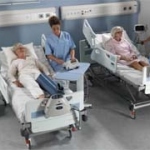
ArjoHuntleigh, formed in 2007 from the merger of ARJO and Huntleigh Healthcare, is showing a broad portfolio of products and services for patient care.
Lab Tests Online, an online encyclopaedia on laboratory testing and related conditions, is expanding to include eight languages.
A new website - www.RadiologyCases.com - has been launched to present publications and education for radiologists.

Inequalities in radiology services across Europe may be levelled out due to R-Bay, a new project in which a consortium of hospitals and healthcare providers will create an e-marketplace to sell and buy radiological services like commodities.
Regulars at MEDICA well understand the energy needed to stay the pace. A welcome break at the end of the days could be found at the receptions or `Happy Hours´ held by certain exhibitors who will be happy to welcome visitors to their stands.

Maquet has launched Cardiohelp, the world's smallest, lightest heart-lung machine, that can not only provide a total therapy solution for heart surgery, cardiology, intensive and emergency care, but also, due to its suitcase size and 10 kg weigh, the device can be carried by just one person onto a helicopter or ambulance for mo-bile use.

The Swiss charity EurAsia Heart, founded in 2006 by cardiac surgeon Professor Paul Vogt MD, at Zurich University Hospital, emerged from numerous contacts being made with Asian heart surgeons at the beginning of 2000, and consequent invitations to perform surgery and lecture tours in China.

ElsMed Ltd takes pride in providing fully-refurbished diagnostics equipment, servicing/training, application/clinical user training, parts and technical support, all reportedly at affordable prices.
Web 2.0 is a 'buzz# phrase used to describe users' involvement with the Internet. This form of electronic exertion of influence is still fairly rare.

In September 2006, Dr Albrecht Bornscheuer (right) changed roles within the Hannover Medical School (MHH): the anaesthetist became a manager responsible for the coordination and capacity utilisation of the school's 41 operating theatres.

His work is discussed controversially across the world: his supporters call it art, his opponents call it illegal an immoral. Nevertheless, Gunter von Hagens' plastinations fascinated an audience of millions and now the University of Warwick, UK, ordered 200 plastinations for anatomy teaching.

Presidential candidates use them to persuade voters, drug companies use them to sell their products, and the media spin them in all kinds of ways, but nobody - candidates, reporters, let alone health consumers - understands them.