

Article • Digital pathology
From single-tumour to pan-cancer AI diagnostics
Artificial intelligence is transforming the way cancer is diagnosed and treated. Dr Yuri Tolkach, from the University Hospital Cologne in Germany, shared his group's advances in developing AI-based tools for oncological pathology at the 12th Digital Pathology and Artificial Intelligence Europe congress in London.
By Mark Nicholls
Photo courtesy of Dr Tolkach
During his presentation, Tolkach explained how algorithms for pathology and oncology have evolved over the years – from basic diagnostic levels to more advanced prognostic and predictive models. This evolution now extends to harnessing the capabilities of large language models (LLMs) and multi-modal reasoning with agentic AI integrated into clinical workflows.
From years to days: accelerating annotation
Four years ago, the Cologne group published its first findings on prostate cancer and tumour detection with good degrees of accuracy, but then switched to multi-segmentation algorithms for colorectal cancer with better results. 'Annotations are the major problem for colorectal cancer,' said Tolkach. 'It took us more than one year to prepare all annotations to train it but now there are different ways we can accelerate the annotations.'
This breakthrough has significantly reduced the annotation time – down to days in some instances – as the group developed a number of precise algorithms for different tumours such as prostate, lung and colorectal cancer.
Recommended article
News • Automated tissue analysis
Digital pathology: AI platform to improve lung cancer diagnosis
Cologne researchers have developed an AI-based digital pathology platform to enable extremely fast and accurate fully automated analysis of tissue sections from lung cancer patients.
One algorithm for multiple cancers
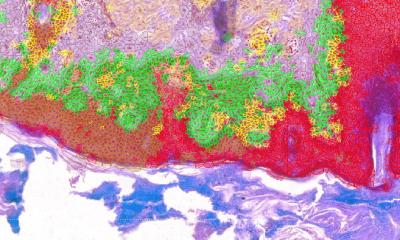
The latest phase of the research has seen a shift towards 'pan-tumoral algorithms'. Tolkach said: 'The question was, why can't we develop one algorithm for more types of cancers; we have lung, colon and breast AI, but what if we applied these algorithms to another tumour type, why can't we develop one algorithm for all these cancers? When we applied our five algorithms to different tumour types, we saw that the performance was so high to cervical cancers and other cancers and with the same segmentation accuracy.'
While the importance of clinical validation cannot be underestimated, the development of the fast-track principle of annotating has been a significant step forward.
Extracting data and modelling tumour growth
There is great potential for AI in diagnostic tasks, Tolkach explained, particularly with interobserver variability and aggressivity grading. Advanced algorithms are giving clinicians a very clear understanding of tumours from the outset, with LLMs extracting data from AI parameters for the training of algorithms and making effective large-scale analysis possible.
Multi-modal models are also supporting prediction of relapse after cessation of immune checkpoint therapy in malignant melanoma, with mathematical modelling of tumour growth and evolution. 'When we extract all this information from tumour cells, we can create a model on our computers of tumour growth and see how that tumour grows,' he said. 'That intratumoral heterogeneity is so close to the real-world data.'
Profile:
Dr Yuri Tolkach is Senior Attending Physician and Research Group Lead at the Institute of Pathology at University Hospital Cologne in Germany. His ‘Digital and computational pathology’ working group has research interests in diagnostic, prognostic, and predictive tools for pathology/oncology, multi-modal data integration (molecular characterisation), intratumoral heterogeneity and cancer evolution, large language models and reasoning, and quality control in digital pathology.
18.06.2026