

News • Focus on FAP
New radiopharmaceutical therapy shows broad effectiveness across multiple cancers
A novel radiopharmaceutical therapy approach that targets fibroblast activation protein (FAP)—which is highly expressed on many types of cancers—is safe and effective for patients.
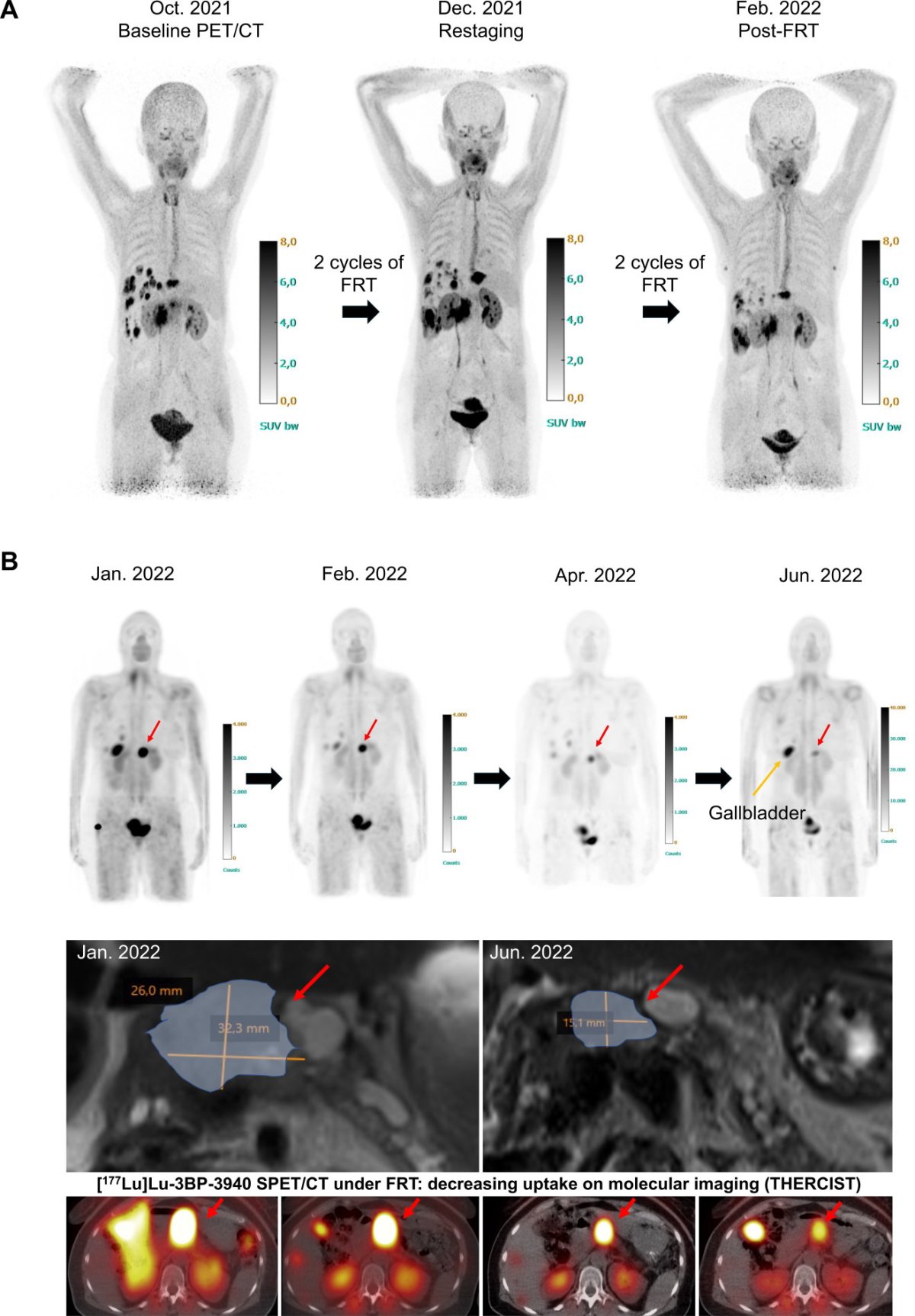
Image source: SNMMI; from: Baum RP, Zhao T, Jakobsson V et al., Journal of Nuclear Medicine 2026
This is according to a new study published in the Journal of Nuclear Medicine. In a study of nearly 90 patients with 21 different types of cancer, FAP-targeted radiopharmaceutical therapy achieved objective responses in approximately two-thirds of patients and disease control in more than 80%.
Radiopharmaceutical therapy has already transformed care for neuroendocrine tumors and metastatic castration-resistant prostate cancer, but patients with other tumor types still lack targeted treatment options. FAP is rare in healthy adult tissue but overexpressed in solid cancers—including breast, colorectal, gastric, and ovarian cancers and sarcomas—making it an attractive target for new radiopharmaceutical therapy approaches.
The first-in-human study included 88 patients with heavily pretreated, end-stage cancers representing 21 distinct advanced metastatic solid tumors. In total, patients received 227 cycles of either 177Lu-, 90Y-, or 225Ac-3BP-3940 FAP radiopharmaceutical therapy. Researchers evaluated toxicity, assessed treatment response, and calculated survival from the start of therapy.
Administrations of the FAP-targeted radiopharmaceutical therapies were well tolerated, with mild adverse events. After two cycles of therapy, tumor response included complete remission (3.0%), partial remission (51.5%), stable disease (15.2%), and progressive disease (30.3%). The FAP-targeted therapy demonstrated potent antitumor activity, achieving objective responses in 66.7% of patients and disease control in 80.4%. For the entire cohort, the median overall survival was seven months from the start of FAP-targeted radiopharmaceutical therapy.
For patients who have run out of options, this kind of therapy can make a meaningful difference, not only in controlling the disease but also in maintaining quality of life
Richard P. Baum
“This study included patients with very advanced cancers who had already gone through multiple treatments,” said Richard P. Baum, MD, PhD, professor in the Department of Molecular Radiotherapy at Curanosticum Wiesbaden-Frankfurt in Germany, an ICPO Center of Excellence. “Even in this challenging group, we observed tumor shrinkage or disease stabilization in many cases. For patients who have run out of options, this kind of therapy can make a meaningful difference, not only in controlling the disease but also in maintaining quality of life.”
As research continues, this approach could make radiopharmaceutical therapy accessible to a much wider group of patients.
“What makes this work exciting is that we’re no longer limited to treating just one cancer type. By targeting the tumor microenvironment itself, we’re seeing meaningful responses across many cancers, even in patients with few remaining options,” said Jingjing Zhang, MD, PhD, assistant professor in the Department of Diagnostic Radiology at the National University of Singapore. “This could open the door to a new generation of radiopharmaceutical therapies that are much more broadly applicable.”
The authors of “FAP-Targeted Radiopharmaceutical Therapy using [177Lu]Lu-, [90Y]Y- and [225Ac]Ac-labeled 3BP-3940: First Experience in 21 Different Advanced Malignancies” include Richard P. Baum, Lukas Greifenstein, Aleksandr Eismant, Kriti Ghai, Aditi Mishra, Andre Klega, Christian Landvogt, Corinna Mueller, and Daniel Benz-Zils, Curanosticum Wiesbaden-Frankfurt, Department of Molecular Radiotherapy, ICPO Center of Excellence, DKD HELIOS Klinik, Wiesbaden, Germany; Tianzhi Zhao, Vivianne Jakobsson, and Jingjing Zhang, Department of Diagnostic Radiology, Yong Loo Lin School of Medicine, National University of Singapore, Singapore, Singapore, Theranostics Centre of Excellence, Yong Loo Lin School of Medicine, National University of Singapore, Singapore, Singapore, Clinical Imaging Research Centre, Centre for Translational Medicine, Yong Loo Lin School of Medicine, National University of Singapore, Singapore, Singapore, and Nanomedicine Translational Research Program, Yong Loo Lin School of Medicine, National University of Singapore, Singapore, Singapore; Ortwin Klein and Bastian Jaeschke, Department of Oncology and Hematology, DKD HELIOS Klinik, Wiesbaden, Germany; and Elisabetta Perrone, Nuclear Medicine Unit, Diagnostic Imaging and Radiation Oncology Department, Fondazione Policlinico Universitario Agostino Gemelli IRCCS, Rome, Italy.
Source: Society of Nuclear Medicine and Molecular Imaging
22.06.2026