Image credit: Courtesy of SNMMI
News • Novel radiopharmaceutical therapy
Promising treatment option for aggressive neuroendocrine tumors
Study explored safety and efficacy of novel PRRT approach using SSTR antagonist DOTA-LM3 labeled to the alpha-emitting nuclide 225Ac to provide targeted therapy
This novel approach, presented at the Society of Nuclear Medicine 2026 Annual Meeting, resulted in partial remission of the disease in the majority of patients with advanced cases of neuroendocrine tumors.
Neuroendocrine tumors are a type of cancer that begins from neuroendocrine cells (most commonly located in the gastrointestinal tract, pancreas, and lungs) and can spread to other parts of the body. Patients with progressive neuroendocrine tumors often have limited treatment options, especially after conventional therapies and approved beta-emitting PRRT have failed. Their prognosis is generally poor, and there is a clear unmet need for new therapeutic strategies.
Based on this real-world experience, alpha-PRRT may offer a potential additional option for selected patients whose tumors still express somatostatin receptors, as documented by pre-therapeutic 68Ga-DOTA-LM3 PET/CT
Elisabetta Perrone
"It can be very challenging to treat these patients as they have already received many different types of therapies," said Elisabetta Perrone, MD, a nuclear medicine physician at Policlinico Universitario Agostino Gemelli IRCCS in Rome, Italy. "In our study we explored the safety and efficacy of a novel PRRT approach that uses a somatostatin receptor (SSTR) antagonist (called DOTA-LM3) labeled to the alpha-emitting nuclide 225Ac to provide targeted therapy. Since alpha particles deliver high-energy radiation over a very short distance: this aspect may help target tumor cells while limiting unnecessary exposure to close healthy tissues, therefore balancing efficacy and toxicity an important consideration for patients undergoing systemic therapies."
Twenty patients with different primary origins of well-differentiated neuroendocrine tumors grade 3 received 225Ac-DOTA-LM3 PRRT administered as monotherapy (9 cycles) or in TANDEM with the beta-emitting nuclide 177Lu (32 cycles). After receiving treatment, acute adverse events and long-term hematologic, renal, and hepatic toxicities were monitored and graded. Molecular imaging response was evaluated with post-PRRT SPECT/CT and follow-up 68Ga- DOTA-LM3 PET/CT, and survival was calculated.
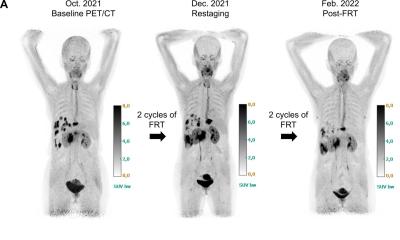
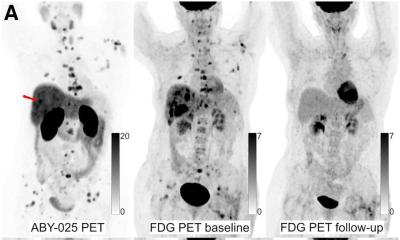
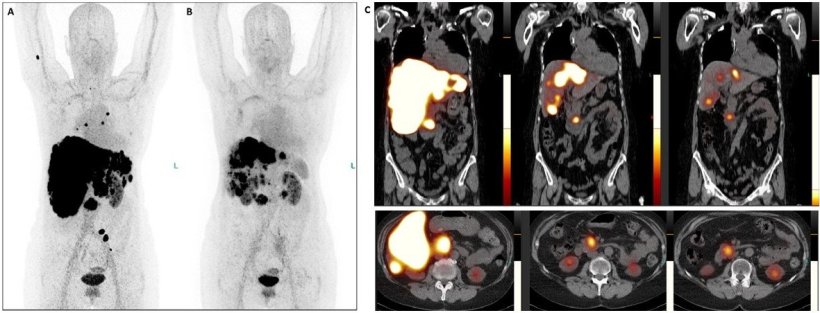
The treatment, both as monotherapy and in TANDEM, was generally well-tolerated, with only mild, self-limiting acute adverse effects, mainly nausea, and a few cases of long-term toxicities, such as anemia, reduced white blood cell counts and reduced platelet counts. Molecular imaging demonstrated complete remission in one patient, partial remission in 10, stable disease in two patients, and progressive disease in six; one patient experienced clinical progression to death before post-PRRT imaging. At time of analysis, 11 patients were alive (median follow-up of seven months) and nine had died (median survival of 18 months).
"This cohort of patients was heterogeneous with respect to primary tumor site, prior treatments and number of alpha-PRRT cycles; nevertheless, alpha-PRRT with 225Ac-DOTA-LM3 (as monotherapy or in TANDEM), showed a manageable acute and long-term safety profile and encouraging antitumor activity, follow-up and survival outcomes," said Perrone. "Based on this real-world experience, alpha-PRRT may offer a potential additional option for selected patients whose tumors still express somatostatin receptors, as documented by pre-therapeutic 68Ga-DOTA-LM3 PET/CT."
225Ac-DOTA-LM3 PRRT is considered investigational and is currently offered only in highly specialized centers--including CURANOSTICUM Wiesbaden-Frankfurt, ICPO Center of Excellence for Advanced Radiomolecular Precision Oncology in Germany, where this study was conducted under the guidance of nuclear medicine physician Richard P. Baum, MD, PhD--and generally within controlled clinical, compassionate use or individualized treatment settings.
"Before it becomes more broadly available, larger multicenter studies and prospective clinical trials are needed to confirm efficacy, better define safety, optimize dosing and identify which patients are most likely to benefit," said Baum.
Abstract 261577. "Beyond β-Peptide Receptor Radionuclide Therapy (PRRT) with somatostatin receptor (SSTR) Agonists: Real-world outcomes of SSTR Antagonist α-PRRT in heavily pretreated G3 Neuroendocrine Neoplasms," Elisabetta Perrone, Policlinico Universitario A. Gemelli IRCCS, Rome, Italy, and Curanosticum Wiesbaden-Frankfurt, ICPO Center of Excellence for Advanced Radiomolecular Precision Oncology, Germany; Kriti Ghai, Aleksandr Eismant, Tanay Parkar, Lukas Greifenstein, and Richard P. Baum, Curanosticum Wiesbaden-Frankfurt, ICPO Center of Excellence for Advanced Radiomolecular Precision Oncology, Germany; Flaminia Vocaturo, Institute of Nuclear Medicine, Universit Cattolica del Sacro Cuore, Rome, Italy; and Marianne Pavel, Friedrich-Alexander University, Erlangen, Germany.
Source: Society of Nuclear Medicine and Molecular Imaging
01.06.2026