

The 91220 mCare 300
Spacelabs Healthcare is a growing group of companies now operating under one new name. Earlier companies incorporated under this name include Spacelabs Medical, Del Mar Reynolds, Blease, Hertford Cardiology and Spacelabs Medical Data.
The company focuses on products for patient monitoring and connectivity; anaesthesia and ventilation; diagnostic cardiology and clinical trials, with service, supplies and accessories for all products.
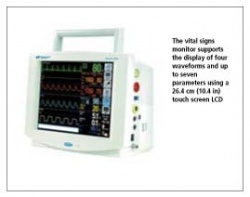
Spacelabs Healthcare has launched a new device for the bedside – the mCare 300 Vital Signs Monitor. ‘This is intuitive, immediate, portable and flexible for any care environment, the company reports. ‘Its clean design makes the mCare 300 easy to use, fast, flexible and lightweight – it weights just 4.1 kgs (9 lbs.), and has one battery. For immediate care assessment, the common functions are controlled by a single button. The new monitor delivers essential parameters – ECG, respiration, Sp02, NIBP and dual temperature. Higher acuity parameters can be added with optional invasive blood pressure and EtC02.
17.11.2006