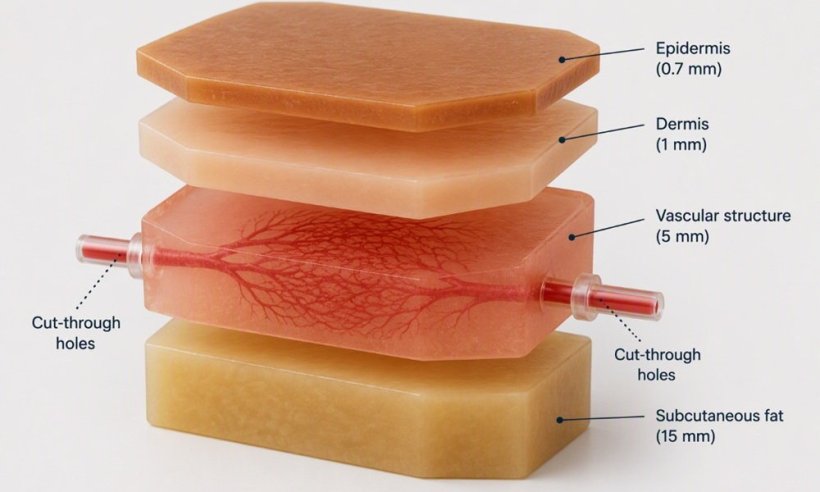
Image source: SPIE; image courtesy of Alexey Popov (VTT, Sensing Solutions)
News • Skin-like optical phantom
Improving medical device testing for all skin colors
Skin-mimicking models reproduce a range of skin tones, giving researchers a more realistic way to test and improve light-based medical devices for diverse populations
Many medical devices and wearable health sensors work by shining light into the skin and measuring the signal that returns. These technologies are used in products ranging from pulse oximeters to fitness trackers. However, studies have shown that some optical devices can be less accurate for people with darker skin, raising concerns about healthcare equity and patient safety. In a recent study reported in the Journal of Biomedical Optics (JBO), researchers at the VTT Technical Research Centre of Finland addressed this problem by developing realistic skin-like test models that represent a range of skin tones and include artificial blood vessels with flowing blood-like fluid.
Recommended article
News • Review calls for immediate action
Medical devices: prone to unfair bias, study finds
Pulse oximeters delivering poorer results in people with darker skin tones, underdiagnosis of cardiac conditions in women: some medical devices are not as fair as the ought to be, a new review finds.
Such models, known as optical phantoms, are designed to help researchers test and improve devices before they are used on patients. Unlike human volunteers, phantoms provide a controlled and repeatable way to evaluate how light-based technologies perform under different conditions. Yet many existing phantoms do not adequately represent the diversity of human skin tones.
To create more representative models, the researchers built multilayer structures that mimic the outer skin layer, deeper tissue, and underlying fat. They also embedded a network of artificial blood vessels and connected it to a miniature pump that circulates a blood-like liquid through the phantom. This allowed the team to simulate blood flow beneath the skin, similar to what occurs in the body.
The team fabricated skin models representing lighter, medium, and darker skin tones and then measured how they interacted with light. Their results showed that the phantoms closely reproduced the reflectance patterns seen in real skin. The models covered skin-tone categories similar to those reported for European, South Asian, and African populations.
To evaluate the phantoms, the researchers used hyperspectral imaging, a technique that records information across many wavelengths of light. They compared regions containing flowing blood-like fluid with nearby regions that did not contain vessels. This allowed them to measure how easily blood-related signals could be detected through skin layers of different pigmentation levels.
The experiments revealed an important effect. In lighter skin models, the blood-like fluid created clear optical signals. As the skin models became darker, those signals became increasingly difficult to detect. In the darkest phantom, the upper pigmented layer largely concealed the signature of the flowing fluid.
According to the researchers, this result mirrors a real-world challenge for optical medical devices. Increased pigmentation can make it harder for light to probe blood vessels beneath the skin, potentially affecting measurement accuracy. By providing a realistic testing platform, the new phantoms could help device developers identify and reduce such biases during product design and validation. The phantoms also proved durable. After nine months, their optical properties had changed only slightly, suggesting they could be used for long-term testing in research and industry settings.
The researchers plan to further expand the range of skin tones represented by the phantoms and to compare their performance directly with measurements taken from human skin. Ultimately, they hope the technology will help developers create optical medical devices and wearable sensors that work more consistently across diverse populations.
Source: SPIE--International Society for Optics and Photonics
06.08.2026