

Image source: Society of Nuclear Medicine and Molecular Imaging
News • Lung cancer insights
Brain metabolism predicts survival in advanced NSCLC patients
Brain metabolism identified as independent prognostic factor for overall survival, complementary to clinical and blood biomarkers
Low brain metabolism as measured from 18F-FDG PET/CT is associated with higher mortality in patients with advanced non–small cell lung cancer (NSCLC), according to new research published in the July issue of The Journal of Nuclear Medicine. Incorporating brain 18F-FDG uptake alongside clinical, tumor, and biological data improved prediction of overall survival, providing physicians with valuable insight to identify patients most likely to benefit from early supportive care.
Our findings [...] suggest that the patient’s prognosis does not only depend on tumor features; other organs and tissues, which have so far remained largely unexplored, may also provide valuable information about the patient’s outcome
Julie Auriac
Lung cancer is a leading cause of cancer-related deaths worldwide. Despite promising new therapies, the prognosis for patients is relatively poor, with a mean overall survival ranging from more than three years in early-stage disease to less than five months in the metastatic stage. In clinical practice, the management of metastatic lung cancer remains challenging, as some patients are resistant to treatments or experience only short-term benefits without any significant impact on their survival.
“Recent studies have suggested that metabolic activity and density in various organs and tissues measured from whole-body 18F-FDG PET/CT images provide valuable information for predicting patient outcomes in lung cancer by reflecting the patient’s general condition,” said Julie Auriac, PhD, research engineer at Imaging, Innovative Radiotherapy, and Systems Medicine Laboratory (IRIS) in Orsay, France. “The aim of this study was to evaluate the relationship between brain metabolic activity, measured using 18F-FDG PET/CT, and survival in patients with advanced NSCLC.”
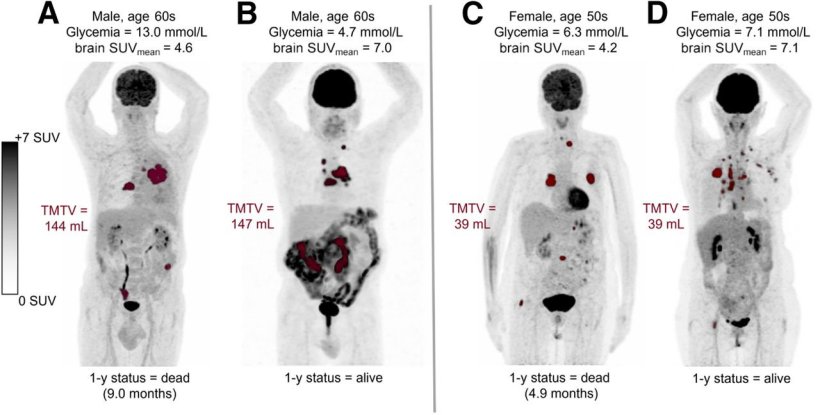
The retrospective study included patients with advanced NSCLC who underwent pretreatment 18F-FDG PET/CT scans between 2010 and 2023. Clinical and biologic data, tumor features, and brain metabolism data were collected. The ability of these features to predict overall survival was evaluated, and the correlation between brain metabolism and clinical, imaging, and blood biomarkers was investigated.
Researchers found that high brain metabolism was associated with longer overall survival: brain metabolism was significantly lower in patients who died within one year compared with those who were still alive at the same time point. Brain metabolism was an independent prognostic factor for overall survival and was significantly correlated but complementary to several clinical and blood biomarkers.
“Our findings highlight the importance of considering cancer as a systemic disease,” said Auriac. “They suggest that the patient’s prognosis does not only depend on tumor features; other organs and tissues, which have so far remained largely unexplored, may also provide valuable information about the patient’s outcome.”
She continued, “Importantly, these metabolic measurements are available without requiring any additional examinations for the patient, as the brain metabolism can easily be obtained from 18F-FDG PET/CT images acquired during routine clinical care, representing a more efficient use of existing data.”
Source: Society of Nuclear Medicine and Molecular Imaging
27.07.2026