

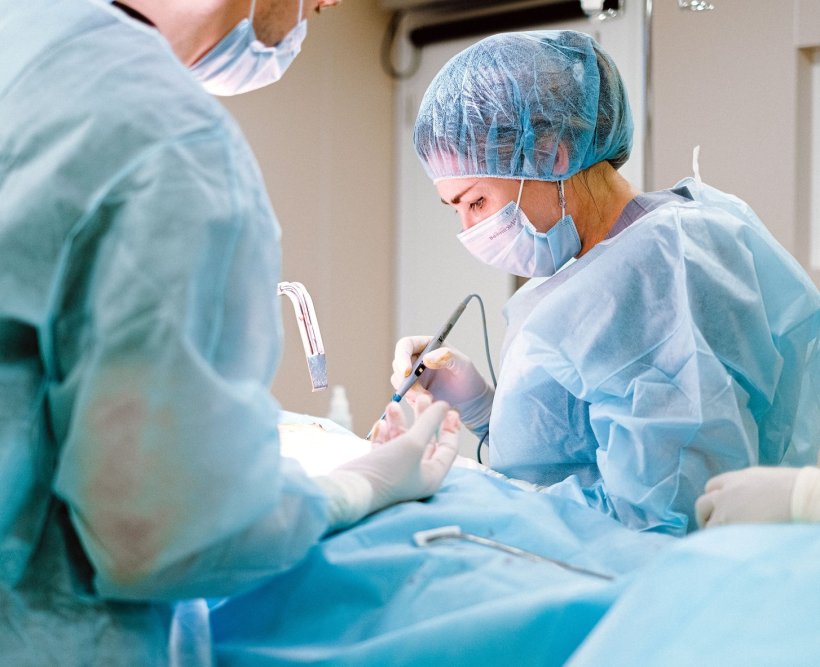
© Anna Shvets – pexels.com
News • Promising trial results
Rectal cancer treatment spares surgery for most patients
Combined chemoradiotherapy allows four out of five patients with early- and intermediate-stage rectal cancer to keep their rectum.
This is according to 12-month results from the international STAR-TREC trial, published in The Lancet Oncology. The findings have already prompted an update to Dutch clinical guidelines and are expected to shift treatment standards more broadly.
Rectal cancer – a tumour in the final section of the large intestine – is diagnosed in around 3,500 people per year in the Netherlands and roughly 4,100 people with early-stage disease per year in England. Until now, standard treatment for most patients meant total mesorectal excision: complete removal of the rectum, frequently followed by a temporary or permanent stoma, along with long-term bowel, urinary and sexual dysfunction. STAR-TREC set out to test whether organ-preserving treatment with radiotherapy – with or without chemotherapy – could match surgery in safety and effectiveness while sparing patients these consequences.
Recommended article
News • New organ-preserving options explored
Five major advances in anal and rectal cancer treatment with radiotherapy
From organ-preserving treatments to chemo-immunotherapy combinations: five studies presented at ESTRO 2025 showcase how radiotherapy is reshaping the treatment landscape for anal and rectal cancer.
The phase II/III trial recruited 503 patients across the United Kingdom, the Netherlands, Denmark, Belgium and Sweden. Participants could choose between standard radical surgery and an organ-preserving approach; the large majority opted for the latter. Within that group, patients received either:
- five weeks of chemoradiotherapy, or
- five days of short-course radiotherapy.
Surgery was reserved for cases where the primary treatment did not sufficiently shrink the tumour, and where possible was limited to a smaller, minimally invasive transanal procedure rather than full rectal removal.
For decades we've asked patients to accept the loss of their rectum – and often a permanent stoma – as the price of curing their cancer. These results suggest that for many people, this price no longer has to be paid
Simon Bach
At 12 months, chemoradiotherapy proved the more effective organ-preserving strategy: 79% of patients who received it avoided radical surgery entirely or needed only the local procedure, keeping their rectum intact. In the short-course radiotherapy group, this was achieved in 61% of patients. Chemoradiotherapy patients were also less likely to need radical surgery than those who received radiotherapy alone.
The trial was coordinated by the Cancer Research UK Clinical Trials Unit (CRCTU) at the University of Birmingham, with academics from UCL and the University of Leeds, and led in the Netherlands by Radboudumc surgical oncologist Hans de Wilt together with radiotherapist Corrie Marijnen of Leiden University Medical Center (LUMC) and the Netherlands Cancer Institute.
"For decades we've asked patients to accept the loss of their rectum – and often a permanent stoma – as the price of curing their cancer," said Professor Simon Bach, co-chief investigator of STAR-TREC, Honorary Chair at the University of Birmingham and Professor of Colorectal Surgery at UCL. "These results suggest that for many people, this price no longer has to be paid."
Hans de Wilt described similar experiences among patients treated in the Netherlands: "Patients for whom the organ-preserving treatment was successful were often very happy. They did not need to undergo major surgery and did not require a stoma." He noted that even those who ultimately still required surgery generally viewed their choice positively, as they had first been able to try to preserve their rectum.
David Sebag-Montefiore, co-chief investigator and Professor of Clinical Oncology at the University of Leeds, highlighted the radiotherapy technique itself: "It is gratifying that patients experienced a relatively low level of severe short-term side effects as a result of the smaller, more targeted radiotherapy approach that we specifically developed for STAR-TREC."
Dutch clinical guidelines have already been revised: patients with rectal cancer can now opt for organ-preserving treatment, with chemoradiotherapy as the preferred approach and short-course radiotherapy as an alternative for those who cannot tolerate chemotherapy.
Researchers are now following patients for a further three years to determine whether cancer recurrence rates and overall survival are comparable to radical surgery in the longer term. Ongoing work also aims to better predict which patients are most likely to benefit from organ preservation, and to explore whether outcomes can be improved further. "Our goal is personalised treatment," said De Wilt. "This allows us to provide each patient with the care that best suits them." Bach added that the next step is "to confirm these results hold over the longer term, and then to make sure the approach is available to every patient who could benefit."
Patients interested in organ-preserving treatment for rectal cancer are advised to discuss the option with their treating specialist.
Source: Radboudumc / University of Birmingham
25.08.2026