


Image source: Royal Pharmaceutical Society
Sponsored • On-demand Webinar
Pharmaceutical Press shares the most common types of medication errors
Watch the webinar anytime
Duration: 30 minutes
What are medication errors?
A medication error is defined as:
Any preventable event that causes or leads to inappropriate medication use or patient harm while the medication is under the control of a health professional, patient or consumer.1
Medication errors occur frequently in health systems around the world, and, according to the World Health Organization (WHO), nearly 50% of preventable harm to patients globally is due to inappropriate use of medicine. A quarter of this preventable harm can be severe or even life-threatening.1,2
As a leading cause of avoidable patient harm, a recent study estimated that there are 237 million medication errors in England every year. The majority are thought to have little or no potential for harm but 66 million of these are potentially significant.3
With the right education, policies, prescribing tools, and reporting and learning systems, errors can be minimised and patients protected.
What are the most common types of medication errors?
Medication errors can occur at any stage in the medicines use process. Most studies refer to five main types of error, prescribing, transcribing, preparation or dispensing, administration, or monitoring. Literature suggests that prescribing, administration, and monitoring errors are the most frequent.1
Administration errors
Administration errors include using the incorrect route, wrong patient, or using the wrong dose or rate. The worldwide prevalence of these is around 22%.1
An analysis of medication error claims over a five-year period found that of 487 claims settled with damages paid, 45% related to administration errors. In 27% of these cases, the wrong dose was given, in 18%, the wrong drug was given, and in 15%, the wrong route of administration was used.4
Prescribing errors
Prescribing errors account for a high proportion of all medication errors, with the WHO suggesting the error rate may be as high as 53%.1
These can happen at any part of the prescribing process and include irrational, inappropriate or ineffective prescribing, under and over-prescribing, and medicines that are omitted or delayed.
Preventing medication errors
Image source: Royal Pharmaceutical Society
Preventable errors can occur for any number of reasons, from illegible prescriptions, incomplete patient records regarding information on co-prescribed medications, previous response to therapy, and allergy status, to incorrect drug or dose selection and drugs with similar looking or sounding names. With so many contributing factors, there is no one size fits all solution. Rather, tailored approaches to understanding and mitigating the risks are required.
Reporting all errors and near misses, regardless of whether the patient came to harm, and having processes to investigate and analyse the data is crucial. It is only by building the baseline evidence that health systems can better understand how errors occur, and how to prevent them.
A culture of safety in the health system is necessary to ensure medication safety. With the necessary education, support, and tools, individual health professionals can do much to ensure safe practice.
MedicinesComplete
MedicinesComplete brings regularly updated medicines information, and expert guidance on the use and administration of drugs together in one place, helping health professionals to use medicines safely and avoid medication errors.
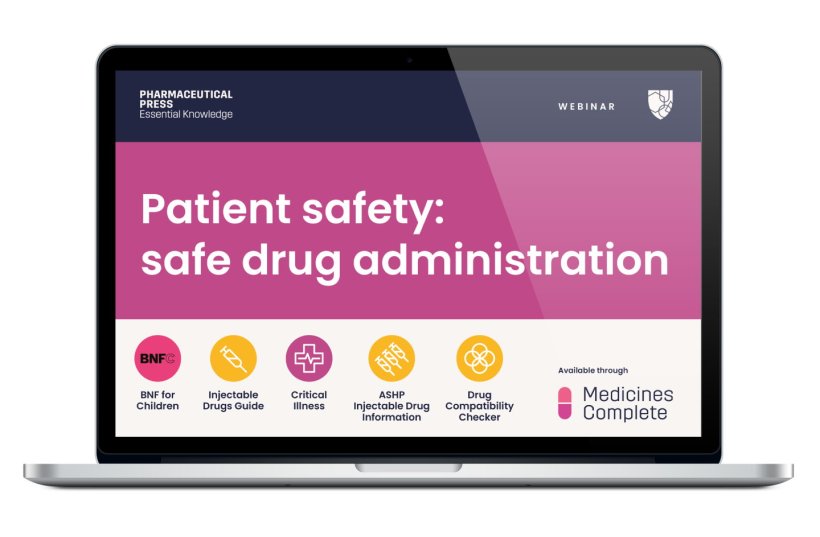
Patient safety: Safe drug administration
As patient care grows more complex, access to reliable, evidence-based information is fundamental. Register for our on-demand webinar to learn how to:
- Safely support patients with swallowing difficulties or enteral feeding tubes.
- Make confident decisions regarding injectable drug administration.
- Assess compatibility when administering multiple injectable drugs.
References
- WHO. (2023). Medication without harm. Available at: https://iris.who.int/bitstream/handle/10665/376212/9789240062764-eng.pdf. Last accessed: 22 April 2024.
- Panagioti M., Khan K., Keers R.N., Abuzour A., Phipps D., Kontopantelis E., et al. Prevalence, severity, and nature of preventable patient harm across medical care settings: Systematic review and meta-analysis. BMJ. 2019;366:I4185. doi: 10.11136/bmj.I4185.
- Elliott R.A., Camacho E., Jankovic D., et al. Economic analysis of the prevalence and clinical and economic burden of medication error in England. BMJ Quality & Safety 2021;30:96-105. Accessed: 1 June 2024.
- NHS Resolution. (2022). Did you know? Insights into medication errors. Available at: https://resolution.nhs.uk/resources/did-you-know-insights-into-medication-errors/. Last accessed: 16 April 2024.
Source: Royal Pharmaceutical Society
09.02.2026