

News • Precision medicine
Magnetic microcatheter to improve fertility treatment
A new international study led by the Nanobiosystems group at the CIC nanoGUNE Basque Nanoscience Cooperative Research Center, is developing miniature, non-invasive, precise robotic catheters for use in reproductive medicine and gynaecological health.

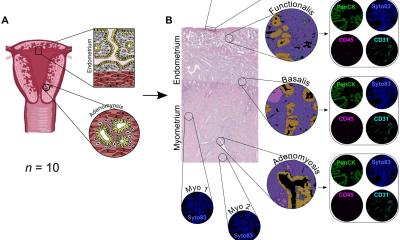
Image source: CIC nanoGUNE; adapted from: Chen Z, Rivkin B, Castellanos-Robles D et al., Advanced Materials 2025 (CC BY 4.0)
This research, which was recently published in the journal Advanced Materials, has the potential to improve infertility treatments, for example, and enable the highly localized release of drugs and cells.
Minimally invasive therapies require precise navigation through complex and delicate anatomical pathways, necessitating medical tools that are small, flexible and highly maneuverable. This study presents a high-yield fabrication method for producing magnetic miniature robotic catheters, enabling them to operate across diverse microenvironment, for precision medicine.
"The catheter is manufactured using a scalable method that incorporates magnetic particles into elastomeric material matrices. These composites are programmed to respond to external magnetic fields, and each particle maintains a specific magnetic moment that defines its behavior. This enables smooth, controlled movement similar to the undulations of a flagellum, facilitating navigation through narrow and complex channels in the human body without applying forces that could damage tissue," explains Dr Medina-Sánchez, leader of the Nanobiosystems group at nanoGUNE. Unlike traditional mechanical thrust, which can generate high forces and risk perforation, this system reduces the force applied to tissues. 'The device has proven its effectiveness in releasing sperm directly into the fallopian tubes, as well as in the precise release of embryos in 2D and 3D models, including materials with compliance similar to living tissue, as well as with real ex vivo tissue lining. It has also been tested in 3D anatomical models based on X-ray tomography images. This holds promise for increasing the chances of success in cases of infertility and recurrent pregnancy loss," adds Medina-Sánchez.
The methods and devices presented here, protected by a patent application and is one of nanoGUNE's industrial property assets, establish a solid foundation for biological and clinically relevant studies. This paves the way for the platform’s translational application in precision medicine, particularly in reproductive medicine, with potential for expansion into other biomedical fields.
Source: CIC nanoGUNE
06.12.2025