Article • Equity, access, and the future of radiotherapy
Radiation oncology: the beam widens
Radiation oncology is a field in remarkable transformation: a deepening global shortage of trained practitioners, persistent inequities in access to treatment – and, on the other side of the ledger, a new generation of technologies, from AI-driven adaptive planning to photon-counting CT, that are expanding what the field can do in ways previously unimaginable. At this year’s World Health Expo (WHX) in Dubai, we spoke with Sasa Mutic about a field caught between mounting pressures and exciting new possibilities.
Article: Wolfgang Behrends
© BoliviaInteligente – unsplash.com
Radiotherapy is relevant to more than half of all cancer patients at some point in their treatment.1 Yet the gap between what it could deliver and what it actually delivers – globally – remains vast. A 2015 Lancet Oncology report projected that by 2035, the world would need twice the current radiotherapy machine capacity and four times as many trained practitioners.2

Photo: HiE/Behrends
‘Today is roughly the halfway mark,’ says Mutic, head of radiation oncology at Varian, a Siemens Healthineers company. ‘They were right on the machines. Unfortunately, they were also right about the people.’
The workforce implication is sobering: those practitioners should already be in training. Many are not – and the programmes to prepare them do not yet exist at the scale required. The challenge, moreover, is not confined to low-resource settings. ‘I live in St. Louis, Missouri. In our city, access to care is a major problem,’ Mutic notes. Inequity in radiotherapy access is as much an urban reality in wealthy countries as it is a feature of global health geography.
Making technology do more with less
Varian’s response to this challenge is, in essence, to reduce the human overhead that radiotherapy currently requires – not by replacing clinical judgement, but by automating the steps that surround it. ‘If we’re going to have four times as many practitioners by 2035, and they’re not in schools today, then we have to make technology that can do more with less.’ In that framing, AI and automation are not primarily productivity tools – they are prerequisites for keeping pace with a burden that no foreseeable workforce can address alone.
Internally, Varian frames this around what Mutic calls "zero-error systems" – an approach in which AI-driven decisions are paired with independent checks, so that automation and reliability reinforce rather than undermine each other. This extends to the treatment itself. Where conventional radiotherapy treats a tumour as a uniform target, the direction of travel is toward systems that can respond dynamically to anatomical changes occurring between or even during treatment sessions – adapting each fraction to what is actually happening in the patient’s body, in real time.
Efficiency, in Mutic’s framing, is not separate from efficacy. Systems that are fast, quiet, and simple enough to be used at high throughput are not a lesser alternative to more complex technology – they are what makes radiotherapy clinically and logistically viable in the settings where it is most needed. ‘Things that are complex to use, clinicians don’t want to use,’ he says.
A merger and its consequences
The acquisition of Varian by Siemens Healthineers, completed in April 2021 and now approaching its fifth anniversary, was the largest deal in the German company’s history. The two organisations brought markedly different cultures to the table: Varian, one of Silicon Valley’s original startups, founded in the 1940s and still based near Stanford; Siemens Healthineers, shaped by a century of European engineering tradition. Mutic is candid that the early period required genuine adjustment on both sides.
Had Siemens made [the dynamic treatment couch] alone, it wouldn’t be what it is. Had Varian made it alone, it wouldn’t be what it is either
Sasa Mutic
The practical gains, however, have been considerable. Where pre-merger collaboration required complex legal arrangements between two independent companies, joint development can now proceed directly. The first product designed collaboratively – a dynamic treatment couch – has recently come to market. ‘Had Siemens made it alone, it wouldn’t be what it is. Had Varian made it alone, it wouldn’t be what it is either.’
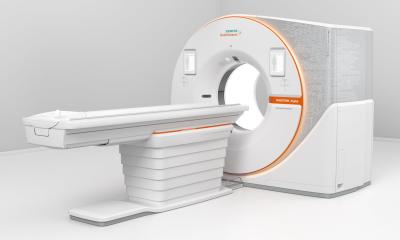
The deeper gain may be one of combined expertise. Varian’s strength lies in radiotherapy systems and workflow; Siemens Healthineers brings unmatched expertise in diagnostic imaging. The combination creates capabilities at a pace and scale that neither company could have matched independently – among them the transfer of Siemens’ photon-counting CT technology into the radiation oncology workflow. Where a conventional CT renders a lung tumour as an undifferentiated mass, photon-counting CT allows clinicians to look inside it: ‘We can start to differentiate inside a tumour where we need to give more radiation or where we need to give less,’ Mutic explains. It is a concrete illustration of the broader concept he describes: a continuously updated digital model of the individual patient, fed by imaging data, that allows treatment to be personalised and adapted throughout a course of therapy.
A field redefining itself
Perhaps the most provocative thread in the conversation concerns a boundary most clinicians take as given: that radiation oncology is, by definition, about cancer. A growing body of clinical work is now applying precision radiation to non-oncological indications – among them essential tremor3, ventricular tachycardia4, and certain forms of treatment-resistant arthritis. The underlying physics is unchanged; the clinical context is entirely different.
‘People ask me: what is the future of radiation oncology’; Mutic says. ‘I think part of the answer is that it stops being oncology.’ It is a statement that invites debate – but the accumulating clinical evidence around non-oncological applications suggests it is not merely speculative. It raises real questions about how the specialty should define itself, how it trains the next generation of practitioners, and how it engages with disciplines it has not traditionally considered its neighbours.
References:
- Barcellini A, Dal Mas F, Paoloni P et al.: Please mind the gap—about equity and access to care in oncology; ESMO Open 2021; https://doi.org/10.1016/j.esmoop.2021.100335
- Atun R, Jaffray DA, Barton MB et al.: Expanding global access to radiotherapy; The Lancet Oncology 2015; https://doi.org/10.1016/S1470-2045(15)00222-3
- Siemens Healthineers/Varian: Bringing a Non-Invasive Treatment Option to Patients Suffering with Medically Refractory Essential Tremor; Centerline Blog, May 5, 2025; https://cancercare.siemens-healthineers.com/newsroom/blog/bringing-a-non-invasive-treatment-option-to-patients-suffering-with-medically (accessed Feb 25, 2026)
- Siemens Healthineers/Varian: Varian Announces First Participant Treated in RADIATE-VT Clinical Trial of Cardiac Radioablation for Patients with Refractory Ventricular Tachycardia; Press Release, May 19, 2023; https://www.siemens-healthineers.com/press/releases/radiate-vt (accessed Feb 25, 2026)
04.03.2026
- AI (881)
- cancer (1097)
- company (216)
- CT (617)
- management (231)
- oncology (497)
- radiation therapy (196)
- radiology (760)