

Image source: CNIO/MadMoviex
News • Prediction model
Building a “calculator” for breast cancer risk
The MamoRisk project will validate in Spain a new statistical model that predicts each woman’s risk of developing breast cancer based on non-genetic, genetic and mammographic risk factors.
MamoRisk will collect data from 10,000 women randomly selected from participants in screening programmes across 14 autonomous communities. The study is beginning this month in Galicia. The study provides the equivalent of “a calculator” that uses each woman’s risk factors to inform her whether her risk is low, intermediate or high, the MamoRisk team explains.
The mammograms currently offered by Spain’s National Health System to women according to their age and family history remain the best way to detect breast cancer at an early stage. However, more precise methods are already being tested, including a statistical model that predicts each woman’s risk based on her lifestyle, genetics and mammographic characteristics. The MamoRisk project aims to confirm that the new model works, an essential step before it can be used in population-based breast cancer screening programmes. “Once the risk model has been validated through MamoRisk, its use could substantially improve the early detection of breast cancer,” the project team says.
Recommended article
Article • Research, diagnostics, treatments
Focus on breast cancer
Breast cancer (breast carcinoma; often abbreviated as BRCA) is the most common cancer in women in many countries and the cancer with the highest mortality rate. The diagnostic and therapeutic options for breast cancer are correspondingly diverse. Keep reading for latest developments in early detection, staging, treatment and research.
MamoRisk provides the equivalent of “a calculator into which each woman’s risk factors are entered, producing a classification of low, intermediate or high risk over a two- and five-year period,” the research team explains. The project is led by the Santiago de Compostela Health Research Institute (IDIS), the Spanish National Cancer Research Centre (CNIO) and the Galicia Sur Health Research Institute (IISGS).
Spain’s Ministry of Science, Innovation and Universities (MICIU) is funding MamoRisk with €1.2 million from the European NextGenerationEU programme, through the Precision Personalised Medicine call for proposals launched by the Carlos III Health Institute (ISCIII). The ministry’s involvement extends beyond funding, since two of the organisations conducting the study are linked to the Carlos III Health Institute: CNIO is a foundation affiliated with the ISCIII, while IDIS is one of the 36 Health Research Institutes accredited by the ISCIII throughout Spain.
MamoRisk has just begun in Galicia. During this initial phase, women diagnosed with breast cancer and healthy women have started receiving invitations to participate in the study. In addition to Galicia, the autonomous communities participating in MamoRisk are Madrid, Cantabria, Castilla-La Mancha, Murcia, Extremadura, Asturias, Castilla y León, Andalusia, Aragón, Catalonia, La Rioja, the Valencian Community and the Canary Islands.
A total of 4,000 women diagnosed with breast cancer and 6,000 healthy women will be invited to participate. They will be randomly selected from women who have been monitored for at least six years through the early-detection programmes of the 14 autonomous communities. The model will be applied using their clinical and epidemiological data and genetic information obtained from a saliva sample. Its predictions will then be compared with what actually occurred during the follow-up period.
Should the risk-prediction model prove effective and begin to be used in screening programmes, women with a higher probability of developing cancer could be offered much more intensive monitoring. The aim is to detect cancer earlier or, where possible, introduce targeted preventive measures.
MamoRisk begins with the collection of clinical and epidemiological data and biological samples. This is followed by genetic and image analysis using artificial intelligence, and the project concludes with an evaluation of the model’s effectiveness.
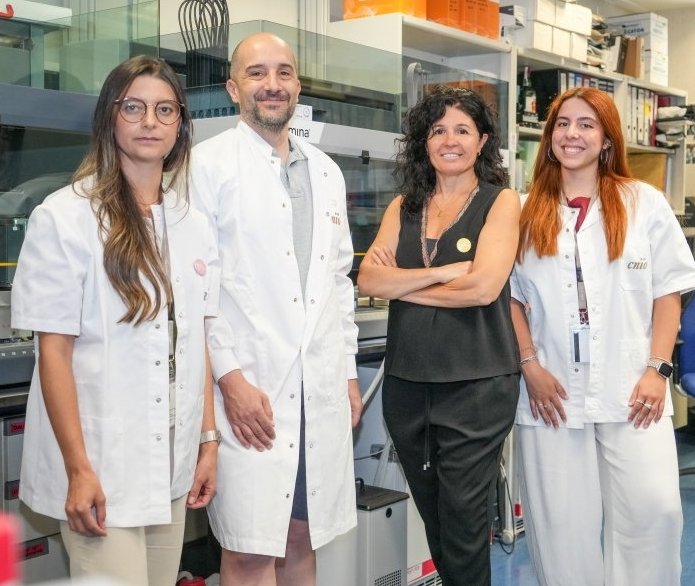
At IDIS, Manuela Gago coordinates the selection and recruitment of participants and collects the clinical data. At CNIO, Anna González-Neira and Guillermo Pita conduct the participants’ genetic analyses and estimate their genetic risk of developing breast cancer. José Esteban Castelao, from IISGS, applies artificial intelligence to the analysis of mammograms. At the international level, the project includes the notable collaboration of Antonis Antoniou, Professor of Cancer Risk Prediction at the University of Cambridge.
The model to be validated by MamoRisk uses the BOADICEA algorithm—Breast and Ovarian Analysis of Disease Incidence and Carrier Estimation Algorithm—which combines genetic, family, clinical and epidemiological information to estimate an individual’s probability of developing breast and ovarian cancer. It is the result of decades of research that have contributed to current knowledge about the factors influencing the risk of developing breast cancer.
Hundreds of genetic variants associated with an increased risk have been identified. These include variants in the BRCA1 and BRCA2 genes, which confer a high risk; other variants associated with a moderate risk; and variants with a smaller individual effect that are nevertheless present in a large proportion of the population.
A lifestyle involving low alcohol consumption, regular physical activity and the avoidance of postmenopausal obesity is also important. Such a lifestyle has been associated with a 20% reduction in the risk of breast cancer.
Source: Centro Nacional de Investigaciones Oncológicas
22.07.2026