


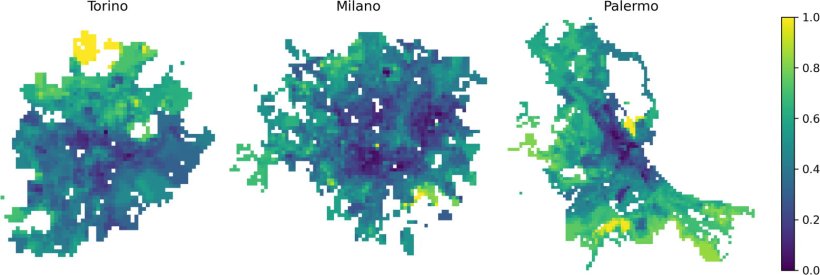
Data-driven distribution of the proportion of non-compliant individuals, ri, scaled such that 0 represents the minimum level and 1 the maximum level of non-compliance. Darker colours correspond to smaller values, using the same colour normalization for the three cities.
Image source: Mazza F, Brambilla M, Piccardi C, Pierri F, Proceedings of the Royal Society A (CC BY 4.0)
News • Public health compliance
Epidemic spread: individual behaviour matters
Simulations of Turin, Milan and Palermo reveal that individual behaviour affects the intensity and timing of epidemics spreading in urban areas.
Even a small proportion of citizens who do not follow health measures can amplify the spread of an epidemic and make it expand faster in large cities. Such were the results of research conducted by the Politecnico di Milano and published in the journal Proceedings of the Royal Society A by the Royal Society of London.
The study, authored by Fabio Mazza, Marco Brambilla, Carlo Piccardi and Francesco Pierri from the Department of Electronics, Information and Bioengineering (DEIB), analyses how individuals who do not comply with public health recommendations influence the spread of contagions in urban environments.
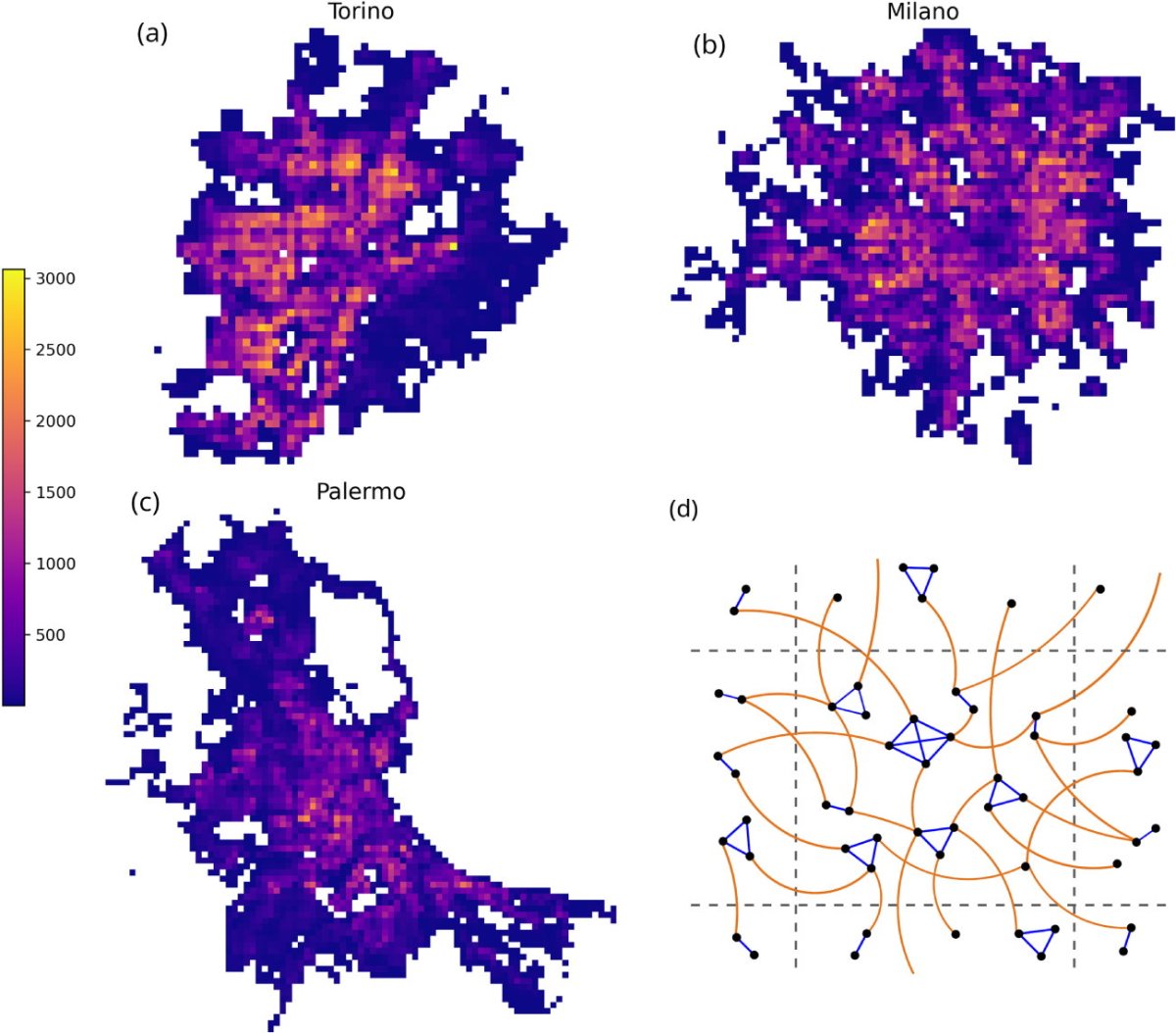
Image source: Mazza F, Brambilla M, Piccardi C, Pierri F, Proceedings of the Royal Society A (CC BY 4.0)
Using contact networks based on real data and a mathematical model that distinguishes between citizens ‘adhering’ and ‘not adhering’ to public health measures, the researchers simulated the spread of an epidemic in three Italian cities: Turin, Milan and Palermo.
The simulations showed that even a small proportion of non-adherents can substantially increase the infection peak and hasten the time of infection, straining healthcare facilities. The effect is particularly evident when the transmissibility of the disease is moderate. Moreover, when people who ignore preventive measures are concentrated in certain areas, local hotspots can form, making it more difficult to contain the epidemic.
‘We observed that although the epidemic followed similar overall dynamics in the cities we studied,’ explains Francesco Pierri, a researcher in the Data Science Lab and coordinator of the study, ‘the geographical distribution of non-adherent behaviour significantly alters local contagion trajectories, leading to marked differences between city districts.’
This work emphasises the need to monitor the distribution of preventive behaviour and adapt public health strategies to the nature of individual urban contexts, thereby making public health interventions more effective.
The research is part of the CODE — Coupling Opinion Dynamics with Epidemics project, financed by NRRP Mission 4 ‘Education and Research’ – Projects of National Interest (PRIN 2022 NRRP).
Source: Politecnico di Milano
13.12.2025