


© Dr_Microbe – stock.adobe.com
Article • Hospital hygiene
Breaking chains of infection to combat antimicrobial resistance
With antimicrobial resistance causing over 5 million deaths annually, rapid outbreak detection is critical. A German lab demonstrates how FTIR spectroscopy can transform hospital infection control.
Authors: Kim Kahnau, Senior Medical Microbiologist, MVZ Labor Münster and Markus Meyer, Head of Business Unit Hygiene/Epidemiology, Bruker Microbiology & Infection Diagnostics
Efficient detection of infectious disease outbreaks within hospital settings is a challenge that is becoming increasingly urgent given the growing number of antibiotic-resistant bacteria. A recent study found that between 2010 and 2020 around 136 million cases of healthcare-associated antibiotic-resistant infections occurred globally each year1 and, in 2019 alone, the World Health Organization (WHO) reported over 5 million deaths associated with antimicrobial resistance.2 Rapid outbreak detection is essential to break chains of infection early, reduce use of antibiotics and prevent further spread of resistant bacteria. Surveillance frameworks should be built around proactive systems that can identify infections quickly and accurately to help contain outbreaks and ultimately protect vulnerable patients.
Recommended article

Article • Bacterial defense mechanism
Antibiotic resistance: a global threat to healthcare
Antimicrobial resistance (AMR) is becoming more prevalent around the world, constituting a serious threat to public health. When bacteria acquire resistance against antibiotics, common medical procedures – for example, in surgery – become impossible due to the high infection risk. Keep reading to find out about AMR research, development of new antibiotics and antibiotic alternatives.
Outbreak detection in Germany
Despite an advanced national infection prevention and control (IPC) program reinforced by federal law, annual healthcare-associated infection cases in Germany number between 400,000 and 600,000.3 In 2008, the German Federal Government set up the German Antimicrobial Resistance Strategy (Deutsche Antibiotika-Resistenzstrategie, or DART) with the aim of reducing further development and spread of antibiotic resistance. The strategy has since undergone various revisions and its latest iteration, DART 2030, was published in 2023.
DART highlights infectious disease outbreak detection and containment as an essential tool to combat the rise of antibiotic resistance. It calls for hospitals nationwide to adopt reliable surveillance systems which can promptly diagnose infections with a high level of accuracy, allowing targeted hygiene measures to be initiated as quickly as possible to help limit bacterial spread.
FTIR spectroscopy for outbreak analysis
Existing systems and workflows can be too slow and fragmented to provide the timely and actionable results required to detect and contain potential outbreaks. Many hospitals rely on traditional methods, such as genomic sequencing, which lack the necessary speed. There is, therefore, a clear need for a more efficient method to confirm microbial outbreaks quickly in line with DART requirements.
Fourier-transform infrared (FTIR) spectroscopy offers a new approach for efficient microbial outbreak analysis. It can be used to compare isolates and classify microorganism strains with high specificity. Results can then be visualized in the form of cluster analyses (dendrograms) or 3D scatter plots, allowing scientists to identify relationships between isolates and outbreaks.
In the case of a suspected outbreak, the methods used by most hospitals typically require several days, by which point bacterial spread may already have occurred. FTIR spectroscopy can shorten this timeline considerably. By mapping the unique fingerprint of microorganisms, FTIR spectroscopy can provide results within hours rather than days, enabling clinicians to implement effective treatment and containment strategies much more rapidly.
Cluster analysis of resistant pathogens
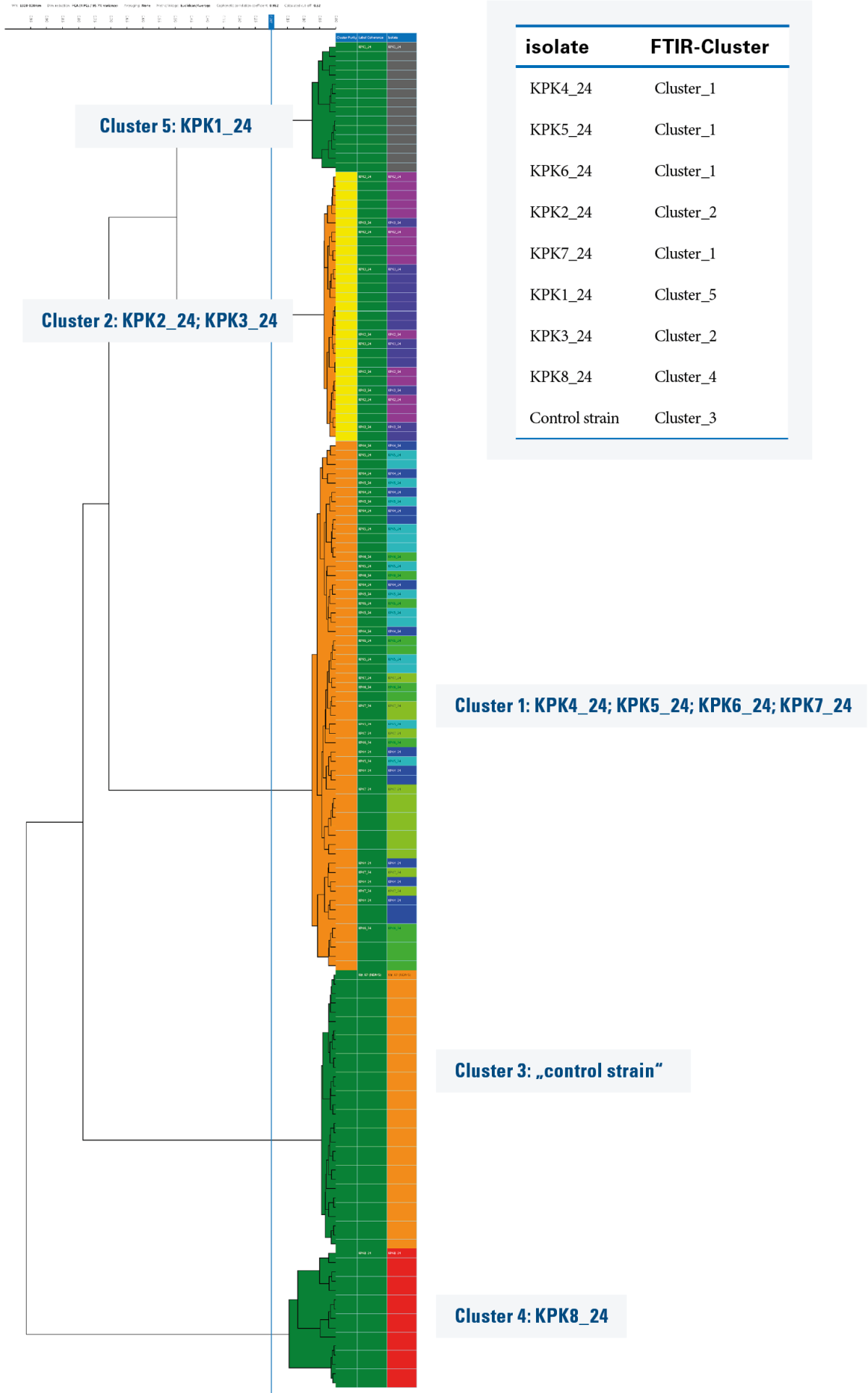
Image source: Bruker Daltonics GmbH & Co. KG, Bremen, Germany
Multidrug-resistant gram-negative pathogens, a leading cause of healthcare-associated infections,4 can be particularly difficult to detect. Klebsiella pneumoniae (K. pneumoniae) is a gram-negative bacterium that can cause lung inflammation in people with weakened immune systems. The European Centre for Disease Prevention and Control (ECDC) has recently reported the emergence of hypervirulent carbapenem-resistant K. pneumoniae cases across Europe.5
In a recent investigation, researchers at MVZ Labor Münster used FTIR spectroscopy to perform cluster analysis on resistant K. pneumoniae isolates from eight patients to determine whether transmission had occurred. The isolates and a control strain were measured at least three times a day over three days. The resulting dendrogram analysis (see Figure 1) revealed five clusters, with four isolates (see cluster 1) and two isolates (see cluster 2) clustering together. As the isolates in cluster 1 are very closely related, there is a strong indication that transmission has occurred. In contrast, clusters 4 and 5 consisted of only one isolate each, therefore ruling out transmission.
The need for accelerated outbreak analysis
As the threat of antimicrobial resistance continues to grow internationally, a timely outbreak detection and containment strategy is crucial. The speed and accuracy of FTIR spectroscopy has the potential to transform outbreak control. While this technology is more commonly found in research environments, its expansion into routine hospital settings could provide clinicians with the rapid results required to implement effective hygiene measures, break chains of infection early and limit development of resistance – all critical points on the world’s healthcare agenda.
References:
- Balasubramanian R, Van Boeckel TP, Carmeli Y, Cosgrove S, Laxminarayan R. Global incidence in hospital-associated infections resistant to antibiotics: An analysis of point prevalence surveys from 99 countries. PLOS Medicine. 2023;20(6). doi:10.1371/journal.pmed.1004178.
- World Health Organization. "Key Facts and Figures on Health Care-Associated Infections and Antimicrobial Resistance." Accessed October 2, 2025.
- Robert Koch Institute. "Activities at RKI." August 27, 2025. Accessed November 12, 2025.
- Macesic N, Uhlemann A-C, Peleg AY. Multidrug-resistant gram-negative bacterial infections. The Lancet. 2025;405(10474):257-272. doi:10.1016/s0140-6736(24)02081-6.
- European Centre for Disease Prevention and Control. "Increase of hypervirulent carbapenem-resistant Klebsiella pneumoniae in the EU/EEA." February 14, 2024. Accessed November 12, 2025.
05.01.2026
- antibiotic resistance (198)
- hospital (324)
- hygiene (285)
- infections (788)
- laboratory (1148)
- microbiology (306)