

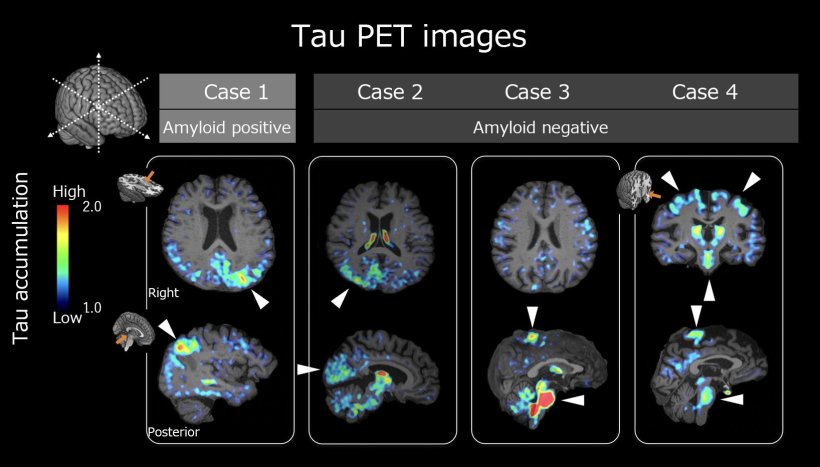
Image source: The National Institutes for Quantum Science and Technology; adapted from: Kubota M, Kurose S, Tagai K et al., Molecular Psychiatry 2026 (CC BY 4.0)
News • Molecular psychiatry
Late-onset psychosis: PET scans reveal tau buildup in the brain
PET scans show tau buildup in many people with psychosis beginning in midlife or later, pointing to brain changes that may guide earlier diagnosis and future treatments.
Hallucinations and delusions that appear for the first time in midlife or later are often treated as psychiatric symptoms whose biological cause is unclear. The study, published in Molecular Psychiatry, suggests that, for many patients, these symptoms may be linked to brain changes also seen in dementia.
Using positron emission tomography, or PET, the research team found that about 65% of patients who developed psychosis after age 40 showed abnormal buildup of tau, a protein associated with Alzheimer’s disease and other forms of dementia. By comparison, tau PET positivity was seen in about 15% of healthy older controls. The study also found amyloid PET positivity in 35% of patients, compared with 2% of controls.
Patients can show the same symptoms, such as hallucinations or delusions, but their clinical course and response to treatment can be very different
Manabu Kubota
The findings provide the first in vivo evidence that diverse tau-related brain changes may be involved in late-onset psychosis. Until now, earlier epidemiological and postmortem studies had suggested a possible relationship between late-life psychotic symptoms and neurodegeneration, but direct evidence in the living brain had been limited. “Patients can show the same symptoms, such as hallucinations or delusions, but their clinical course and response to treatment can be very different,” said Manabu Kubota, the study’s representative researcher. “This study started from a clinical question: whether hidden biological differences in the brain could explain those differences.”
Late-onset psychosis can place a heavy burden on patients, families and caregivers, especially in aging societies. People who first experience hallucinations or delusions in midlife or later may not always receive medical care, and their symptoms can be difficult to diagnose and manage using psychiatric evaluation alone.
To look for biological signs of disease, the team examined 37 patients with psychosis that began after age 40 and 47 healthy older adults. They used amyloid PET and QST’s tau PET tracer florzolotau (18F), which can visualize a broad range of tau pathologies in the living brain. The PET scans revealed not only a higher rate of tau positivity among patients, but also diverse patterns of tau buildup. Some patients showed amyloid-positive patterns consistent with Alzheimer’s disease, while others showed amyloid-negative patterns, suggesting non-Alzheimer’s disease types of tau-related neurodegeneration.
In amyloid-negative patients, tau accumulation was especially notable in posterior brain regions, including the parietal and occipital lobes. The researchers suggest that tau buildup in these regions may affect higher cognitive functions such as attention, judgment and problem solving, potentially contributing to psychotic symptoms.
Recommended article
Article • Cerebral insights
The brain: mysterious grey matter
More than 80 billion neurons, trillions of synapses and almost 6 kilometres of neural pathways: The brain is an anatomical masterpiece – and still puzzles science. Keep reading to find out about latest research and therapies of brain diseases.
The study also linked tau buildup with cognitive function. Among amyloid-positive patients, greater tau accumulation in the parietal lobe was associated with lower executive function, which includes abilities such as planning and controlling attention. This suggests that the amount of tau in the brain may help explain some clinical features seen in late-onset psychosis.
Alzheimer’s disease diagnosis and treatment increasingly rely on detecting amyloid and tau in the brain. By contrast, objective biological tools for hallucinations and delusions have remained limited. The new findings may help move late-onset psychosis toward earlier diagnosis and intervention based on measurable brain changes rather than symptoms alone.
In the longer term, the researchers hope that PET-based assessment could support more personalized treatment. If doctors can identify whether a patient’s symptoms are related to Alzheimer’s-type or non-Alzheimer’s-type tau pathology, future therapies may be selected or developed according to the patient’s underlying disease process.
Source: National Institutes for Quantum Science and Technology
07.08.2026