

© F. Lemaitre @ UNIGE
News • Immuno-Oncology
Killer cells caught in the act: a 3D view of T lymphocytes
A collaboration between UNIGE and CHUV-UNIL has made it possible to visualise the mechanisms of cytotoxic T cells in three dimensions.
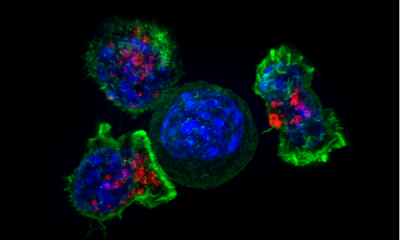
Cytotoxic T lymphocytes are the body's specialised "killer" cells, precisely eliminating infected or cancerous cells. Their action relies on a specialised exchange zone called the "immune synapse," where they release active molecules to destroy the target cell without damaging neighbouring ones. A study conducted by the University of Geneva (UNIGE) and the Lausanne University Hospital (CHUV) has made it possible to visualise these mechanisms in three dimensions in a near-native state. Published in Cell Reports, the study reveals how the molecular organisation of cytotoxic T cells underpins their function, opening new perspectives in immuno-oncology.
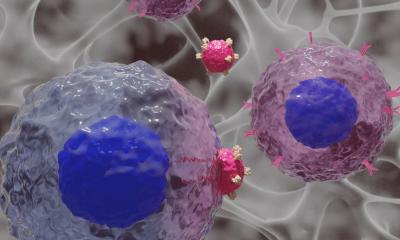
During infection or cancer, cytotoxic T lymphocytes attach to their target and establish an exchange zone known as the immune synapse, then release toxic molecules that trigger the death of the targeted cell. This mechanism enables precise and controlled destruction, essential for protecting the body while avoiding damage to nearby healthy cells.
Although this process has been widely studied, its organisation at the nanometer scale in intact human cells remained difficult to access. One of the main obstacles lies in sample preparation methods, which can alter fragile cellular structures. Existing imaging approaches often involve trade-offs between resolution, observable volume, and preservation of structures.
A technique to see the invisible
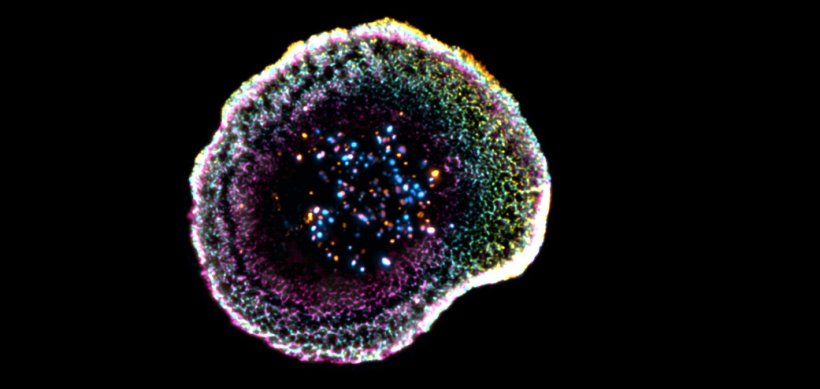
To overcome these limitations, a study by UNIGE and CHUV-UNIL, supported by the ISREC Foundation TANDEM programme, relied on cryo-expansion microscopy (cryo-ExM). "This technique involves instantaneously freezing cells at very high speed, placing them in a so-called vitreous state, where water solidifies without forming crystals and thus faithfully preserves biological structures. The samples are then physically expanded using an absorbent hydrogel, making it possible to observe their internal organisation with great precision while maintaining their near-native architecture," explains Virginie Hamel, senior lecturer in the Department of Molecular and Cellular Biology at the Faculty of Science of UNIGE.
"Our work reveals that at the point of contact between the immune cell and its target, the membrane forms a kind of dome, whose structure appears to be linked to adhesion interactions and to the internal organisation of the cell," notes Florent Lemaître, postdoctoral researcher in the Department of Molecular and Cellular Biology at the Faculty of Science of UNIGE and first author of the study. The research team also visualised cytotoxic granules – responsible for destroying target cells – with an unprecedented level of detail. The study shows that these structures can vary in their organisation, with one or more "cores" concentrating the active molecules that enable the destruction of the target cell.
From cells to patients
"We extended this approach to human tumour tissues, making it possible to directly observe T lymphocytes infiltrating tumours and their cytotoxic machinery at the nanometer scale. This allows us to study immune responses directly in their clinical context and to better understand the mechanisms that determine their effectiveness," explains Benita Wolf, Chief Resident and associate researcher in the Department of Clinical Oncology at CHUV, who co-led the study.
By providing a three-dimensional and near-native view of these processes, this work establishes a reference framework for analysing how immune cells function. It could help improve therapeutic strategies, particularly in immuno-oncology, by enabling a better understanding of the mechanisms that determine the effectiveness – or limitations – of the immune response.
Source: University of Geneva (UNIGE)
05.05.2026