

Image credit: UPF
News • New insights on TILs
Immune cells in the tumour microenvironment: Better near than far away?
A study led by Universitat Pompeu Fabra (UPF) on immune cells in the tumour microenvironment describes the relationship between the proximity of lymphocytes to the blood supply and their functional capacity.
The infiltrating lymphocytes found in solid tumours vary according to the microenvironment in which they are found. Proximity to the blood supply – and, therefore, the ability to access nutrients (glucose) and oxygen – determines different functional capabilities of the lymphocytes. This is the main conclusion of a research study conducted at Pompeu Fabra University in collaboration with the Hospital del Mar Research Institute. It found that T lymphocytes located far from the blood supply – which are found in a potentially hostile tumour microenvironment – have distinctive characteristics but retain their functional capacity. This discovery reveals previously unknown aspects of the heterogeneity of T cells, which are key in immunotherapy.
In tumours, the immune response faces strong opposition from the microenvironment. A better understanding of how the location of lymphocytes within this heterogeneous mass determines their metabolic strengths and vulnerabilities can help develop more effective immunotherapies
José Aramburu
Tumours are abnormal tissue masses that arise when cells multiply excessively or do not die when they should. However, we often forget that these masses are not uniform. They are small ecosystems that contain dozens or even hundreds of different cell types. In addition to cell diversity, tumours are characterized by abnormal vascularization, which creates different microenvironments within the mass where access to nutrients and oxygen varies.
Tumour-infiltrating lymphocytes (TILs) are immune system cells found within tumours. When TILs are active, they can help destroy tumour cells. Hence the different immunotherapy treatments based on the reactivation of these cells.
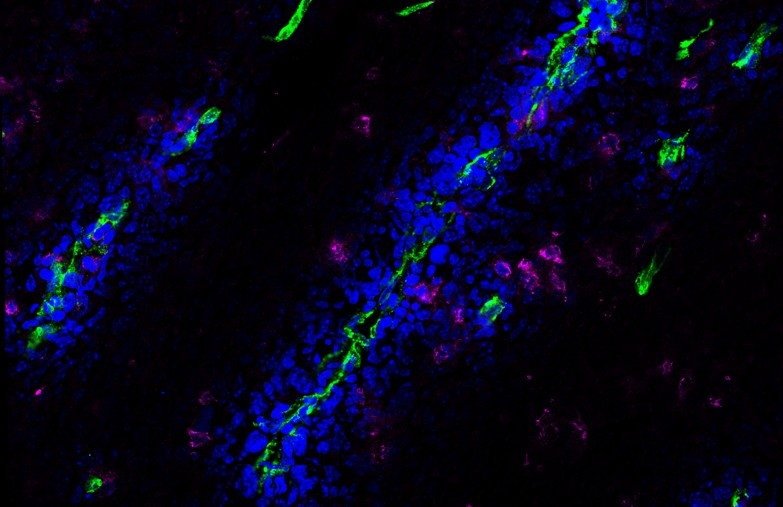
A study by the Immunology Group at Pompeu Fabra University, carried out in collaboration with the B Cell Biology Research Group at the Hospital del Mar Research Institute, reveals the functional and metabolic differences of TILs depending on their access to the blood supply. “Lymphocytes with greater access can obtain nutrients such as glucose more easily and be more active biosynthetically”, asserts José Aramburu, study co-director and member of the UPF Immunology Group.
According to the study, lymphocytes located in adverse microenvironments –distant from the blood supply– retain their functionality. “Surprisingly, these lymphocytes can achieve substantial activation and might be able to maintain sufficient energy at very low glucose levels”, explains Cristina López-Rodríguez, who also co-led the study. In addition, these T lymphocytes “show a lower expression of immune markers associated with inhibition and exhaustion, which suggests that they could play a different role in the anti-tumour response”, adds López-Rodríguez, who also leads the UPF Immunology Group.
Beyond the functional and metabolic differences in lymphocytes, this knowledge has potential in the design and improvement of immunotherapy treatments. “In tumours, the immune response faces strong opposition from the microenvironment”, Aramburu states. “A better understanding of how the location of lymphocytes within this heterogeneous mass determines their metabolic strengths and vulnerabilities can help develop more effective immunotherapies”, the researcher concludes.
Source: Universitat Pompeu Fabra Barcelona
24.07.2026