

Video • Robot-human and robot-robot setups
Humanoid robot team shows promise for surgery
Proof-of-concept suggests robots could first assist during procedures then later perform surgeries while teleoperated by surgeons
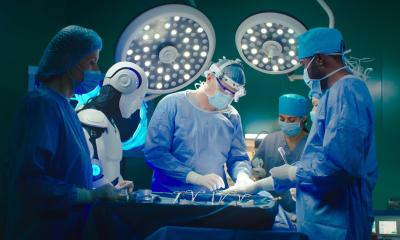
For the first time, two teleoperated humanoid robots have been used to complete two surgeries during a preclinical trial, researchers report in the journal Nature. The work is the result of a collaboration between a team of engineers and a team of surgeons at the University of California San Diego.
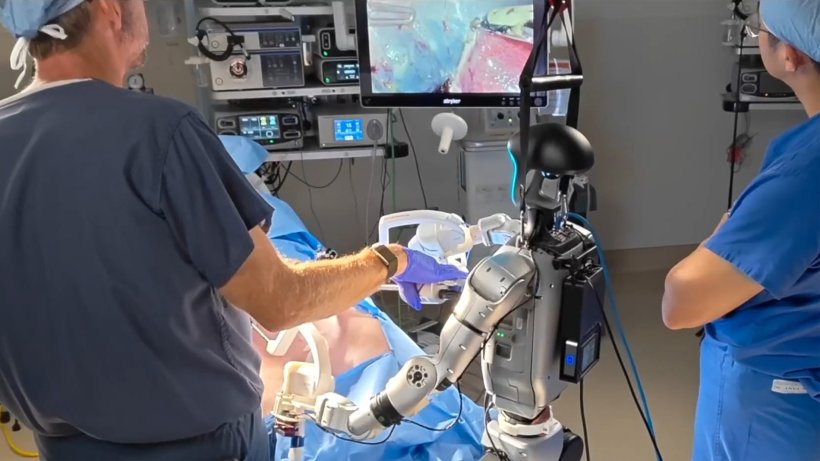
Image credit: University of California San Diego
In one surgery, a human-robot team made up of a humanoid robot and a human surgeon acting as an assistant successfully performed a gallbladder removal. A second successful surgery was performed by two humanoid robots working side by side in a robot-robot team. Both procedures were performed on large non-primate mammals (pigs).
The proof-of-concept experiment is a first step toward introducing humanoid robots in the operating room, researchers said. These robots could first assist during procedures then later perform surgeries while teleoperated by surgeons.
Remotely operated and autonomous humanoid robots have real potential for amplifying access to critical surgeries to which patients would otherwise not have access
Michael Yip
There is a shortage of surgeons in parallel with growing patient needs, which leads to longer wait times, reduced access and greater healthcare disparities, said Michael Yip, a faculty member in the UC San Diego Department of Electrical and Computer Engineering and one of the paper’s senior authors. “Remotely operated and autonomous humanoid robots have real potential for amplifying access to critical surgeries to which patients would otherwise not have access. This can help address the healthcare crisis not only in the United States, but also worldwide.”
Unlike specialized robotic surgery systems that can only perform one function, humanoid robots are versatile and could be used to perform a wide range of procedures and general tasks, the researchers said. These robots also are easier to deploy in remote areas and other challenging environments, where versatility is important.
“This study shows that humanoid robots have a viable future in the field of surgery. You can imagine these robots being deployed in remote communities where staffing is challenging, or in austere environments like search and rescue scenarios where a massive deployment of field medicine is needed in a short period of time,” said Yip, who is a faculty member in the UC San Diego Jacobs School of Engineering.
Recommended article
Article • Focus topic
Robotics in healthcare
From science-fiction to powerful medical tool: Robots perform an increasing number of valuable tasks in healthcare settings. From surgical robotics to applications in patient care – medical robots are here to stay. Keep reading for latest developments and exciting new areas of deployment for this technology.
The researchers argue that humanoid robots in the operating room could address one major issue in healthcare: access. Specialized surgery systems are typically equipped with three or four robotic arms, specialized tools and proprietary software. These systems weigh about 1,800 pounds, require a large team to set up, and take up a significant footprint in operating rooms, which usually need to be retrofitted to accommodate them. By contrast, humanoid robots are mobile and more compact. The robots used in this study, nicknamed Surgie, are 5 feet (a bit more than 1,5 meters) tall and weigh 60 pounds (27,2 kg). These relatively light, compact robots are especially useful in remote, under-resourced areas. Building specialized operating rooms for robotic surgical systems or finding large teams to operate a specialized piece of equipment would be prohibitively expensive in these settings, Yip said.
Unlike a typical surgical operating system, humanoid robots fit seamlessly in the operating room. Although researchers did have to build adapters to allow Surgie to hold traditional surgical tools, controlling humanoid robots also feels more natural, especially for those not trained on specialized systems, researchers said. “We were surprised at how well Surgie meshed with our workspace and workflow,” said study co-author Nikita Thareja, MD, a general surgery resident at UC San Diego School of Medicine.
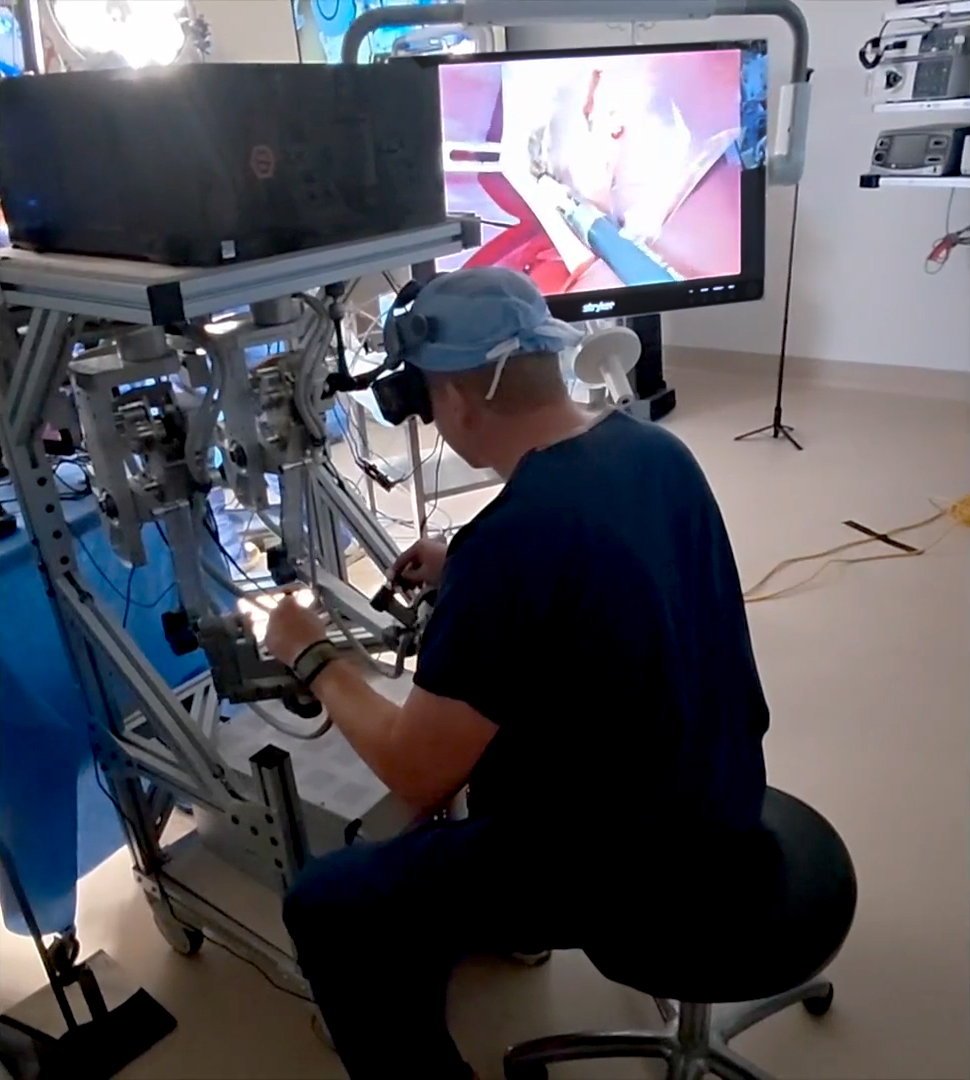
Image credit: University of California San Diego
A procedure performed by a teleoperated humanoid robot is just as precise as one performed with a teleoperated surgical robotic system, said Shanglei Liu, MD, an assistant professor of surgery at the UC San Diego School of Medicine, one of the paper’s senior authors, who teleoperated the robot during the study. “It's a fraction of the cost and it takes a fraction of the space in an operating room. So it’s easy to deploy, anywhere from rural areas, to the battlefield, and even to space,” said Liu, who is also affiliated with the Shu Chien-Gene Lay Department of Bioengineering.
Several issues with teleoperation still need to be addressed. The robots had to be recalibrated several times during surgery. As a result, the procedures took much longer than when performed with existing specialized surgical systems. But this was also common with early-stage specialized robotic systems as well and will likely get better with time, Liu said. The first robotic laparoscopic surgery took six hours; it now takes 30 minutes.
Latency – a delay between when the surgeon moves the controller and when the robot moves – is something that is being improved as the team explores longer-distance operations to remote communities.
Researchers also see a different role for Surgie. Because it can walk and perform most physical tasks a human can do, it could fetch tools for the surgeons and could clean up an operating room after a procedure. “One of our goals is to develop the autonomous surgical assistant,” Yip said. “Many communities struggle with adequate staffing on the surgical team, which means patients are not being treated. Our goal is an operating theatre of the future, where humanoid robots and humans work side by side as an integrated team to deliver procedures to those in need, both in traditional hospital settings as well as in non-traditional, field medicine scenarios.”
Researchers emphasized that the work would not have been possible without a close collaboration between engineers and surgeons, and the role of the UC San Diego Center for the Future of Surgery. “This achievement reflects the power of bringing engineers and surgeon innovators together to solve meaningful clinical problems at our world-class training and research lab,” said Ryan Broderick, MD, the interim director of the Center for the Future of Surgery and associate professor of surgery at the UC San Diego School of Medicine. “Our center provides a setting to bridge engineering innovation and clinical expertise, allowing transformative ideas to be rigorously developed, tested, and refined.”
Source: University of California - San Diego
10.07.2026