

News • Magnet-controlled chemotherapy delivery
Treating bladder cancer with algae-based robots
Experts say the technology could improve the efficiency of local chemotherapy delivery, potentially reducing drug exposure while improving treatment effectiveness.
Tiny algae-based robots guided by magnets could improve bladder cancer treatment by boosting delivery of chemotherapy drugs into tumours, researchers say. Tracked using real-time imaging, the miniature robots help drugs penetrate deep into tumour tissue while limiting damage to healthy cells.
In lab tests with mice, the approach increased drug penetration by more than ten times compared with the standard treatment method. After one week of therapy, tumour burden was reduced to less than three per cent of that seen in the conventional treatment group. Experts say the technology could improve the efficiency of local chemotherapy delivery, potentially reducing drug exposure while improving treatment effectiveness.
The study is published in the journal Nature Nanotechnology.
Our microrobots [...] release drugs exactly where they are needed to drive rapid tissue penetration in a minimally invasive way
Qi Zhou
Bladder cancer is among the ten most common cancers worldwide. It is often treated by surgery to remove the tumour followed by direct drug instillation, in which drugs are delivered into the bladder through a catheter. However, the drugs often struggle to penetrate deeply into the tumour tissue, limiting their effectiveness and requiring longer treatment times or higher doses.
Researchers at the University of Edinburgh and Xiamen University in China developed biohybrid magnetic microbots engineered from natural microalgae to overcome this challenge.
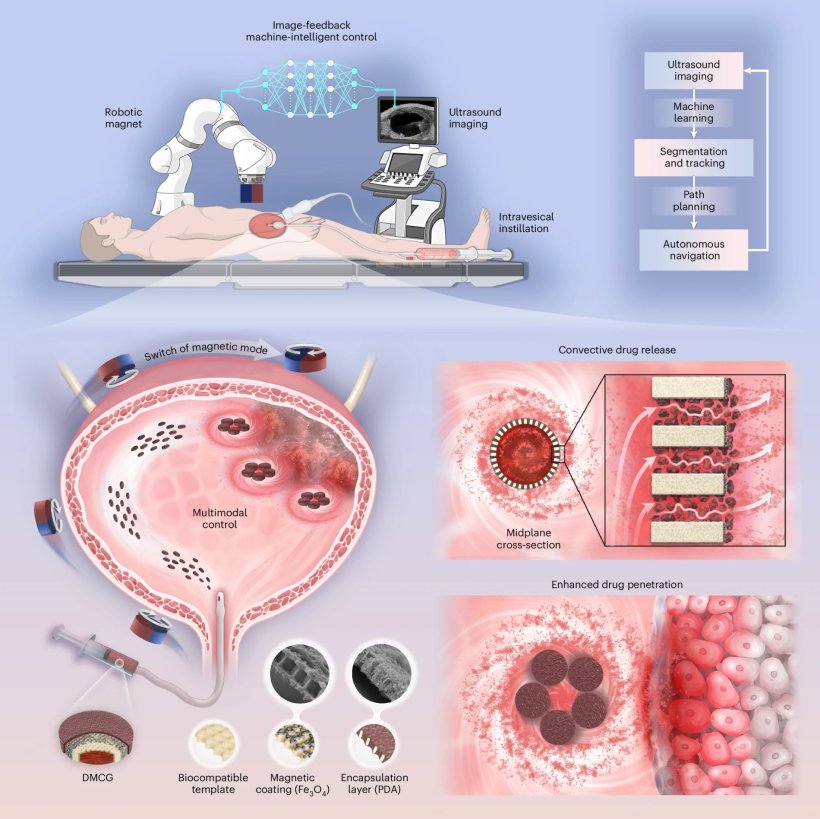
The single-celled algae are biocompatible and biodegradable, allowing them to be used safely in the body, and their delicate nanoporous structure is well suited for secure packaging and controlled release of drugs. They are also abundant in nature, cost-effective and suitable for scalable production, researchers say. The microbots are loaded with the chemotherapy drug doxorubicin and guided towards tumours using externally programmed magnetic fields.
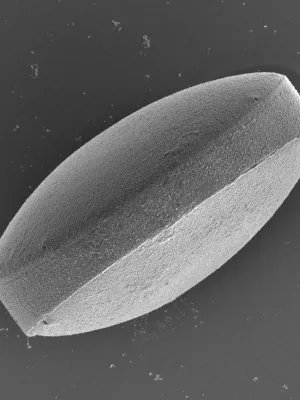
Image credit: Lin Lin
Using real-time ultrasound imaging feedback, researchers can precisely control how the swarm of drug-loaded robots move inside the bladder, causing them to roll and rotate to switch between transport and release modes for targeted drug delivery. Researchers likened the coordinated motion of the microbots through narrow spaces to schools of fish or flocks of birds moving together.
The team tested the technology in mice with bladder tumours and found that the microbots delivered drugs across the tumour rapidly and efficiently while minimising side effects. The treatment in mice can be completed in around 30 minutes, compared with the much longer exposure times often used in conventional treatments. Researchers say the improved therapeutic effect could support less invasive strategies for the treatment of bladder cancer, although further studies are needed.
Study co-lead Dr Qi Zhou, Lecturer in Biomedical Informatics at the University of Edinburgh’s Institute for Neuroscience and Cardiovascular Research, said: “Our microrobots are engineered from tablet-like microalgae, can be remotely guided to the tumour using real-time imaging feedback, and release drugs exactly where they are needed to drive rapid tissue penetration in a minimally invasive way.”
Professor Xiaohui Yan, from Xiamen University in China, said: “This study highlights a non-invasive approach to overcoming the biological barriers that limit drug penetration in bladder tumours. We are now discussing translational follow-up studies with hospitals, with the long-term aim of clinical trials after further preclinical validation and regulatory review.”
Source: University of Edinburgh
27.06.2026