

Image source: Netherlands Institute for Neuroscience; adapted from: Zhang L, Heimel JA, Swaab DF, British Journal of Psychiatry 2026
News • Neuroscience
Possible biomarker for suicidal thoughts identified
Research into receptor P2RX7 suggest disctinctively separate biological processes between depression and suicidal ideation
Researchers at the Netherlands Institute for Neuroscience have identified a possible biological marker linked to severe suicidal thoughts. The finding, published in the British Journal of Psychiatry, may also help explain why some people recover from these thoughts, opening a new path for research into resilience and suicide prevention.
Every day, almost five people die by suicide in the Netherlands. For every death, there may be around twenty suicide attempts. Yet despite the enormous impact on individuals and their loved ones, the biological processes linked to suicidal thoughts are still not well understood. There is also a great need for an effective drug against suicidal thoughts.
We want to understand what happens when someone feels suicidal. But it may be even more important to understand what helps someone to be resilient to these thoughts
Lin Zhang
Lin Zhang, a researcher in the Swaab group at the Netherlands Brain Institute, wants to gain a better understanding of the biological processes that play a role in suicidal behaviour. During her PhD research, she focused on the changes in the brain associated with severe suicidal thoughts. Her current research is shifting its focus to recovery: what mechanisms help people to put this period behind them?
“We have found indications that the human brain not only changes during severe suicidal thoughts, but may also have mechanisms that help some people recover from them,” Zhang says. “We want to understand what happens when someone feels suicidal,” she adds. “But it may be even more important to understand what helps someone to be resilient to these thoughts.”
Zhang started her exploration with brain donors from the Netherlands Brain Bank. “In the beginning we just had two groups: those with mood disorders, and those without”, Zhang begins. “But we did not find a clear difference in the area we studied.” A different pattern appeared when Zhang grouped the donors according to their cause of death. Brain tissue from people who had died by suicide or euthanasia showed a clear difference from tissue belonging to people who had died from natural causes, regardless of whether that donor had been diagnosed with a mood disorder. “This suggests that the biological processes linked to severe suicidal thoughts may be partly separate from those linked to depression,” Zhang explains.
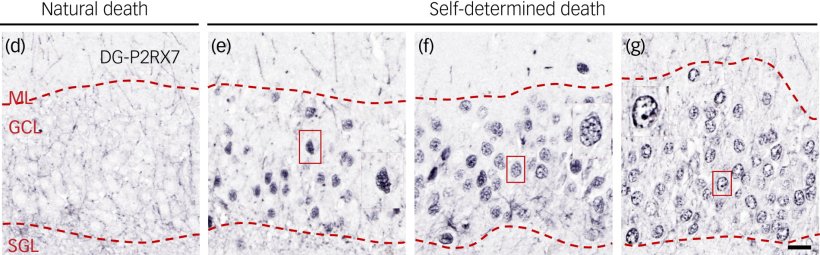
Zhang was specifically interested in a very specific receptor: “P2RX7”, she says. P2RX7 is involved in how cells react to stress, inflammation and energy metabolism. As she explains her findings, she points to four figures (top image). The first is virtually empty, showing a sample from a donor who died from natural causes. The remaining three figures are speckled with dark blue dots. “These donors died by suicide or euthanasia.”
The dark blue dots show the presence of P2RX7. When donors died by suicide or euthanasia, the levels of P2RX7 in their nerve cells was significantly higher. It is therefore possible that the nerve cells expressing them behave differently during severe suicidal thoughts. More research is needed to understand exactly what this difference means.
Zhang returned to the first figure, representing the donors who died from natural causes. While this group may appear to serve solely as a comparison group, their medical histories reveal a more complex story. “Some of these donors had experienced suicidal thoughts or had attempted suicide earlier in their lives as well,” she says. Surprisingly, earlier suicidal thoughts did not seem to reflect the same increase in P2RX7. “These donors experienced suicidal thoughts at some point, so it is possible that their P2RX7 levels were once higher,” Zhang explains. “But because they recovered, those levels may have fallen again. Unfortunately, we cannot yet confirm this using brain tissue collected at only one point in time.”
The results raise the possibility that P2RX7 changes as suicidal thoughts become stronger or weaker. “If we can follow a biological marker like this over time, it may help us better understand how suicidal thoughts change as well,” Zhang says. “That could eventually be valuable in clinical practice.”
The next step is to investigate P2RX7 in living people who are currently experiencing suicidal thoughts. Researchers at Amsterdam UMC plan to use positron emission tomography, better known as PET imaging, to measure signals related to the receptor in the brain.
The research is still at an early stage, and it is not yet known whether P2RX7 can reliably indicate the presence or severity of suicidal thoughts. “I hope it could eventually become a useful biomarker,” Zhang says. “But first, we need to find out whether we can observe the same pattern in living people.”
For Zhang, the subject is not only scientific. Her research has attracted the attention of people who have experienced suicidal thoughts themselves, and some regularly write to her. Her message to them is one of hope. “Your brain loves you more than you imagine. Every cell in your body is trying to fight against your suicidal ideation. Even when it does not feel that way, recovery remains possible.”
Are you thinking about suicide?
Take these thoughts seriously and do not try to deal with them alone. If you are in the Netherlands, you can call 113 free of charge or start an anonymous online chat with 113 Suicide Prevention. Help is available day and night.
If your life is in immediate danger, call 112.
Source: Netherlands Institute for Neuroscience
17.08.2026