

Image source: NIST; credit: Kazuyoshi Murata
News • Study explores conformational plasticity
Shape-shifting: the key to norovirus infectiousness?
Cryo-electron microscopy captures structural changes that may influence viral infection
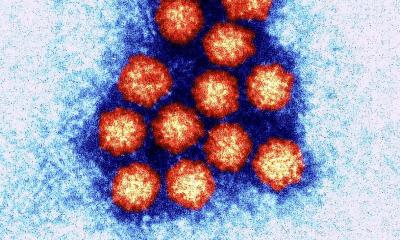
Human norovirus is the leading cause of acute gastroenteritis worldwide and is estimated to infect 600–700 million people each year. Despite its enormous public health impact, no effective antiviral drugs are currently available. A detailed understanding of the three-dimensional structure of the virus is essential for elucidating its infection mechanism and developing effective therapeutics. However, research on human norovirus has been hampered by the inability to efficiently propagate the virus in cultured cells, making it difficult to obtain sufficient quantities of infectious particles for structural studies. In contrast, studies of murine norovirus, which can readily be propagated in cell culture, have shown that its capsid undergoes conformational changes in response to environmental conditions. Whether human norovirus exhibits similar structural dynamics has remained unknown.
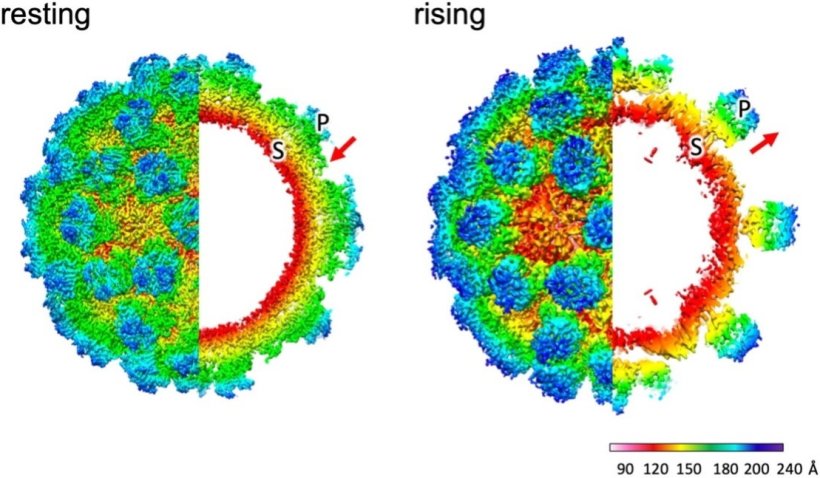
To address this question, a research team led by the National Institutes of Natural Sciences in Japan and Pusan National University in South Korea successfully produced virus-like particles (VLPs) of the human norovirus GII.3 strain, which has been responsible for repeated regional outbreaks, and determined their structures using state-of-the-art cryo-electron microscopy (cryo-EM). Structural analysis revealed that a single VLP preparation contained two distinct conformational states, referred to as the resting and rising states, which differ in the location of the protruding (P) domain (see top figure).
The researchers published their findings in the International Journal of Molecular Sciences.
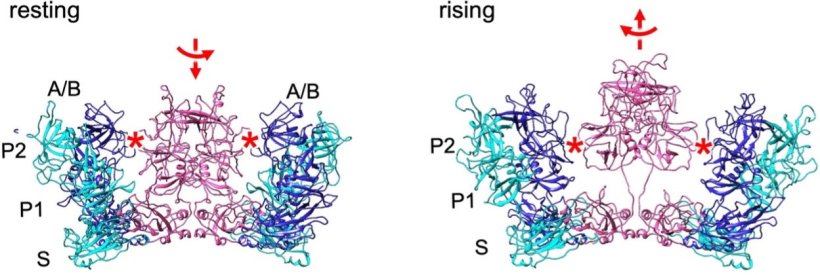
Image source: NIST; credit: Kazuyoshi Murata
Further analysis showed that:
- In the resting state, the P domain is positioned close to the underlying shell (S) domain and forms an extensive interaction network mediated primarily by the distal P2 subdomain.
- In the rising state, the P domain is elevated by approximately 1 nm and rotated by about 55°, accompanied by a reorganization of the interaction network to the P1 subdomain (second figure). In addition, the P domain in the rising state exhibits substantially greater structural flexibility than in the resting state.
These findings provide the first evidence that the human norovirus capsid, like that of murine norovirus, is not a rigid shell but a dynamic molecular assembly capable of adopting multiple conformations in response to its environment. Because the P domain contains both the host receptor-binding sites and the major antibody epitopes, these conformational changes may play important roles in regulating viral infectivity, receptor recognition, and immune evasion.
Future studies will investigate the environmental factors—such as pH, metal ions, and physiological acids—that trigger these structural transitions, determine whether the same conformational changes as shown in murine norovirus occur in infectious virions, and explore the development of antibodies or small-molecule compounds capable of stabilizing or inhibiting these transitions. Such studies are expected to provide a foundation for the development of next-generation vaccines and novel antiviral therapies against human norovirus.
Source: National Institutes of Natural Sciences
06.08.2026