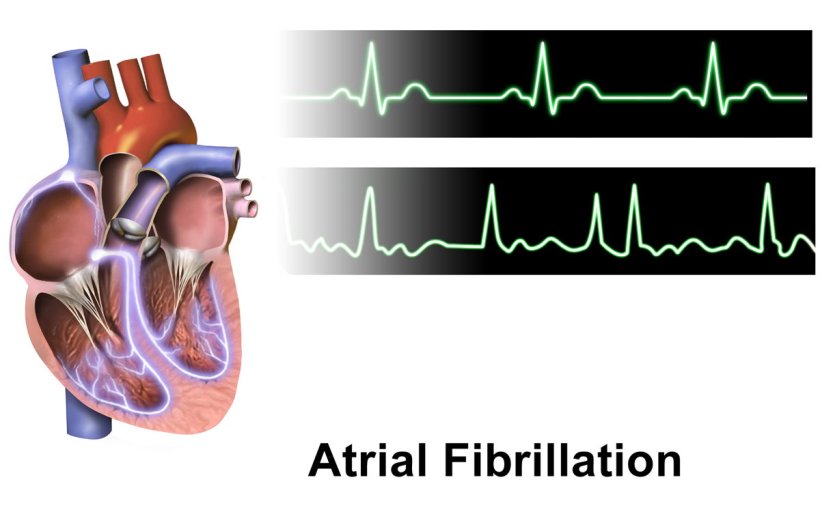
Image source: BruceBlaus, Atrial Fibrillation (CC BY-SA 4.0)
News • Current insights and research priorities
Atrial fibrillation during sepsis: what clinicians know (and what they don't)
A review of sepsis-associated atrial fibrillation maps its frequency, risks, diagnosis, and management – and the uncertainties that remain.
Sepsis sends millions of patients to intensive care units each year, and for many, a second crisis unfolds inside the first. Between 9% and 20% of patients hospitalized with sepsis develop new-onset atrial fibrillation (AF) – an irregular, often rapid heart rhythm that emerges as the body mounts its response to infection. It is linked to higher risks of stroke, death, and recurrence – yet, for how often it occurs, clinicians have no specific guidelines to treat it. Much of what they know still sits alongside what remains unclear.
Sepsis-associated atrial fibrillation sits in a clinical blind spot: it's common, it's dangerous, and yet we're treating it without a map
Sameh Hozayen
A new review published in the Journal of Intensive Medicine, led by a team including researchers at Mayo Clinic in Arizona with collaborators at the University of Pennsylvania, USA, and Mansoura University, Egypt, brings together the current evidence on sepsis-associated atrial fibrillation (SAAF) – how often it occurs, who is most at risk, and how it is diagnosed and managed – and maps the research needed to close the gaps.
“Sepsis-associated atrial fibrillation sits in a clinical blind spot: it's common, it's dangerous, and yet we're treating it without a map,” says Sameh Hozayen, MB, BCh, of the Division of Hospital Internal Medicine at Mayo Clinic in Arizona and corresponding author of the review. “Our aim was to bring the existing evidence together in one place and define exactly what we need to learn to give these patients standardized, evidence-based care.”
Unlike primary AF, which arises without a clear trigger and is supported by decades of trial data and established guidelines, SAAF develops in response to the acute stress of critical illness. It often resolves once the infection is controlled, but the review shows it is far from benign. SAAF is associated with a 4.6-fold increase in stroke risk and a 1.7-fold increase in in-hospital mortality compared with sepsis patients who do not develop the arrhythmia. Recurrence is common – affecting up to half of patients within five years – and survivors face elevated risks of heart failure, stroke, and death that persist long after discharge.
The authors trace why SAAF is so difficult to manage. Its causes are multifactorial, driven by systemic inflammation, autonomic dysfunction, myocardial injury, hemodynamic stress, and electrolyte disturbances that converge to destabilize the heart's upper chambers. Because no randomized studies have compared management strategies specifically in this population, clinicians must extrapolate from studies of primary AF – an imperfect fit for critically ill patients whose physiology can shift hour to hour.
Every major treatment decision carries uncertainty. For rate control, beta-blockers appear superior to alternatives in observational data, but no randomized trial has confirmed the best approach. For rhythm control, cardioversion can restore normal rhythm yet frequently fails to hold while the underlying illness persists. Anticoagulation – the use of blood-thinning medication – is the thorniest question of all: Critically ill patients face simultaneous risks of dangerous clotting and dangerous bleeding, and standard stroke-risk tools have not been validated in this setting. In observational studies, anticoagulation has not clearly reduced stroke risk – and in one multicenter cohort, it increased bleeding – leading many clinicians to defer it – a decision the review stresses must be individualized to each patient's phase of illness.
The review distills these challenges into concrete research priorities: a universally accepted definition of SAAF, validated prediction models to identify high-risk patients early, prospective trials comparing rate and rhythm control, clearer anticoagulation strategies, and standardized rhythm monitoring after discharge. The authors also underscore the economic stakes – SAAF adds roughly $9,000 in charges per patient – and point to emerging roles for artificial intelligence in predicting and detecting the arrhythmia in real time.
Until dedicated trials are completed, the authors conclude, managing SAAF will remain a matter of careful, individualized judgment—treating the whole critically ill patient rather than the arrhythmia in isolation.
Source: Journal of Intensive Medicine
06.10.2026