

News • Single-cell spatial atlas
Breast cancer: map explores role of aging tissue
Scientists have created the most detailed map to date, comprised of over 3 million cells, showing how breast tissue changes as women age – including dramatic changes during menopause.
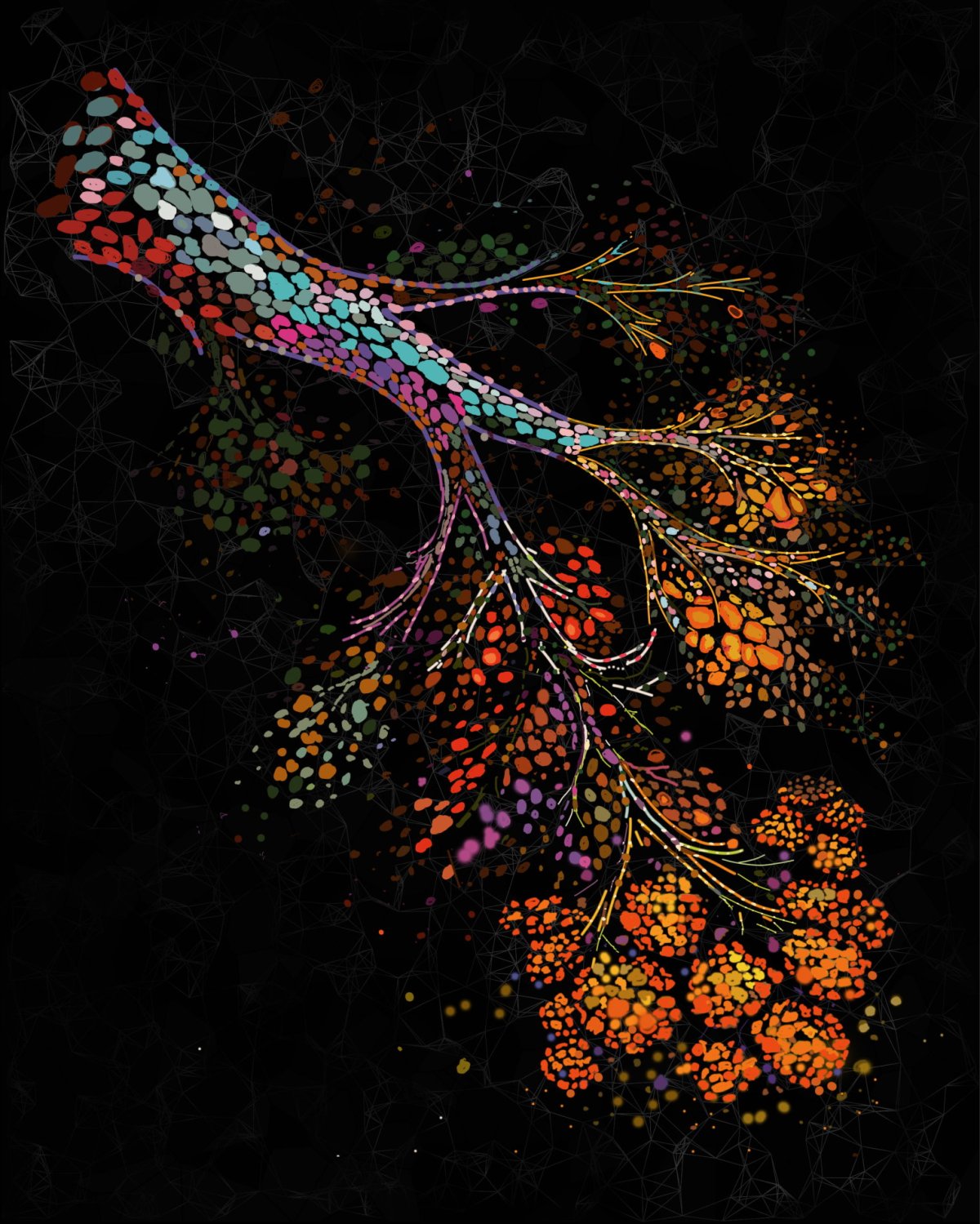
Image source: University of Cambridge
The map reveals how, as women age, the number of cells in their breast tissue decreases, and these in turn proliferate less, and the structure of breast tissue changes. This creates a ‘micro-environment’ in which cancer cells can thrive. Details of the study, led by scientists at the Universities of Cambridge and British Columbia, are published in Nature Aging.
Breast cancer is the most common form of cancer in women. It accounts for 15% of all new cancer cases, with four out of five cases occurring in women over 50. As many as one in seven women will develop breast cancer in their lifetime.
Pulkit Gupta from the Cancer Research UK Cambridge Institute at the University of Cambridge, joint first author, said: “Even though breast cancer affects well over two million women worldwide, we understand very little about why and when it occurs. As cells divide and replicate, they accumulate mutations that can drive cancer, but why is it that the body can get rid of these mutated cells when we’re younger, but struggles later in life?”
The team used advanced imagining techniques to analyse breast tissue from more than 500 women aged 15 to 86 years old. The tissue included biopsies taken from women for non-cancer-related reasons. Combining these images with details of the hormone receptors and immune cells present, as well as the tissue architecture, the researchers were able to map how breast tissue changes over time in unprecedented detail. Their findings point to reasons why breast cancer risk increases with age and why tumours in younger women differ biologically.
Gupta added: “Our map revealed that as women age, their breast tissue goes through major changes, with the most dramatic changes occurring at menopause. There are changes, too, during their twenties, possibly linked to pregnancy and childbirth, but these are far less pronounced.”
Recommended article

Article • Female patients
Focus on women's health
From gynaecology to obstetrics, from breast cancer treatments to menopause research: the distinct medical needs of female patients are manifold. But also in many other areas of research, diagnostics and therapy, the awareness of women requiring different approaches than male patients is dawning. Keep reading to find out more.
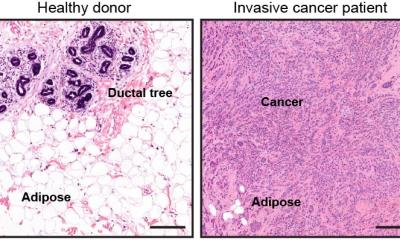
The map revealed that all types of cells become fewer in number and divide far less often. Milk-producing structures known as lobules shrink or disappear, while the ducts that that carry milk become relatively more common, with the supporting layer around them becoming thicker. Fat cells increase while blood vessels decrease.
The sheer scale of changes across the breast surprised us. What is clear from our map is that all of these changes create an environment where cancer cells that emerge naturally find it easier with age take hold and spread
Raza Ali
Meanwhile, changes occur in the immune environment. Younger breasts have more B cells and active T cells, which helps them identify and kill cancer cells. As tissue ages, these types of cells decline in number, replaced by other types of immune cell that indicate a more inflammatory and potentially less protective immune environment.
Co-senior author Dr Raza Ali from the Cancer Research UK Cambridge Institute at the University of Cambridge said: “We don’t know for certain why the types of immune cell change. We can speculate that one reason may be because breast milk contains a high concentration of immunoglobulins, probably to help build the infant’s immunity, and these are produced by B cells.”
At the same time, the cells begin to interact with each other less. Immune cells and stromal cells (those that create a tissue ‘scaffold’) become physically further away from epithelial cells (specialised cells that line the mammary ducts and lobules, forming a structure responsible for milk production and transport). This may make it easier for pre-cancerous cells to escape control.
Co-senior author Professor Samuel Aparicio from BC Cancer, University of British Columbia, Canada, said: “We’ve previously seen that age dependent changes in oestrogen activity occur strongly in milk secreting cells of the breast and now we can see the surprising extent of changes in all cell types, including the immune system, with age. We are now seeking to understand the relationship between changes in immune cells and surveillance of early mutations that can arise in milk secreting cells over time.”
Dr Ali added: “It isn’t surprising that we should see fewer epithelial cells, as these play a role in producing breast milk, something that becomes less important with age, but the sheer scale of changes across the breast surprised us. What is clear from our map is that all of these changes create an environment where cancer cells that emerge naturally find it easier with age take hold and spread.”
The research was supported by Cancer Research UK.
Source: University of Cambridge
31.03.2026