

Image courtesy of SNMMI
News • Promising prototype
Bringing a PET scanner to the bedside
Portable point-of-care technology enables imaging for interventional procedures
A newly developed portable, point-of-care PET technology can image any organ, delivering high-quality results to guide interventional procedures. With real-time visual feedback, the bedside technology provides a cost-effective approach for hospitals to perform biopsies, tumor ablations, and other procedures in constrained clinical environments. This research was presented at the Society of Nuclear Medicine and Molecular Imaging 2026 Annual Meeting.
A portable PET device with real-time imaging capability could bring vast information and benefits from molecular imaging to interventional radiology procedures
Yuan-Chuan Tai
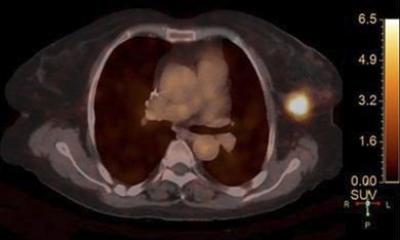
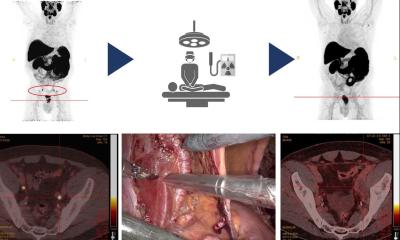
Current interventional procedures (minimally invasive, image-guided techniques used to diagnose or treat conditions) rely mainly on anatomical imaging such as ultrasound, x-ray fluoroscopy, and CT for guidance. Studies have shown that interventional radiology procedures guided by a dedicated PET/CT achieve higher accuracy; however, this solution is cost-prohibitive to most hospitals and thus not widely available.
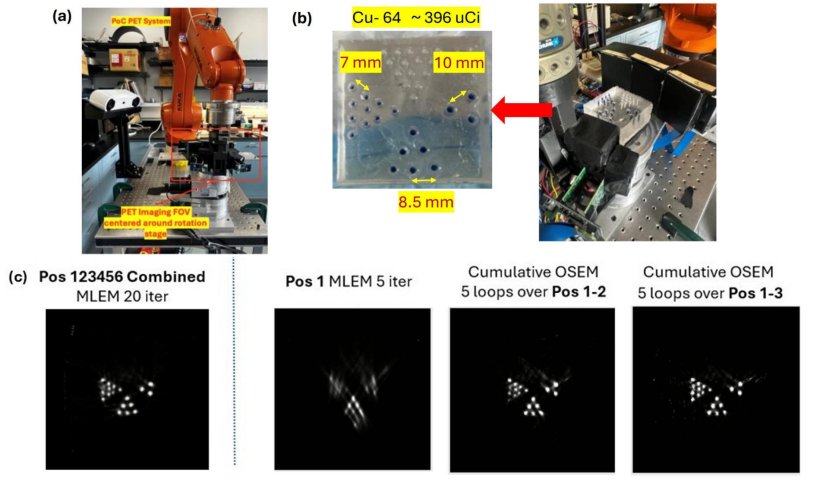
"A portable PET device with real-time imaging capability could bring vast information and benefits from molecular imaging to interventional radiology procedures," said Yuan-Chuan Tai, PhD, senior author, from Washington University in St. Louis. "To address this unmet need, we developed a portable point-of-care PET system with a robotic arm that can position detector panels at arbitrary locations to image any organ of interest."
Using the portable point-of-care PET system, the study investigated the feasibility of interactive PET scanning and a real-time image updating strategy. A phantom containing three clusters of radiotracer-filled rods was imaged with the point-of-care PET detector panels moved to six user-selected positions. Image reconstruction began with five iterations using data from the first position, followed by alternating single-iteration updates as data from each new position become available. Since data acquisition time was significantly longer than the reconstruction time, images were continuously updated as data was acquired. A conventional PET reconstruction framework, in which images were generated after the entire scan was completed, was also used for comparison.
The image quality from portable point-of-care PET using a real-time image updating framework was comparable to conventional reconstruction framework. Phantom structures become clearly distinguishable after three to four positions, suggesting that scanning could be terminated early if imaging tasks can be fulfilled. Alternatively, image quality can be further improved with additional scanning positions and/or reconstruction iterations.
"This proposed approach better supports interactive and adaptive imaging workflows at the bedside," said Xiyan Li, a graduate researcher in Imaging Science doctoral program at Washington University in St. Louis. "It represents a paradigm shift that offers new avenues to deploy novel molecular imaging applications."
The current study utilized a benchtop prototype system for point-of-care PET. Researchers are currently building a prototype system suitable for initial human imaging study which will begin in 2027.
Source: Society of Nuclear Medicine and Molecular Imaging
06.06.2026