


© Nadzeya – stock.adobe.com
News • Research identifies information barriers
‘Top surgery’ and breast cancer risk: Towards informed decision-making
Goal is to reduce the informational barriers that prevent transgender people from making informed decisions about their health
Transgender and gender diverse (TGD) individuals experience significant healthcare disparities across the oncology spectrum of care. Systemic barriers, past harmful healthcare experiences and sociopolitical climate, and other impediments to accessing health care among others, combine to influence these disparities. TGD individuals undergoing gender-affirming mastectomy (‘top surgery’) face unique challenges related to breast cancer risk assessment and screening. Currently, a patient can undergo top surgery without understanding how that procedure will affect their lifelong breast and chest cancer risk – and critically, without knowing if they carry predispositions that could fundamentally reshape their surgical decisions.
Every person – transgender or cisgender – deserves clear information about their cancer risk and access to prevention. As it stands, trans people are diagnosed with cancer at later, more dangerous, stages than cisgender people
Kim Zayhowski
A new study by researchers at Boston University Chobanian & Avedisian School of Medicine has identified critical barriers that influence healthcare professionals' integration of cancer risk evaluation, within the context of gender-affirming mastectomy and pre-surgical planning. They include clear institutional accountability, harmonized evidence-based guidelines, standardized care pathways and embedded genetic counseling in multidisciplinary gender-affirming care teams. These findings mirror what patients reported in a previous companion study – that they lack clear information before and after surgery.
“Every person – transgender or cisgender – deserves clear information about their cancer risk and access to prevention. As it stands, trans people are diagnosed with cancer at later, more dangerous, stages than cisgender people,” explains corresponding author Kim Zayhowski, MS, CGC, genetic counselor and assistant professor of medical sciences & education at Boston University Chobanian & Avedisian School of Medicine. “We're calling on healthcare institutions and organizations to move beyond reliance on individual provider commitment and invest in the institutional infrastructure necessary to guarantee that trans patients receive comprehensive cancer risk information to make truly informed decisions about their care.”
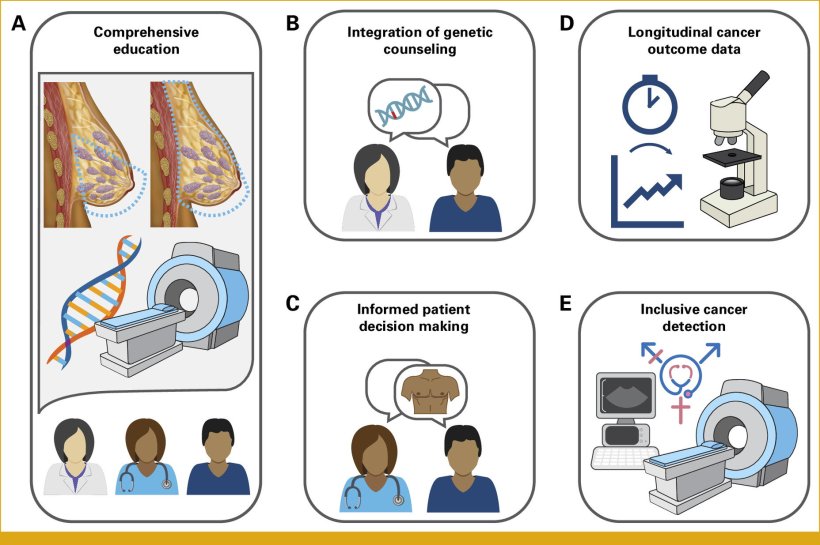
Image source: Zayhowski K, Blumen K, Mittendorf KF, Pratt R, Streed C, Berro T, MacFarlane IM, JCO Precision Oncology 2025 (CC BY-NC-ND 4.0)
The researchers conducted two parallel qualitative studies. In the previous study, they interviewed 16 transgender patients about their experiences with breast/chest cancer risk assessment and top surgery. In the current study, they interviewed 20 healthcare professionals – primary care physicians, genetic counselors, oncologists and plastic surgeons – about current practices and barriers to breast/chest cancer risk assessments for these patients.
According to the researchers, this study showed that the problem is that healthcare institutions are not built to serve this population. “Many healthcare professionals caring for transgender patients want to help, but there is currently no standardized conversation about breast/chest cancer risk (e.g. what screening looks like after surgery or whether they should consider having more tissue removed based on a genetic or familial risk for cancer),” adds Zayhowski.
To help patients deal with specific barriers to breast/chest cancer risk assessment in transgender care that have been identified, the team of researchers is in the process of developing CHESTcare – Cancer & Hereditary Risk Education & Support for Transgender and nonbinary individuals – an online toolkit that integrates cancer and hereditary risk education with support for informed decision-making about breast/chest cancer screening in the context of gender-affirming care. The toolkit includes resources for both patients and providers.
Source: Boston University School of Medicine
01.08.2026