

© WavebreakMediaMicro – stock.adobe.com
News • Gesture sequence recognition and clinical outcome prediction
Prostate cancer: AI analyzes surgical technique to improve care
Findings suggest this technology could help surgeons refine their techniques, predict likelihood of patients regaining sexual function
Investigators at Cedars-Sinai Health Sciences University have developed an AI system that analyzes surgeons’ techniques during prostate cancer surgery, helping identify the surgical movements associated with the best patient outcomes while also predicting whether patients are likely to regain sexual function.
The findings, published in npj Digital Medicine, suggest this technology could help surgeons refine their techniques and improve patient outcomes.
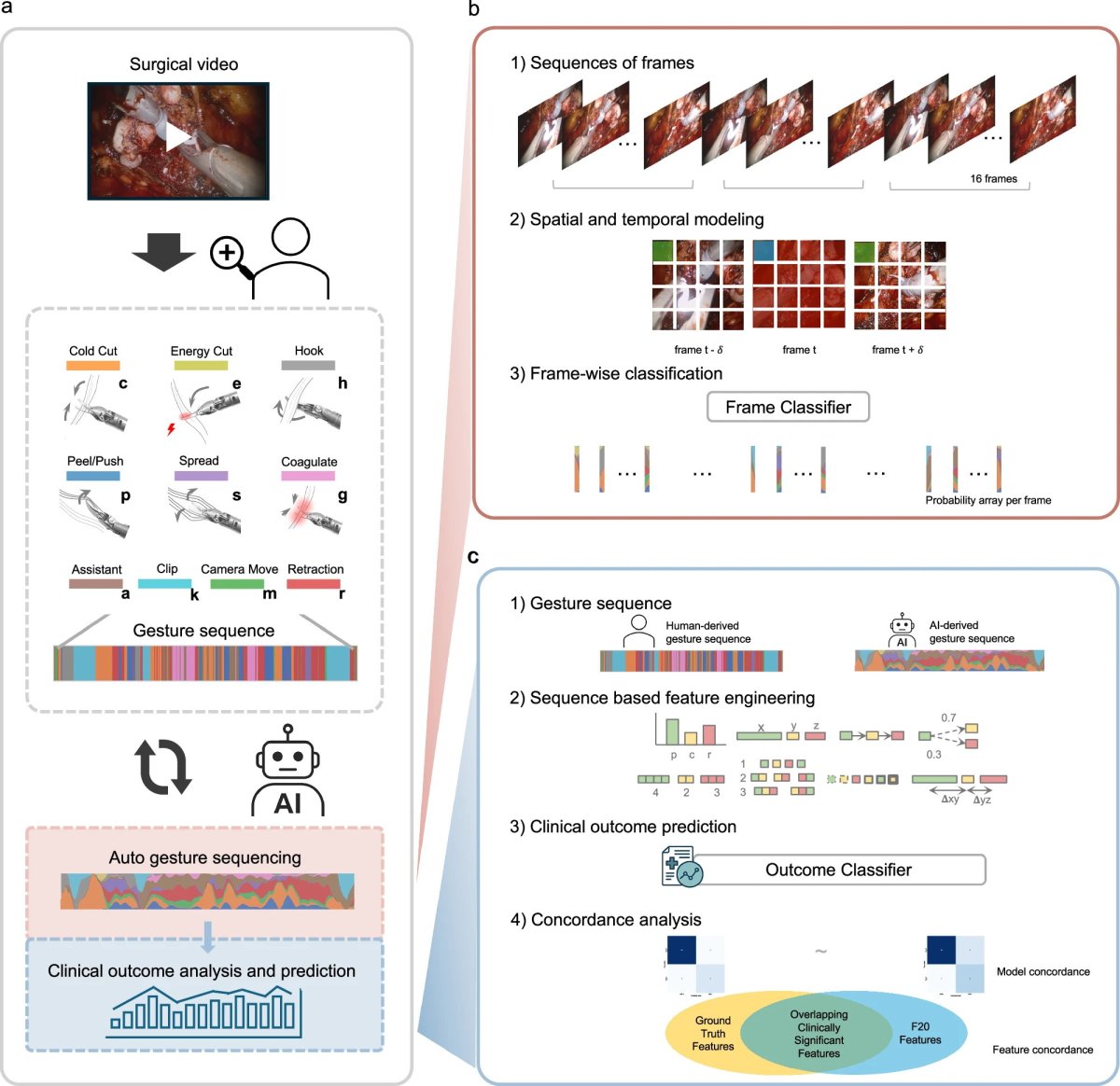
Image source: Li X, Matsumoto N, Pasupulety U et al., npj Digital Medicine 2026 (CC BY 4.0)
The AI system, called Frame-to-Outcome (F2O), analyzes video recorded during the nerve-sparing portion of robot-assisted prostate surgery, when surgeons work to preserve the nerves responsible for sexual function. Rather than relying on experts to manually evaluate each procedure, the system automatically identifies patterns in a surgeon’s movements—called “surgical gestures”—and uses them to predict patient recovery.
Prior studies of these surgical gestures demonstrated a strong relationship between the gestures performed by the surgeon—such as the sequence of instruments used or the speed of stretching nerves to move them aside—and the patient’s outcome. By analyzing the gestures used during surgery, the AI system made determinations about whether the patient will be more or less likely to have a good outcome. Until now, this type of analysis required labor-intensive review by trained human observers.
“Our goal isn’t simply to predict who will recover,” said Andrew Hung, MD, corresponding author of the study and professor of Urology at Cedars-Sinai. “We want to identify the surgical techniques with the best outcomes so surgeons can learn, refine and improve care for our future patients.”
Investigators found that F2O matched expert human reviewers in predicting patient outcomes while dramatically reducing the time required to analyze surgical performance. The technology could eventually provide surgeons with objective feedback on the techniques most closely associated with successful patient recovery.
To develop the system, researchers trained the AI system using videos annotated by human analysts from 294 surgeries from 23 surgeons across four international centers. Then they tested it on an additional 29 surgeries and found its predictions closely matched those of expert human reviewers. “By identifying and interpreting the gestures that result in positive patient outcomes, we can offer surgeons insights that can help improve surgical performance and patient care,” Hung said.
The study was a collaboration between the Department of Urology, the Department of Computational Biomedicine and the Center for Artificial Intelligence Research and Education (CAIRE) at Cedars-Sinai. “This work highlights what we can achieve when surgeons and computational biomedicine experts work together toward a shared clinical goal," said Jason Moore, PhD, chair of the Cedars-Sinai Department of Computational Biomedicine and director of CAIRE. "Bringing together these disciplines allowed the team to build something that is technically rigorous and genuinely meaningful for surgeons—and their patients."
Additional Cedars-Sinai authors include Xi Li, Nicholas Matsumoto, Jay Moran, Miguel E. Hernandez, Cherine Yang, Jeanine Kim, Jasmine Lin, Peter Wager, Ujjwal Pasupulety and Atharva Deo. Other authors include Alvin C. Goh, Christian Wagner and Geoffrey A. Sonn.
Funding: Research reported in this publication was supported by the National Cancer Institute of the National Institutes of Health under Award Number R01CA273031. The content is solely the responsibility of the authors and does not necessarily represent the official views of the National Institutes of Health.
Source: Cedars-Sinai Health Sciences University
28.07.2026