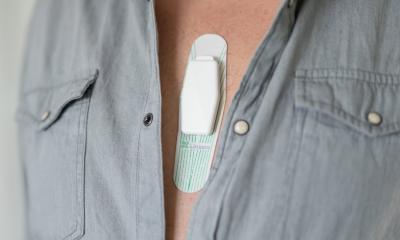



Image source: ams OSRAM
Article • Vital sign monitoring
Multi-chip LEDs read disease risk through the skin
Advances in LED technology are more than brighter bulbs — they’re opening new windows into human biology. By combining ultraviolet-A (UV-A), green and infrared (IR) chips into a compact module and pairing them with sensitive photodetectors, one can non-invasively read tissue autofluorescence signals that reflect accumulation of advanced glycation end products (AGEs).
Guest article by Stephan Haslbeck, Product & Marketing Manager at ams OSRAM

Image source: ams OSRAM
Growing clinical evidence links increased skin AGE autofluorescence to diabetes complications, cardiovascular events, chronic kidney disease and overall mortality — meaning that an emitter–detector combination using UV‑A together with green and IR light can deliver a powerful new vital sign parameter for early risk detection and monitoring.1
What are AGEs — and why autofluorescence works
AGEs are heterogeneous molecules formed when sugars react non-enzymatically with proteins and lipids. They are said to play a decisive role when it comes to the development of chronic age-related diseases such as diabetes, kidney failure, and cardiovascular diseases.
Some AGEs are fluorescent: when excited by specific wavelengths (classically UV-A around ~370 nm – 385 nm), they emit light in the blue–green range (commonly measured around ~ 420–600 nm). That tissue autofluorescence (often measured on volar forearm or fingertip skin) correlates with biopsy-measured AGE accumulation and with long-term disease risk. Because autofluorescence is an optical signal, it can be excited and sampled using LEDs and photodetectors — no blood drawing needed.
Why multi-chip LEDs (UV-A + green + IR) are a practical breakthrough
Single-wavelength AGE readers exist, e.g., devices using UV-A 370 nm excitation. But integrating three chips with UV-A + green + IR into one module multiplies the application options by combining the following features:
- The UV-A chip (centroid wavelength typ. ≈ 383 nm, broadly ≈ 378–387 nm) — excites fluorescent AGEs in skin collagen and other chromophores to generate the diagnostic autofluorescence signal. This is the core AGE excitation band used in validated devices.
- A Green/visible chip (≈ 530 nm or broadly 522–542 nm) — can be used in several ways. It is already well established for heart rate monitoring, but recent research results also show options to utilize it as a second excitation wavelength to probe different AGE/oxidation species and to provide illumination for reflectance correction and spectral discrimination of tissue autofluorescence versus background skin reflectance.2-4
- The IR chip (typically ≈ 850–940 nm or for some applications ~980 nm) — enables simultaneous photoplethysmography (PPG) for heart rate, perfusion and hydration (980-1400 nm), potentially pulse-wave timing and even measuring stress due to variations in the blood flow. IR light penetrates deeper and is standard for PPG/oximetry; combining PPG with AGE autofluorescence lets one correlate biochemical risk (AGE load) with hemodynamic parameters in a single device.
The result: a small, multi-functional optical module capable of non-invasive AGE measurement via UV-A induced autofluorescence, multi-spectral discrimination to improve specificity and reduce confounders, and concurrent vital signs for richer clinical context.
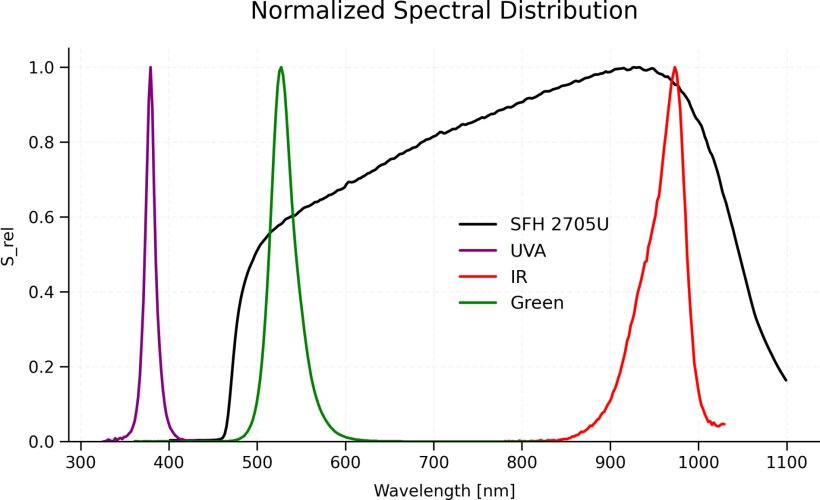
Figure: ams OSRAM
Technical considerations
A purpose-built optical module that combines UV-A excitation with green spectral probing and IR physiological sensing converts the established science of AGE autofluorescence into an actionable, multi-modal vital sign. The approach builds on validated Skin Autofluorescence (SAF) work and extends it by improving specificity (multi-band fluorescence), adding physiological context (PPG/IR), and enabling compact, affordable devices suited to clinics, home care, and research.
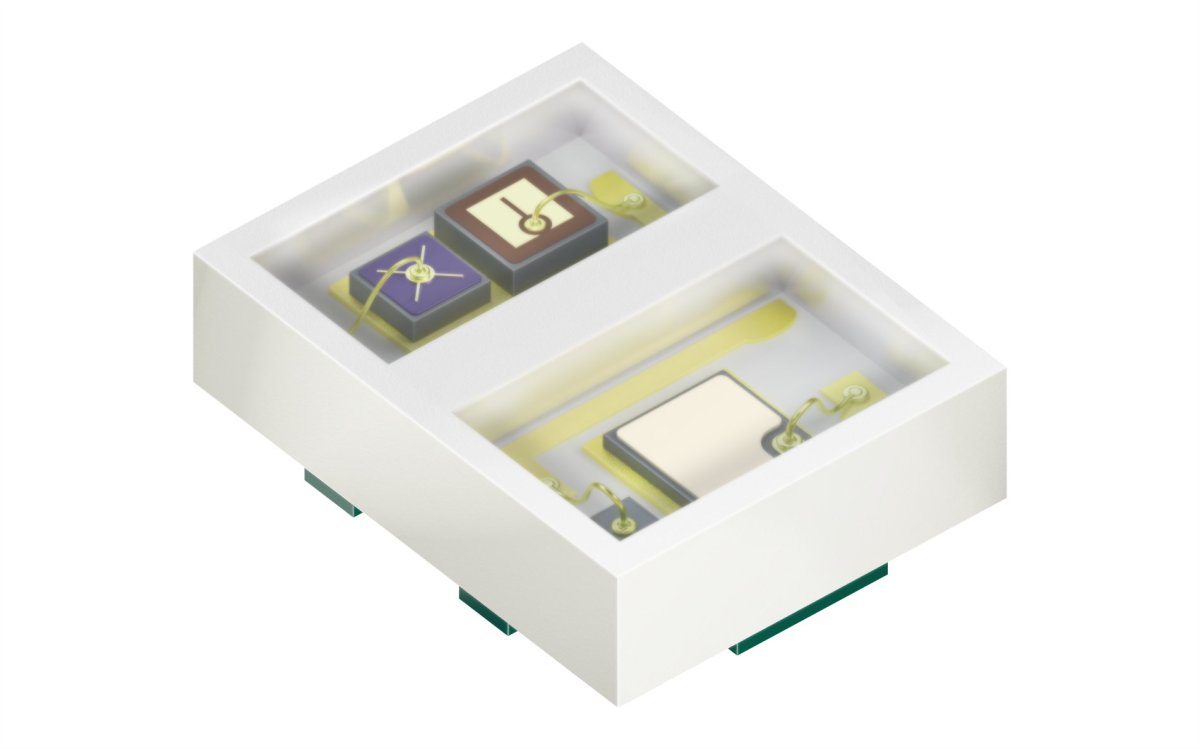
Image source: ams OSRAM
The latest multi-chip LED SFH 7019 by ams OSRAM for example has been developed with vital sign applications in mind. It combines chips for green (530 nm), IR (980 nm), and UV-A (383 nm).
The new wavelength combination supports both heart rate monitoring and AGE measurements and thereby complements established vital sign measurements with information about long-term metabolic stress.
A sophisticated package design helps avoiding interference between UV chip and green chip. In addition, each chip can be addressed separately. The extremely compact footprint of 1.65 mm x 2.15 mm x 0.6 mm fulfills the low-profile requirement of compact vital sign monitoring devices and even smartwatches, smart rings, etc.
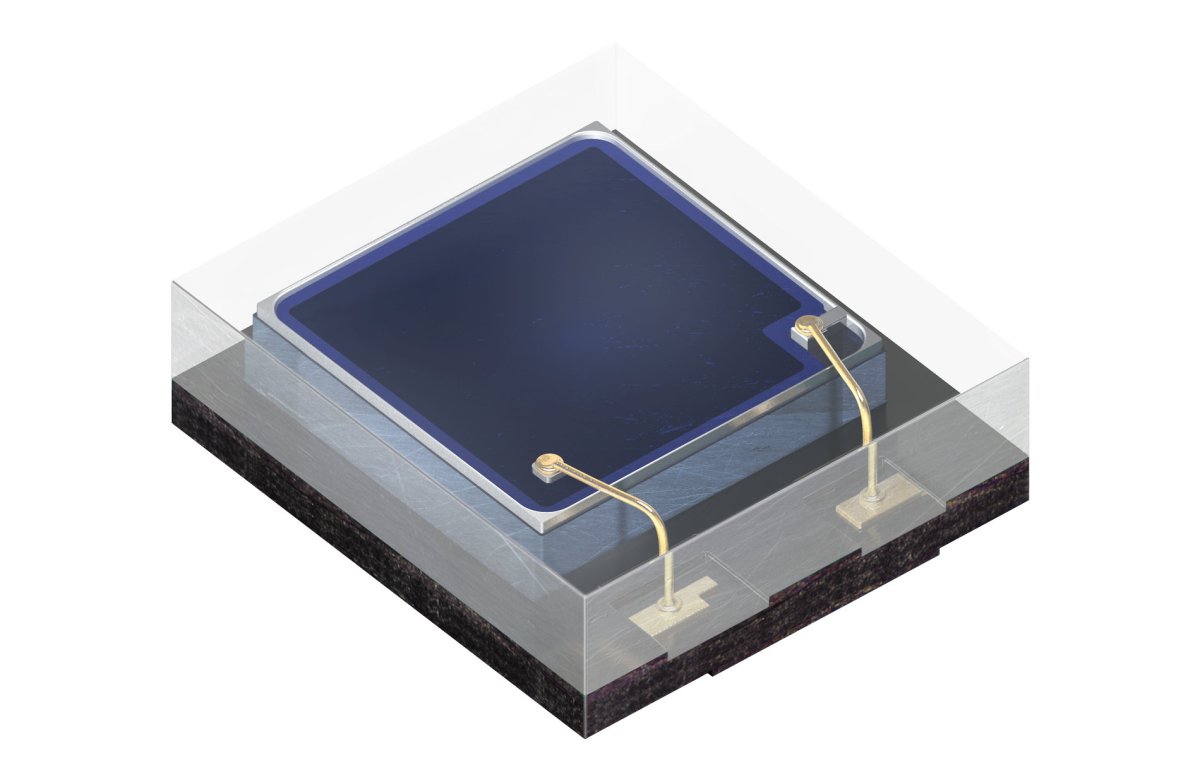
Image source: ams OSRAM
A matching photodiode (Chip LED SFH 2705U) with the same compact footprint as the multi-chip LED has been designed to improve the accuracy of skin autofluorescence measurement by preventing UV light from reaching the detector. At the same time, it maximizes sensitivity for green, and IR light, enabling accurate measurement of both biochemical and physiological parameters. A filter surrounds the photodiode to block UV-A excitation and starts to open up from 445 nm onwards allowing the detection of the fluorescence wavelengths while avoiding crosstalk of the UV-Emitter. It also maintains highly accurate PPG measurements, such as HRM functionality: green and IR signals pass through the filter, and synchronized LED pulses let the photodiode measure fluorescence and PPG in separate time windows. This enables one tiny optical module to combine biochemical and vital sign data collection without compromising accuracy or safety.
“With careful engineering for spectral fidelity, skin-type compensation and UV safety, multi-chip LEDs such as the SFH 7019, together with the matching SFH 2705U photodiode, are uniquely positioned to supply the key illumination building blocks that will bring AGE-based risk assessment into routine care”, said Stephan Haslbeck, Product Manager at ams OSRAM. “We work closely together to develop products for the specific requirements of our partners and there is already interest in other wavelength combinations in this multi-chip LED format. Our solution design allows medical OEMs to integrate multi-chip modules into handheld readers, wearables and point of care (POC) instruments.”
Enabling new medical applications⁵
The technical progress and purpose-built LED in combination with matching photodiodes form a complete optical sensing solution, paving the way for new and advanced medical applications in the field of vital sign monitoring and non-invasive procedures.
- Point-of-care risk screening — primary care, pharmacies and diabetes clinics can offer quick, non-invasive AGE scans that flag patients at higher risk for complications and prompt targeted follow-up (lab testing, lifestyle interventions). Devices become more robust when green illumination is used for skin reflectance and provide multi-band AGE signatures.
- Integrated metabolic and hemodynamic profiling — combining Skin Autofluorescence (SAF) with simultaneous PPG (from IR) produces coupled biochemical + physiological snapshots: e.g., elevated AGE load + abnormal pulse-wave timing could identify patients with vascular stiffening earlier than either measure alone.
- Remote monitoring and care-path optimization — compact modules embedded in home-care devices, wearable patches (with safety shielding from UV), or handheld exam tools allow longitudinal tracking of AGE trends (treatment response, lifestyle impact), potentially improving personalized care plans.
- Nephrology and dialysis triage — SAF is elevated in Chronic Kidney Disease (CKD) and predicts adverse outcomes in dialysis patients; a rapid SAF measurement at the bedside could help triage high-risk patients and monitor interventions.
- Clinical research and drug trials — multi-spectral autofluorescence provides a sensitive, non-invasive biomarker to include in pharma trials (e.g., therapies targeting glycation, oxidation, renal protection or vascular remodeling).
A new generation of non-invasive medical tools can bring biochemical and physiological insight directly to the point of care. As a result, they have the potential to significantly improve disease detection, personalize treatment pathways, and accelerate innovation across chronic disease management.
References:
- Fokkens BT, Smit, AJ: Skin fluorescence as a clinical tool for non-invasive assessment of advanced glycation and long-term complications of diabetes. Glycoconj J 33, 527–535 (2016).
- Beisswenger PJ, Howell S, Mackenzie T, Corstjens H, Muizzuddin N, Matsui MS: Two fluorescent wavelengths, 440(ex)/520(em) nm and 370(ex)/440(em) nm, reflect advanced glycation and oxidation end products in human skin without diabetes. Diabetes Technol Ther 2012 Mar;14(3):285-92.
- Zhou J, Li X, Zhang J, Cai F: Developing a Portable Autofluorescence Detection System and Its Application in Biological Samples. Sensors 2024, 24(11), 3351.
- Lee J, Jeong ET, Lim JM, Park SG: Development of the facial glycation imaging system for in situ human face skin glycation index measurement. J Cosmet Dermatol. 2021 Sep;20(9):2963-2968.
- Shardlow A, McIntyre NJ, Kolhe NV, Nellums LB, Fluck RJ, McIntyre CW, Taal MW: The association of skin autofluorescence with cardiovascular events and all-cause mortality in persons with chronic kidney disease stage 3: A prospective cohort study. PLOS Medicine 2020.
20.04.2026