

Image source: University of Calgary; photo: Luis Prada/Faculty of Science
News • Treatment-resistant tumours
Researchers tear off "invisibility cloak" of colon cancer
Research shows removing a single gene makes cancerous cells a target for immunotherapy
A study from the University of Calgary shows that removing a single gene makes colon cancer cells a target for immunotherapy — a fundamental breakthrough.
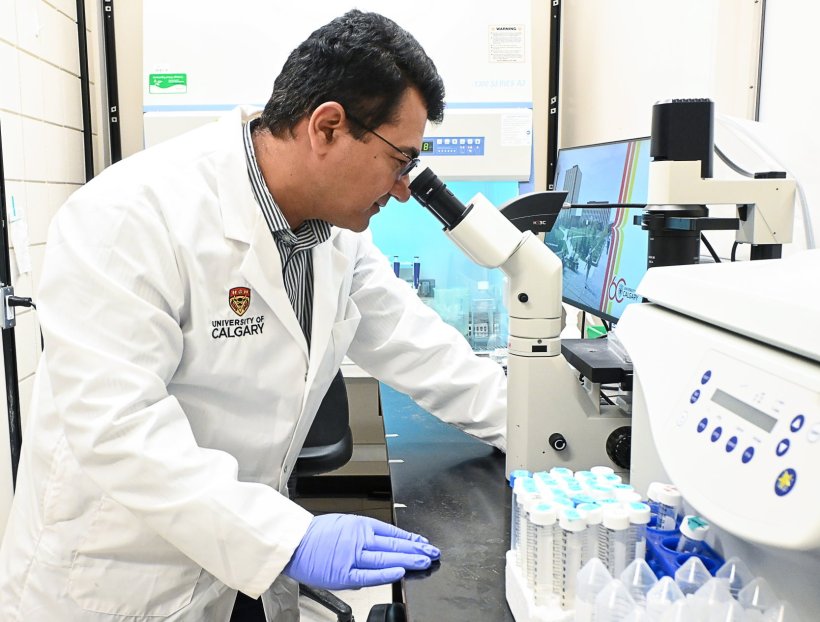
The research, published recently in Cell Reports Medicine, was led by Dr. Arshad Ayyaz, PhD, an assistant professor in the Department of Biological Sciences, and a member of the Arnie Charbonneau Cancer Institute. “We’ve been able to remove the invisibility cloak that colon cancers use to hide from treatment,” says Ayyaz, who has dedicated 20 years to researching the gut.
Even without the immunotherapy treatments, the tumours shrank, meaning they can’t hide from the body’s natural immune response anymore
Arshad Ayyaz
Immunotherapy trains a patient’s own immune system to recognize and attack tumours, reducing or removing the need for radiation and chemotherapy. It has yielded great results for several other types of cancer, but not colon cancer. “Only about 15% of colon cancers respond to immunotherapy. We performed a genetic analysis of them against those that don’t.”
What the research uncovered was a new type of cancer cell. “The treatment-resistant tumours secrete a protein that confuses your immune system into thinking everything’s fine. It’s like an invisibility cloak,” he says. “So, we thought, what happens if we prevent the tumours from making this protein?”
The experiment involved making gene-edited versions of those cancer cells. When the gene that coded the particular protein was knocked out, it made those cells visible to the immune system. The result was 100% eradication of tumours when paired with immunotherapy treatment in mouse models. “I couldn’t believe it at first,” Ayyaz notes. By just knocking out one gene, the results are black and white. “Even without the immunotherapy treatments, the tumours shrank, meaning they can’t hide from the body’s natural immune response anymore.”
He says it is very fundamental research that is still quite some distance away from clinical settings. However, the findings might be applicable to other types of cancer. “Immunotherapy is generally ineffective against solid tumours, like those in pancreatic or lung cancer. It’s possible that a similar cloaking mechanism plays a role there. I’m hoping this discovery will go a long way to help us understand these cases better,” says Ayyaz. “There’s a lot of ongoing cancer research and everyone takes a slightly different approach to it. For example, most efforts are focused on making the immune system more effective against cancers; while others, like us, are attempting to find out how cancers can hide themselves from a perfectly functional immune system. Of course, we’re all working towards the same outcome in the end.”
Source: University of Calgary; author: Giselle Lin
25.06.2026