


© HETT
Article • Experts call for joined-up NHS services
Reshaping women’s healthcare – from postcode lottery to personalised pathways
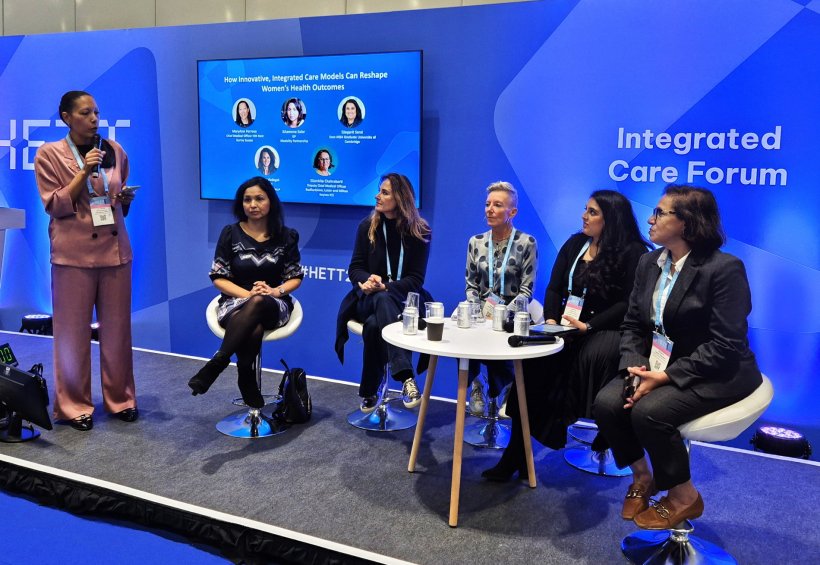
Fragmented care pathways, persistent data gaps and a ‘postcode lottery’ of services continue to undermine the quality of healthcare for women across the United Kingdom. At the HETT25 conference in London, a panel of experts from primary and secondary care, research, femtech and digital health innovation discussed how integrated care models and digital tools can reshape outcomes – and why the emerging women’s health hubs may offer a blueprint for the future.
By Mark Nicholls
Panel chair Dr MaryAnn Ferreux, Chief Medical Officer of Health Innovation Kent Surrey Sussex, said it was important to listen to women when designing new care pathways. The session – entitled ‘How Innovative, Integrated Care Models Can Reshape Women’s Health Outcomes’ – focused on integrated care pathways and the use of digital resources to enable access to screening and early intervention, particularly for underserved populations.
Women are passed from pillar to post, from primary to secondary care, in a very un-personalised pathway and feel they are not being heard by healthcare professionals, or dismissed
Aamena Salar
GP Dr Aamena Salar from the Modality Partnership in Birmingham painted a stark picture of what women currently experience. ‘They are passed from pillar to post, from primary to secondary care, in a very un-personalised pathway and feel they are not being heard by healthcare professionals, or dismissed,’ she said. ‘Watching women through the life course is very limited, we are very much under pressure to see, treat and discharge – that is not what women want.’
Jayprit Serai, an Executive MBA graduate from the University of Cambridge, noted that women often have to ‘repeat themselves over and over again to different physicians’ and that there is a stigma around some treatments. ‘The biggest need is for disaggregated data; we are not understanding that need and are in a big black hole when it comes to women’s health,’ she said.
IT systems that fail to disaggregate
Femtech consultant Katherine Church echoed these concerns, pointing out that IT health systems often do not enable disaggregation of data. Without such data, understanding the true scale and nature of women’s health needs remains impossible.
Amber Vodegel, founder of the Pregnancy+ app and now leading the new 28X Private Period™ app, highlighted the importance of ensuring women have free and safe access to trusted healthcare information. She stressed the need for platforms that help women learn how to ask doctors the right questions, rather than turning to social media for medical advice.
With Pregnancy+ used by 70% of first-time mothers in the UK and two million women a day globally on the platform, Vodegel said there was a need to pitch information at different reading levels to make it more accessible.
Recommended article

Article • Female patients
Focus on women's health
From gynaecology to obstetrics, from breast cancer treatments to menopause research: the distinct medical needs of female patients are manifold. But also in many other areas of research, diagnostics and therapy, the awareness of women requiring different approaches than male patients is dawning. Keep reading to find out more.
There was hope that the work of women’s health hubs across the UK would be continued into the new neighbourhood health services unveiled by the government in July as part of its 10 Year Health Plan aimed at bringing care closer to home. However, panellists wanted to see improved collaboration between primary and secondary care and voluntary organisations, and for health authorities to better share data, best practice and integrate systems, rather than each being ‘left to their own devices.’
Church said her experience of working with Integrated Care Systems (ICS) was that many were 'doing the same thing but in a slightly different way.' She cited an example of one authority offering menopause information in nine different languages – an initiative that could be shared, replicated and nuanced to meet local need. 'Every ICS has different population needs but core things should be standardised.' She also pointed out also examples of a 'postcode lottery' where regions offer different services.
What women are telling us loud and clear is that they want compassionate provision which is close to home that listens to them at the time that they need their support
Sanhita Chakrabarti
Fragmented provision is frustrating for clinicians as well as patients and often sees women turning up to emergency departments with pain and bleeding because they were not getting support elsewhere.
Asked whether there are better ways to address waiting times for women with gynaecological issues, Salar pointed to an initiative in her area where 15,000 women a year are seen by upskilled GPs and nurses, with 90% of women now treated in the community rather than referred to hospital. She also pointed to her team’s research on ovarian cancer pathways showing that women from ethnic minority backgrounds were not coming forward soon enough, often presenting with Stage 4 cancer.
‘Getting under the data’ to reach marginalised groups
Ferreux underlined the importance of disaggregated data to understand who is missing from the data, and putting action plans in place to address that. ‘We need to get under the data to see what is happening and make sure underserved and marginalised groups have the same care as everybody else,’ she added. That not only included obstetrics and gynaecology – which has the largest waiting list for procedures – but also mental health and cardiovascular health, which remains the biggest cause of death in women.
Huge opportunities in the 10 Year Health Plan
Asked what needs to be done over the next five to ten years, panellists felt the 10 Year Health Plan offered ‘huge opportunities’ but underlined the need to nuance models for local needs. A critical point was in women knowing what is available and where to get help.
A further element was integrating with the wider community to work with local authorities and the voluntary sector and ‘empower women to learn about their bodies and understand their presentations.’
Vodegel said there was a need to think differently about care models, having realised that a lot of basic education about pregnancy and women’s health was not standard knowledge, such as not drinking alcohol when pregnant.
Sanhita Chakrabarti, an obstetric gynaecologist, public health consultant and deputy chief medical officer at Bedfordshire, Luton and Milton Keynes ICB, told delegates: ‘What women are telling us loud and clear is that they want compassionate provision which is close to home that listens to them at the time that they need their support.’
Profiles:
Dr Aamena Salar is Medical Director of Modality Outpatient Services and a GP partner at Modality Partnership in Birmingham, United Kingdom. She specialises in women’s health with an extended role in gynaecology and has piloted community gynaecology services. She is a member of the national taskforce championing women’s health and is setting up the Modality Training Academy.
Jayprit Serai is a strategic Global Regulatory Affairs professional, United Kingdom. She recently completed an Executive MBA from Cambridge Judge Business School, where her individual project focused on closing the women’s health gap. She has extensive experience in the pharmaceutical industry.
Amber Vodegel is CEO of 28X Ltd, United Kingdom. She founded Pregnancy+, which became the world’s leading pregnancy app with over 150 million users globally. She is now spearheading 28X, a privacy-first women’s health platform that runs entirely on-device, removing the need for cloud servers or data harvesting.
MaryAnn Ferreux is Chief Medical Officer at Health Innovation Kent Surrey Sussex and a Non-Executive Director for Kent and Medway NHS Partnership Trust, United Kingdom. She is an award-winning medical leader with over 20 years’ experience in Australia and the UK, specialising in digital innovation, clinical transformation and population health.
Sanhita Chakrabarti is an obstetric gynaecologist, public health consultant and deputy chief medical officer at Bedfordshire, Luton and Milton Keynes ICB, Bedfordshire Hospitals NHS Foundation Trust, United Kingdom. She is the ICB’s women’s health champion and was recently appointed as national speciality adviser for women’s health for NHS England.
Katherine Church is a former NHS chief digital officer and an independent femtech consultant, United Kingdom. She works with women’s health founders to create technology that serves the needs of women.
15.06.2026