

Image source: FUJIFILM Wako
Sponsored • Laboratory Diagnostics
Early Detection of Invasive Fungal Infections: The β-D-Glucan Test on the LIMUSAVE MT-7500
Invasive fungal diseases are a growing global health challenge. Immunocompromised patients, those in intensive care, and individuals with chronic conditions – particularly lung disease – are at highest risk. These infections are notoriously difficult to diagnose, yet early detection is critical: delayed treatment significantly worsens patient outcomes. Traditional methods such as histological analysis and fungal cultures often lack the sensitivity required for timely diagnosis.
A Biomarker Hidden in the Cell Wall
(1→3)-β-D-glucan is a structural component of the cell wall of most pathogenic fungi. During active infection, small but detectable quantities are released into the bloodstream. This makes it a highly specific biomarker for invasive mycosis – and the basis of the FUJIFILM Wako β-Glucan Test.
The test uses Limulus Amebocyte Lysate (LAL), an extract derived from the blood cells of horseshoe crabs, which reacts selectively with (1→3)-β-D-glucan. To ensure specificity, the sample is pretreated at 70 °C for ten minutes with a solution containing a non-ionic detergent and polymyxin B. This step inactivates endotoxin and neutralises inhibitory proteins that might otherwise interfere with the result. The pretreated sample is then mixed with the LAL solution, where (1→3)-β-D-glucan activates Factor G and triggers a cascade reaction. The resulting turbidity change is measured as a transmittance shift, and the time taken to reach a defined threshold – the gelation time (Tg) – is used to calculate the exact glucan concentration from a standard curve. The assay is quantitative, with a measurement range of 6 to 600 pg/mL and a clinical cut-off value of 7 pg/mL.
Validated Clinical Performance
Multiple European research groups have published data on the FUJIFILM Wako β-Glucan Test, confirming strong diagnostic performance both as a standalone assay and in combination with other diagnostic tools. The test is suited for integration into clinical routine, supporting clinicians in making timely and evidence-based treatment decisions.
Designed for the Clinical Laboratory
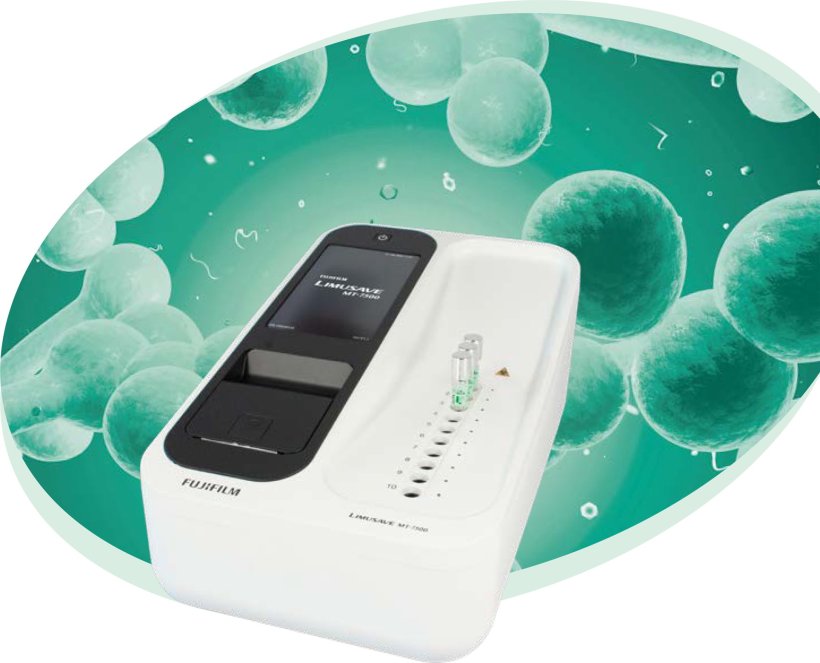
The LIMUSAVE MT-7500 is the dedicated analyser for the β-Glucan Test. Compact in size and straightforward to operate, it is built around a simple touchscreen interface and supports random-access testing. Up to ten samples can be processed simultaneously – expandable to 30 with optional extension modules. Calibration and patient identification are both handled via barcode scan, minimising manual input and potential transcription errors. Results can be printed directly or transferred to a Laboratory Information System (LIS).
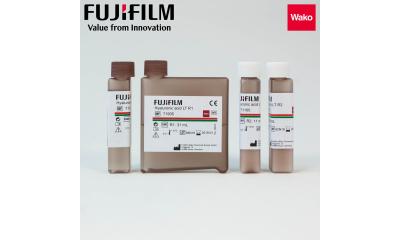
The reagents are ready to use and supplied as single-test assays, reducing preparation time and the risk of cross-contamination. Quality control materials are available, and within-run precision is excellent, with a maximum coefficient of variation (CV) of 6.6%. Maximum measurement time is 90 minutes.
Conclusion
The FUJIFILM Wako β-Glucan Test on the LIMUSAVE MT-7500 offers laboratories a reliable, sensitive, and workflow-friendly solution for the early diagnosis of invasive fungal infections – at a point in the clinical course where timely intervention can make a decisive difference.
04.06.2026
- clinicial chemistry (96)
- diagnostics (614)
- early diagnosis (250)
- infections (790)
- laboratory (1150)
- testing devices (169)