

Sponsored • Produced in partnership with FUJIFILM Wako
Beta-D-glucan testing: More than a single result
Invasive fungal infections remain among the most challenging diagnoses in clinical microbiology. Beta-D-glucan (BDG) testing has emerged as a valuable non-invasive biomarker – but its true utility lies not in any single result, rather in how it is integrated with other diagnostic tools and interpreted within the individual patient’s clinical context. Prof. Isabel Montesinos, Senior Clinical Microbiologist in the Microbiology Service at the Cliniques universitaires Saint-Luc in Brussels, Belgium, shares her experience and insights.
© Dr_Microbe – stock.adobe.com

Image courtesy of Prof. Montesinos
Prof. Montesinos works at the intersection of routine clinical microbiology and research, with a particular focus on the diagnosis of invasive fungal infections (IFIs). Within this field, BDG testing occupies a well-defined role. ‘I mainly use it as a complementary biomarker rather than as a stand-alone test,’ she explains. ‘Its value lies in combining the result with the patient’s clinical context and with other microbiological tools, such as fungal culture, species-specific biomarkers and molecular methods.’
Her clinical experience with BDG has centred on three conditions in particular: Pneumocystis jirovecii pneumonia (PJP), candidaemia and invasive aspergillosis – each of which presents a distinct diagnostic challenge and calls for a different approach to BDG interpretation.
Where BDG adds the most value
BDG is particularly useful in immunocompromised and clinically fragile patients – those with haematological malignancies, transplant recipients, and patients receiving immunosuppressive therapies – where obtaining invasive respiratory samples such as bronchoalveolar lavage (BAL) may be difficult, contraindicated, or simply not feasible. In these settings, the non-invasive nature of serum BDG testing is a significant practical advantage.
A further strength is its broad, panfungal spectrum. ‘BDG can support the suspicion of an invasive fungal infection without prior knowledge of the causative organism,’ Prof. Montesinos notes, ‘making it a useful complementary tool alongside more specific biomarkers.’ However, sensitivity and negative predictive value vary across clinical settings and fungal infections, and a negative BDG result cannot always completely exclude an IFI, she points out. Interpretation must always take account of the broader clinical and microbiological picture.
Interpreting borderline and repeatedly positive results
When faced with a borderline BDG result, Prof. Montesinos applies a consistent principle: no result is interpreted in isolation. ‘A borderline result, particularly when it is isolated, should be interpreted cautiously because several non-fungal factors can influence BDG concentrations,’ she explains. Repeating the test when clinical suspicion remains high is often informative: a repeatedly positive result carries considerably more weight than a single borderline value, especially when supported by microbiological or radiological findings.
Pre-test probability is central to this process. The same BDG concentration may have a very different clinical significance in a high-risk haematology patient with compatible CT findings than in a patient with a low prior probability of IFI.
BDG in pulmonary diagnostics: PJP and invasive aspergillosis
In pulmonary diagnostics, BDG is most informative as one component of a multimodal approach. Its role is perhaps clearest in PJP: serum BDG levels are generally elevated in affected patients, and a negative result makes the diagnosis unlikely in most clinical situations.
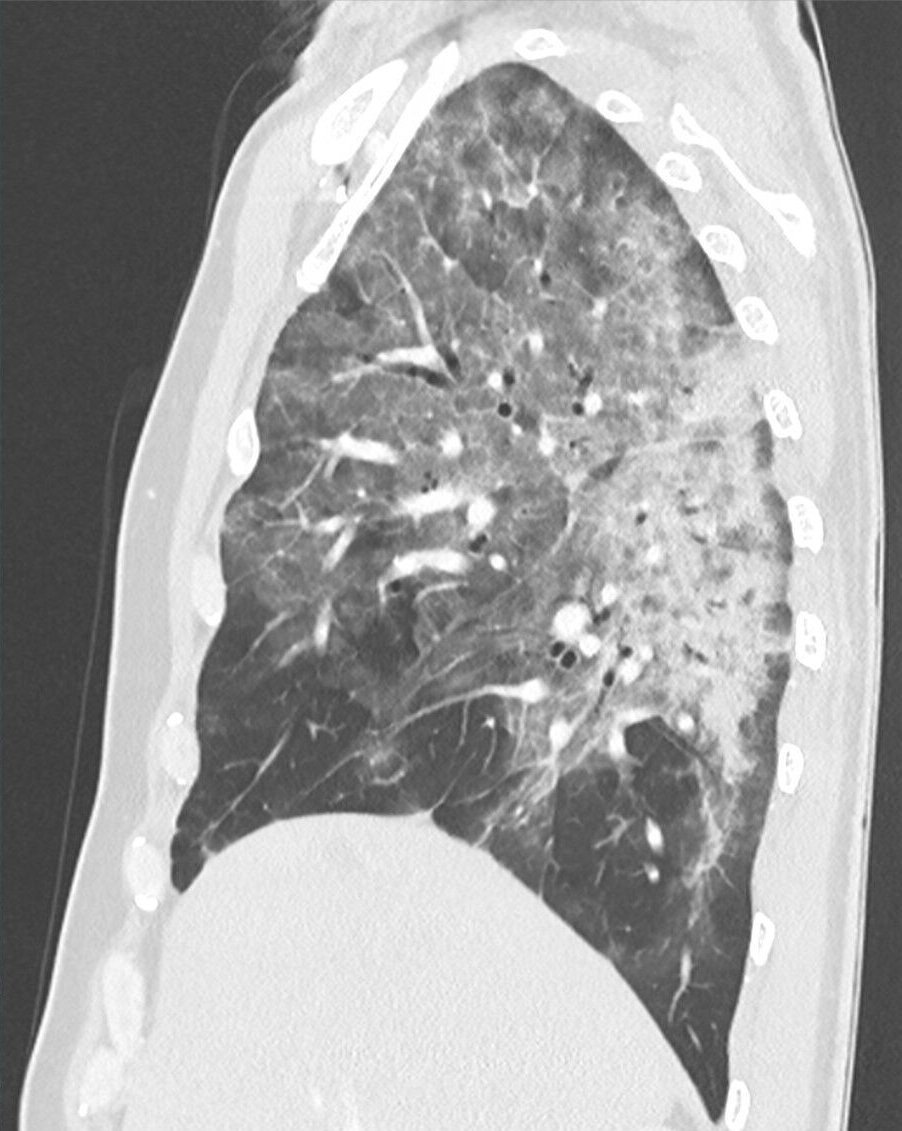
Image source: Hellerhoff, Pneumocystis jiroveci Pneumonie 53M - CR und CT - 001 (cropped) (CC BY-SA 4.0)
When the combination of a positive P. jirovecii PCR, elevated serum BDG and compatible CT findings is present, this provides strong support for active PJP rather than simple colonisation. Conversely, when clinical suspicion remains high despite a negative BDG, molecular testing on respiratory samples – ideally BAL – remains necessary.
The picture is different for invasive pulmonary aspergillosis, where galactomannan and Aspergillus PCR are more specific and better-established biomarkers. BDG has lower sensitivity in this setting and plays a mainly complementary role.
Crucially, a negative BDG result cannot exclude invasive aspergillosis, particularly in high-risk haematological patients or those receiving antifungal prophylaxis. ‘For this reason,’ Prof. Montesinos emphasises, ‘I always interpret biomarker results together with CT findings, the patient’s underlying risk factors, and the overall clinical picture.’
BDG and Candida: An evolving role
In the context of invasive candidiasis, BDG has not yet been systematically incorporated into a specific diagnostic algorithm at the Cliniques universitaires Saint-Luc. Blood cultures remain the cornerstone of diagnosis, despite their limited sensitivity and the time required for positivity. BDG can provide complementary evidence of IFI when cultures remain negative in a clinically compatible setting.
In appropriately selected patients, a negative BDG result may help reduce the probability of invasive candidiasis and support decisions regarding empirical antifungal therapy
Isabel Montesinos
Patients at risk of invasive candidiasis represent a somewhat different population from those at high risk for invasive mould infections. Critically ill and surgical patients – particularly those with risk factors such as abdominal surgery, central venous catheters, prolonged broad-spectrum antibiotic exposure or parenteral nutrition – are also affected, and interpretation of a positive BDG result in these groups can be more challenging. Several clinical interventions, including major abdominal surgery, may be associated with transient or false-positive BDG results.
Prof. Montesinos sees clear potential for a more structured approach: ‘In appropriately selected patients, a negative BDG result may help reduce the probability of invasive candidiasis and support decisions regarding empirical antifungal therapy.’ Such an approach, she suggests, could also contribute meaningfully to antifungal stewardship.
Tailoring the diagnostic pathway to the patient
Rather than advocating a universal BDG algorithm, Prof. Montesinos favours disease- and population-specific diagnostic pathways. For suspected PJP, BDG alongside respiratory PCR plays a central role: a negative result should prompt consideration of alternative diagnoses, while a positive PCR combined with clearly elevated BDG and compatible imaging strongly supports active disease. In haematology patients with suspected invasive aspergillosis, galactomannan, Aspergillus PCR, conventional microbiology and chest CT take precedence, with BDG in a supporting role. In ICU and surgical patients at risk of invasive candidiasis, blood cultures remain essential, with BDG offering complementary – if carefully interpreted – information.
A case in point: diagnosing fungal co-infection
A recent case from Prof. Montesinos’ practice illustrates the value of combining BDG with other diagnostic tools. An oncology patient receiving prolonged corticosteroid and anti-TNF therapy developed acute hypoxaemic respiratory failure with bilateral pulmonary infiltrates. The initial BAL yielded a complex set of findings: Pseudomonas aeruginosa, a positive quantitative P. jirovecii PCR, and positive Aspergillus biomarkers. Serum BDG was strongly positive.
This is exactly where I see the added value of BDG: helping us interpret pathogen-specific results within the patient’s clinical and radiological context
Isabel Montesinos
The combination of markedly elevated BDG, compatible CT findings and a positive quantitative P. jirovecii PCR strongly supported active PJP rather than simple colonisation, despite negative immunohistochemistry. A second BAL confirmed an even higher fungal burden. At the same time, a strongly positive galactomannan and positive Aspergillus PCR raised a strong suspicion of concomitant invasive pulmonary aspergillosis. The patient was ultimately treated for both conditions.
‘What I find particularly illustrative in this case is that no single result provided the complete answer,’ Prof. Montesinos reflects. ‘The combination of BDG with pathogen-specific biomarkers and molecular testing helped identify a complex situation in which more than one fungal infection was likely contributing to the clinical picture. This is exactly where I see the added value of BDG: helping us interpret pathogen-specific results within the patient’s clinical and radiological context.’
The future of BDG in an era of advanced diagnostics
Looking ahead, Prof. Montesinos anticipates that fungal diagnostics will increasingly rely on integrated approaches. Highly sensitive molecular methods, multiplex PCR assays and sequencing-based technologies now provide detailed pathogen-specific information – but BDG addresses a different and complementary question: is there evidence of an invasive fungal process at all?
‘I see BDG remaining useful as part of multimodal diagnostic algorithms, particularly when combined with pathogen-specific biomarkers and molecular techniques,’ she says. Its potential role in antifungal stewardship – where a negative result may support the decision to withhold or discontinue empirical antifungal therapy – is also significant.
The central challenge will be to better define BDG’s performance characteristics across different fungal diseases and patient populations. Sensitivity and negative predictive value differ between PJP, invasive aspergillosis and invasive candidiasis, and between haematology, ICU and surgical patients. A clearer understanding of these disease- and population-specific parameters will be essential to determining how BDG can be optimally integrated with other diagnostic tools in each clinical context. (WB)
Profile:
Prof. Isabel Montesinos is a Senior Clinical Microbiologist in the Microbiology Service at the Cliniques universitaires Saint-Luc in Brussels, Belgium, a leading academic medical centre affiliated with the Université catholique de Louvain (UCLouvain). Her clinical and research work focuses on the diagnosis of infectious diseases, with a particular expertise in invasive fungal infections. She has extensive experience in the evaluation and clinical application of diagnostic biomarkers – including beta-D-glucan, galactomannan and molecular methods – across a range of high-risk patient populations, including haematology patients, transplant recipients and critically ill patients. Prof. Montesinos is actively involved in the development of disease-specific diagnostic pathways and contributes to antifungal stewardship initiatives at her institution.
16.11.2026
- diagnostics (622)
- equipment (494)
- laboratory (1151)
- microbiology (307)
- testing devices (169)
- workflow (509)