

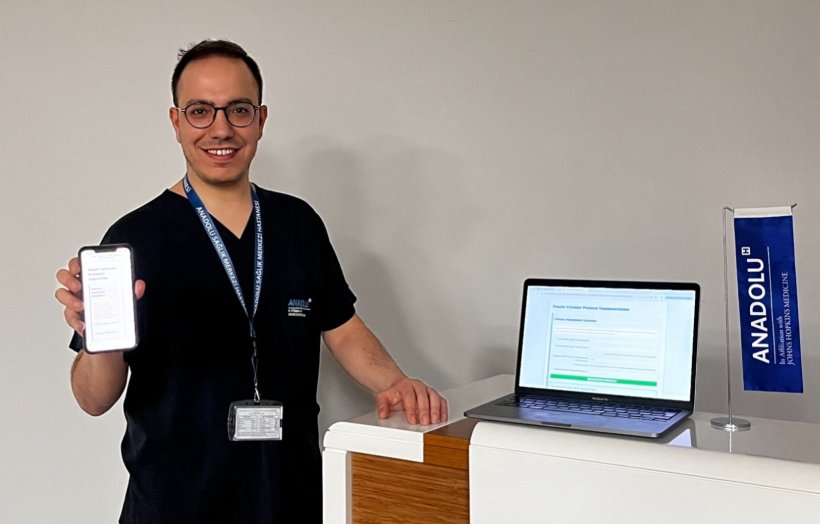
Image courtesy of Gurkan Camok
Article • Digital Health
Insulin infusions: calculating the safety check
Manually calculating intravenous insulin infusion rates is a time-consuming, error-prone process. A Turkish hospital addresses these issues with bedside software built in-house by a clinician who saw the problem firsthand on the ward. The tool already showed promising results during its first clinical implementation – though human oversight still has to stay firmly in the loop.
Article: Wolfgang Behrends
At Anadolu Medical Center, in strategic cooperation with Johns Hopkins Medicine, a browser-based tool now translates the hospital's paper protocol into an executable, step-by-step decision aid. In a prospective validation study, it matched an independent clinical reference standard in all 120 tested cases; manual calculations by nursing staff matched in 35.
Where paper protocols can go wrong
Before development began, the project's lead, Clinical Decision Support Systems Developer and Clinical Research Lead Gurkan Camok, MSc, identified six recurring failure points in the manual workflow: choosing the wrong glucose band, misjudging the direction or size of a glucose change, failing to normalise a two-hour reading to an hourly trend, picking the wrong cell in the protocol's decision table, applying the wrong adjustment step, and simple arithmetic or transcription slips. Because these steps build on each other, a single early error could carry through to the final infusion rate. The process, Camok notes, ‘also imposed a substantial cognitive and time burden while the healthcare professional was managing ongoing patient care’.
An error at any one of these steps translates directly into a wrong insulin rate reaching the patient – too much, risking a dangerous drop in blood glucose, or too little, prolonging hyperglycaemia.
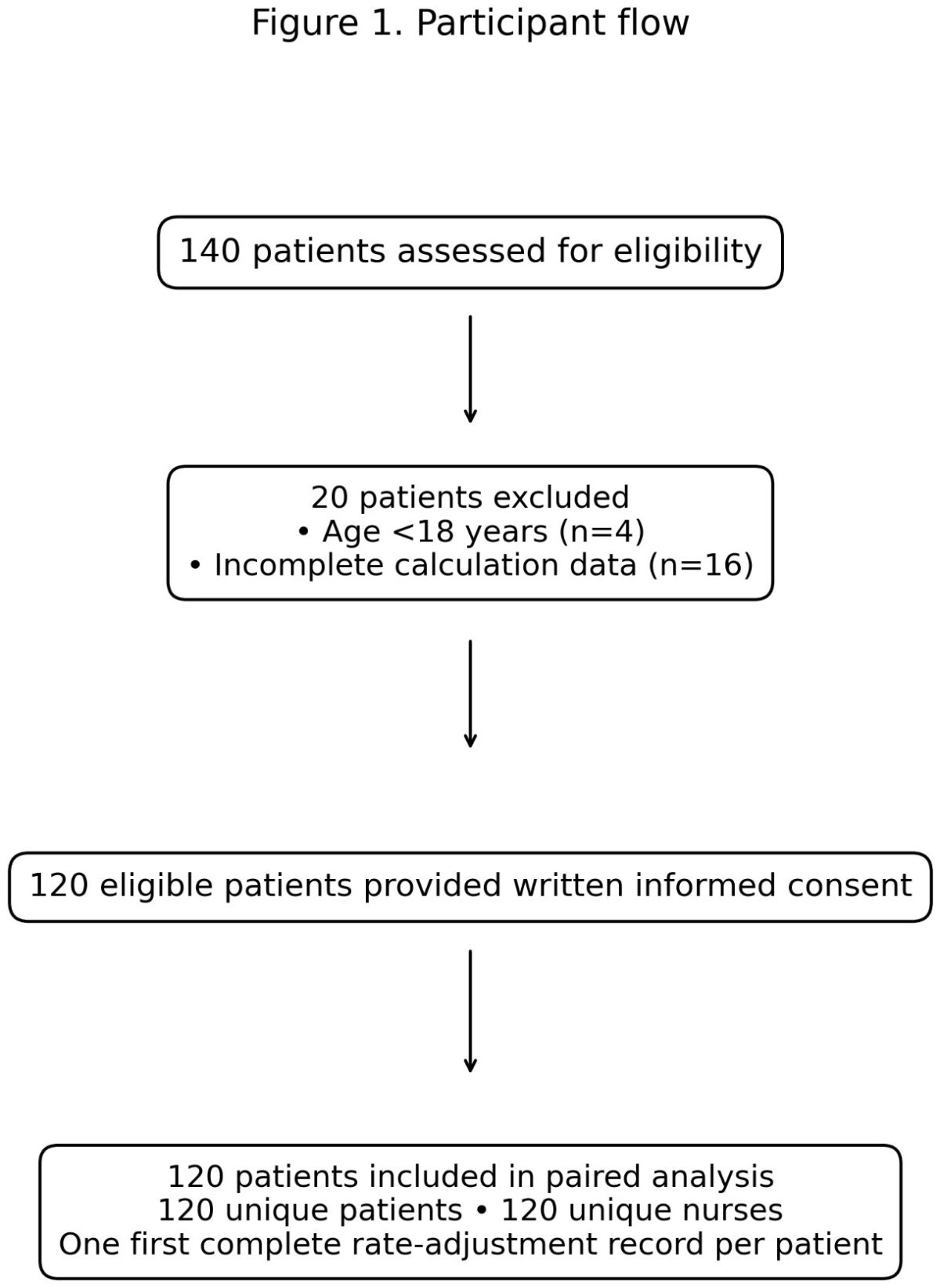
Figure prepared by Gurkan Camok
To avoid this risk, the application takes four inputs – current glucose, previous glucose, the elapsed measurement interval, and the current infusion rate – and runs them through the hospital's own protocol logic. It calculates the hourly glucose trend, identifies the applicable clinical state, and maps the current rate to the permitted adjustment. The output is a recommended rate together with the corresponding action: maintain, increase, reduce, pause or stop the infusion, restart at a lower rate, repeat the measurement, or escalate to a physician.
Crucially, the tool does not connect to infusion pumps or administer insulin itself. It displays a recommendation; verifying the clinical context and source data remains the job of the treating nurse or physician. As Camok puts it, ‘the software does not remove that second-person safety process’ already required for high-alert medications such as insulin.
Study design
Between August and October 2025, 140 patients receiving intravenous insulin at the hospital were screened; 120 met the inclusion criteria. Each record reflects the first eligible case handled by one of 120 different nurses across intensive care, internal medicine, oncology, haematology and surgical wards. The nurse's manually calculated rate was used in actual patient care as usual. The following day, the same input values were entered into the offline application, so the software's output could not influence treatment. Two endocrinologists, blinded to each other's work and to both the manual and digital results, independently calculated a reference rate for every case – their results matched in all 120.
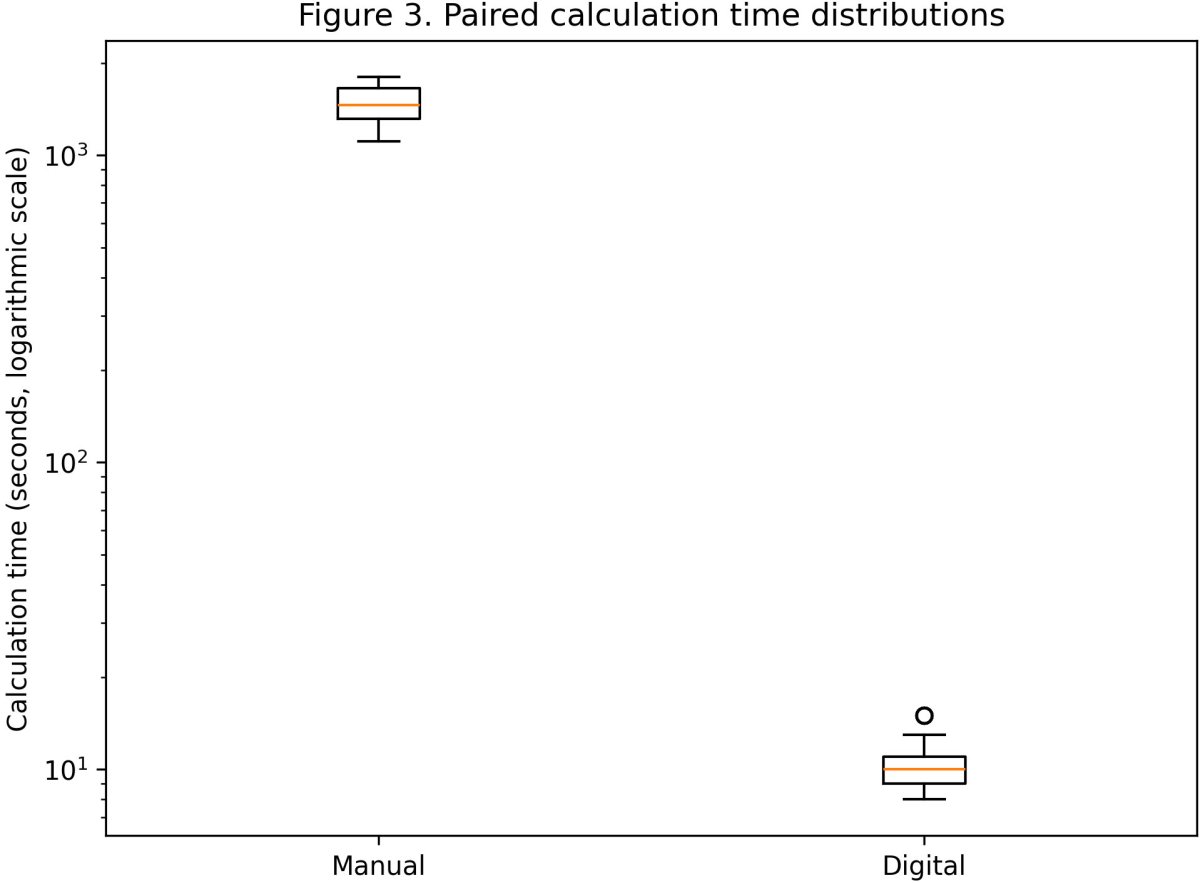
Figure prepared by Gurkan Camok
The study was approved by the hospital's ethics committee (ASM-EK-25/305), and written informed consent was obtained from every included patient.
Against this reference, the digital tool matched in 120 of 120 cases (95% confidence interval: 97.0–100.0%). Manual calculations matched in 35 of 120; where they diverged, 72 were higher than the reference and 13 lower, with a median difference of +1.0 unit per hour. Median calculation time dropped from 24 minutes and 15 seconds by hand to 10 seconds with the tool.
Discrepancy ≠ danger
While this may look like a stark difference at first glance, the clinical reality is a bit more nuanced: Camok is explicit that a numerical deviation is not the same as patient harm:
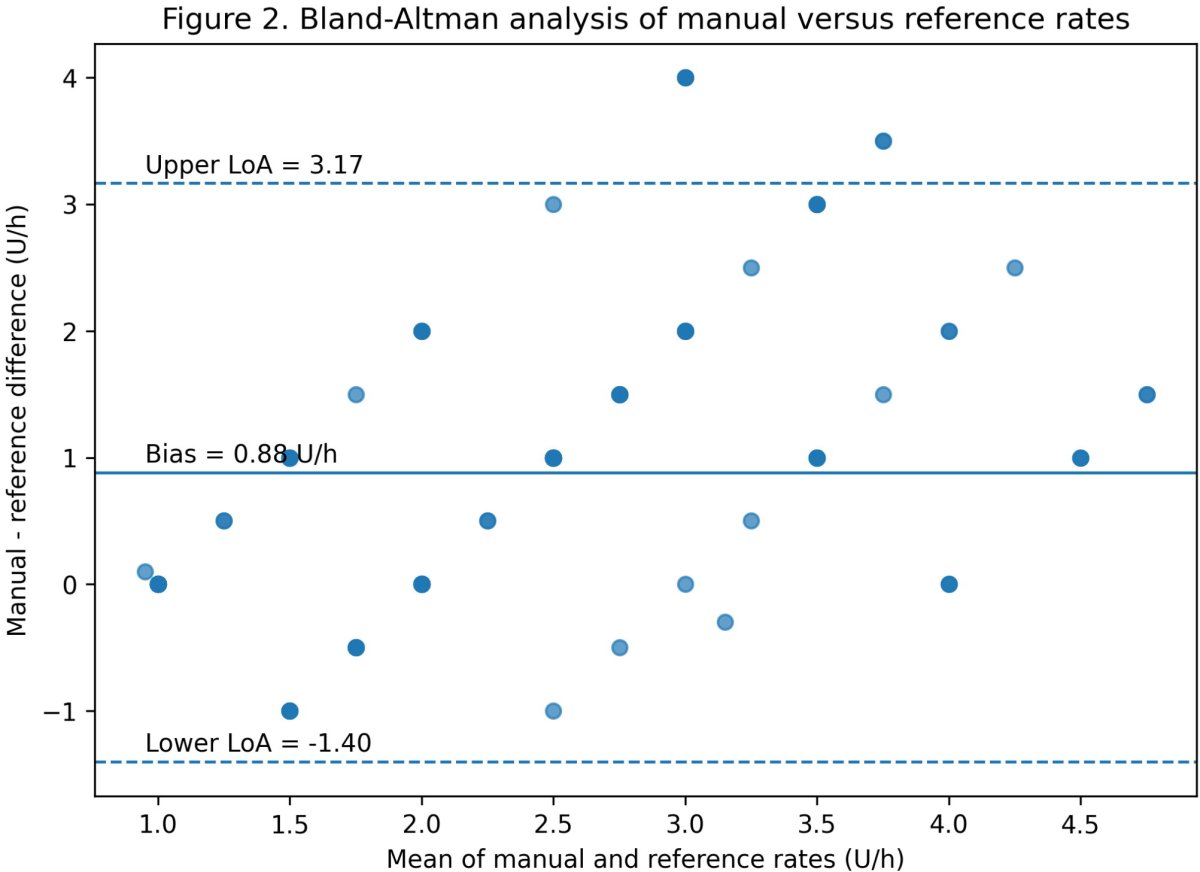
Figure prepared by Gurkan Camok
‘The 85 differences represent process-level discrepancies rather than 85 adverse events. No patient harm was demonstrated or attributed to these discrepancies in this study.’ At the next glucose check after the manually applied rate, no patient measured below 70 mg/dL and none exceeded 180 mg/dL – reassuring, but not proof that the digital rate would have produced a better outcome, since only the manual rate was actually given. ‘The findings identify a medication-safety and workflow-standardisation issue that warrants prospective clinical-outcome evaluation,’ the expert clarifies.
Clinical approval for routine use was granted by the hospital's Medication Management and Use Committee and its Medical Directorate. Since routine rollout in January 2026 across intensive care, emergency and inpatient units, roughly 400 nurses and the involved physicians used the tool, around half of whom provided feedback in a post-deployment survey. According to Camok, ‘users particularly valued the rapid decision pathway, clear presentation of the recommended action and reduced cognitive burden when following the protocol’.
The main implementation risks, he says, include overreliance on the displayed recommendation, incorrect source data, and use outside the intended population or in unusual clinical situations. The limits are structural, not incidental: ‘Software cannot know whether a glucose measurement is technically valid, recognise every deterioration or out-of-scope condition, or prevent a user from entering an incorrect source value.’ That is why human oversight has to remain in place at every step, and why the hospital keeps a backup protocol ready for cases of system downtime, alongside training, usage logging, version control and the unchanged double-check procedure for high-alert medications.
For now, the application remains an internal, non-commercial hospital tool: it has not undergone CE marking or an MDR conformity assessment. Camok points out that any use beyond Anadolu Medical Center would first require formally classifying the software's intended purpose under the applicable medical-device framework – a step he lists among the next priorities, alongside external multicentre validation, formal usability testing and prospective monitoring of clinical outcomes.
Strengths and limitations
The study has real strengths: a prospective, paired design; a reference standard set independently by two blinded endocrinologists who agreed on every case; and a manuscript now submitted for journal review, though not yet published or peer-reviewed. It also has clear limits. It was conducted at a single centre, comparing one hospital's protocol against itself, and Camok both built the software and led the study evaluating it – a dual role he acknowledges in supporting documentation as a ‘non-financial intellectual interest.’

Image courtesy of Gurkan Camok
Despite this, the core finding stands: a two-page paper protocol, however clear to an experienced clinician, leaves considerable room for error once it has to be applied under time pressure at the bedside. During its initial run, the digital tool managed to close this gap efficiently. Since routine rollout, staff acceptance has been high, and Camok sees potential in applying the same approach to other high-risk, protocol-driven calculations, such as heparin titration, electrolyte replacement or selected anticoagulation pathways.
Profile:
Gurkan Camok, MSc, is a Clinical Decision Support Systems Developer and Clinical Research Lead at Anadolu Medical Center in Türkiye. He leads the end-to-end development and evaluation of workflow-integrated digital health products, from requirements and deterministic software logic through validation, implementation, safety governance and lifecycle monitoring.
09.09.2026