

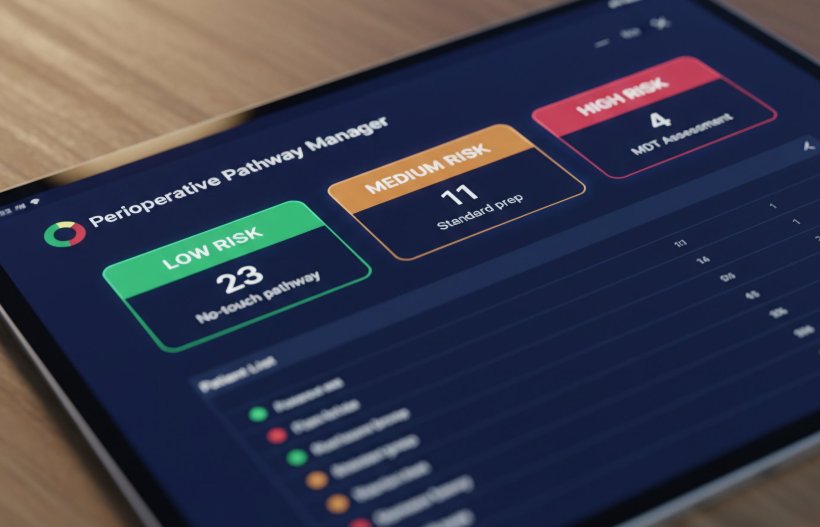
Image generated with use of AI (Gemini 2.5 Flash Image)
Article • Perioperative pathways
Smart waiting lists: From one-size-fits-all to personalised pre-op care
Digital solutions that integrate surgical waiting lists with GP records are helping hospitals improve perioperative pathways and reduce unnecessary appointments. Dr Simon Rang, Consultant Anaesthetist at East Kent Hospitals University NHS Foundation Trust, explains how risk stratification is transforming patient care.
By Mark Nicholls
A UK hospital has demonstrated how digital tools that integrate surgical waiting list data with GP records can improve the patient perioperative pathway. The waiting list tool stratifies patients by risk – enabling clinicians to identify low-risk patients who can be booked for surgery with minimal pre-operative preparation whilst directing high-risk patients to a multi-disciplinary pre-op pathway. The tool also means that waiting lists – primarily for orthopaedic procedures – are organised in a way that reduces the likelihood of late cancellations of surgery.
By using the technology to mine patient data, East Kent Hospitals in the south-east of England has transformed a static waiting list into an active clinical tool. The move has led to reduced consultation times, shorter appointments, improved patient flow, and more efficient use of clinical time.
Matching resources to patient needs

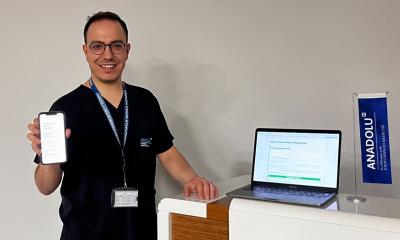
Photo courtesy of Dr. Rang
Dr Simon Rang, Consultant Anaesthetist and Lead for Perioperative Medicine at East Kent Hospitals University NHS Foundation Trust (EKHUFT), says hospitals in the UK are under pressure to reduce waiting lists at a time of growing demand in the NHS.
'What we can do as clinicians,' he says, 'is use our resources efficiently to get to a point where our entire perioperative pathway is running as efficiently as possible. But to do that we realised that patients do not all need a generic pre-operative workup; a healthy 25-year-old needing a knee operation is probably going to require less input than an 80-year-old with medical conditions.'
Risk-based triage using shared health records
The platform, developed by software company Graphnet Health, is combined with population health analytics software to triage patients for their medical complexity and perioperative risk. It is underpinned by a shared healthcare record containing patient data such as medication and medical history from local healthcare organisations such as GPs and neighbourhood hospitals.
The software identifies low-risk patients suitable to follow a 'low touch' pre-op workup with a brief nursing assessment by telephone – with the aim to progress to 'no-touch' pathways for some patients without any need for pre-op consultations, potentially in areas such as carpal tunnel releases and cataract surgery.
Rang says: 'The analytic software allows us to work out which patients are medically complex, or medically simple, and assign them into a RAG (Red, Amber, Green) rating of high, medium and low perioperative risk. The idea is to make the pre-operative workup more personalised, concentrating efforts on patients that will benefit most.'
Significant time savings demonstrated
The initial project demonstrated that low-risk patients could be identified in advance and prepared for surgery in a separate pathway involving low-risk nursing clinics with shorter appointment durations. This resulted in a 27% reduction in consultation times – from 30 to 22 minutes.
In pre-operative assessment we traditionally have offered the same pre-op workup to everyone; it's now very clear that one size doesn't fit all
Simon Rang
Rang continues: 'For the Trust, that means we can target patients that need our services most and focus on patients that need greater pre-op support. But if many patients do not have to come to a pre-op appointment and fill in unnecessary questionnaires, the experience is much better for them too.'
The improvements in workflow, patient throughput, cost and time efficiencies are significant in enabling surgical waiting list co-ordinators to book patients into theatre slots with the confidence that they are actually ready for surgery. Clearer visibility of a patient's status via the triage tool helps avoid uncertainty for the different teams involved in perioperative care and minimises late changes to operating lists and cancellations.
Scaling up towards 'no-touch' pathways
The next step is to scale up the programme to include more patients on the roll-out of the lowest touch pathway with no pre-op work and to improve digital communication with patients.
'The idea is to organise patients waiting for surgery to reduce last minute assessment and optimisation just before surgery, to make the whole pathway smoother and a better experience for patients, and with better outcomes for them,' says Rang. 'The dashboard gives us that early insight – we can see who is low-risk and who needs extra support – and individualise their care. In pre-operative assessment we traditionally have offered the same pre-op workup to everyone; it's now very clear that one size doesn't fit all.'
The East Kent approach forms part of the wider Combined Intelligence for Population Health Action (CIPHA) programme, which is enabling 11 Integrated Care Systems across the NHS to use joined-up data to improve efficiency, reduce inequalities, and deliver better outcomes for patients.
Profile:
Dr Simon Rang is Consultant Anaesthetist and Lead for Perioperative Medicine at East Kent Hospitals University NHS Foundation Trust (EKHUFT), where he provides anaesthetic care and perioperative focus for patients undergoing various surgical procedures. His research interests focus on perioperative medicine, optimising patient care before, during, and after surgery to achieve better outcomes.
17.03.2026