

Image credit: Inc-UAB
News • Research on dopaminergic neurons
Immunotherapy to prevent neuron loss in Parkinson’s disease
By analyzing tissue from patients with Parkinson’s disease, and animal and cellular models of the disease, a research team from the Institut de Neurociències of the UAB has shown that the main immune cells of the brain become reactive and overexpress certain receptors that promote the elimination of dopaminergic neurons, even when these neurons are still functional.
The study, published in npj Parkinson’s Disease, points to a new immunotherapy approach that could help preserve viable neurons in people with this diagnosis.
Parkinson’s disease is characterized by the progressive loss of dopaminergic neurons in a specific brain region known as the substantia nigra. This neuronal degeneration is closely linked to inflammatory processes mediated by microglia, the immune cells of the central nervous system. However, the precise mechanisms that trigger this destructive process are still not fully understood.
Blocking Fc gamma receptors with immunotherapy, as well as pharmacologically inhibiting Cdc42, significantly reduced the elimination of dopaminergic neurons, preserving them even under conditions of intense neuroinflammation
Carlos Barcia
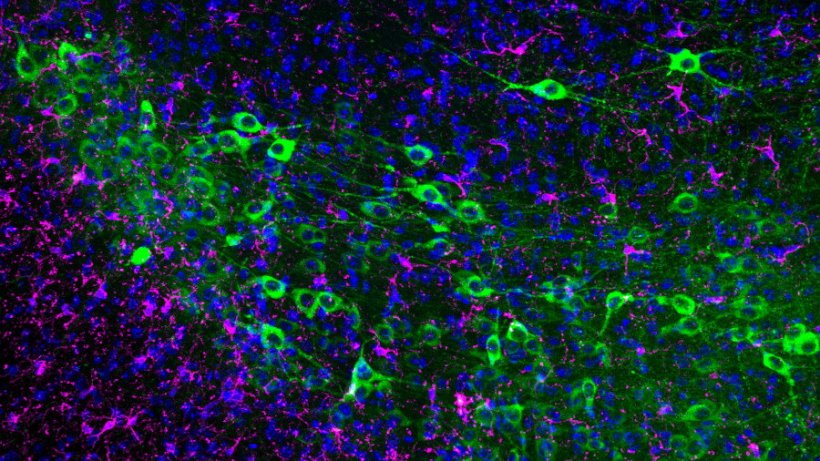
Now, in the new article, researchers from the Institut de Neurociències of the Universitat Autònoma de Barcelona (INc-UAB) and the UAB Department of Biochemistry and Molecular Biology report that brain tissue from Parkinson’s disease patients contains a higher proportion of reactive microglia, meaning cells that are primed to respond. But most importantly, these reactive microglial cells also show an increased density of receptors known as Fc gamma on their membranes.
Under normal conditions, Fc gamma receptors help identify damaged cells or harmful components that need to be removed from the brain, triggering the normal microglia’s cleaning response. However, the INc-UAB team suggests that in Parkinson’s disease, these overexpressed receptors mistakenly identify still-functional neurons as damaged, setting off an inappropriate elimination process.
According to the study, when Fc gamma receptors are activated upon detecting dopaminergic neurons, even those that are still functioning, they cause the microglial cell to change shape through the activation of a cytoskeletal protein called Cdc42. This allows the microglia to surround the target neuron and literally “eat” it, in a process known as phagocytosis.
“What is particularly interesting is that in animal and cellular models of the disease, blocking Fc gamma receptors with immunotherapy, as well as pharmacologically inhibiting Cdc42, significantly reduced the elimination of dopaminergic neurons, preserving them even under conditions of intense neuroinflammation,” explains Carlos Barcia, coordinator of the study.
These findings suggest that regulating microglial phagocytosis through immunotherapy targeting Fc gamma receptors, or their downstream signaling protein Cdc42, could slow disease progression and help protect the function of remaining dopaminergic neurons.
Source: Universitat Autònoma de Barcelona
05.02.2026