

Image source: ESOR
Article • Education, collaboration, innovation
ESOR at 20: building a common language for European radiology
Past and present leaders of the European School of Radiology (ESOR) reflected on the evolution of radiology education in Europe and the challenges facing the specialty at ECR 2026 to mark the 20th anniversary of the school.
By Mélisande Rouger
Established in 2006, ESOR was created at a time when radiology education across Europe remained highly heterogeneous, with major differences in access to subspecialty training, research opportunities, and international mobility. Twenty years later, the school has grown into a broad educational network offering fellowships, scholarships, modular courses, and exchange programmes involving radiologists from Europe and beyond.
Harmonising education across and beyond Europe
ESOR was the fulfilment of a common European dream towards radiological education
Nicholas Gourtsoyiannis
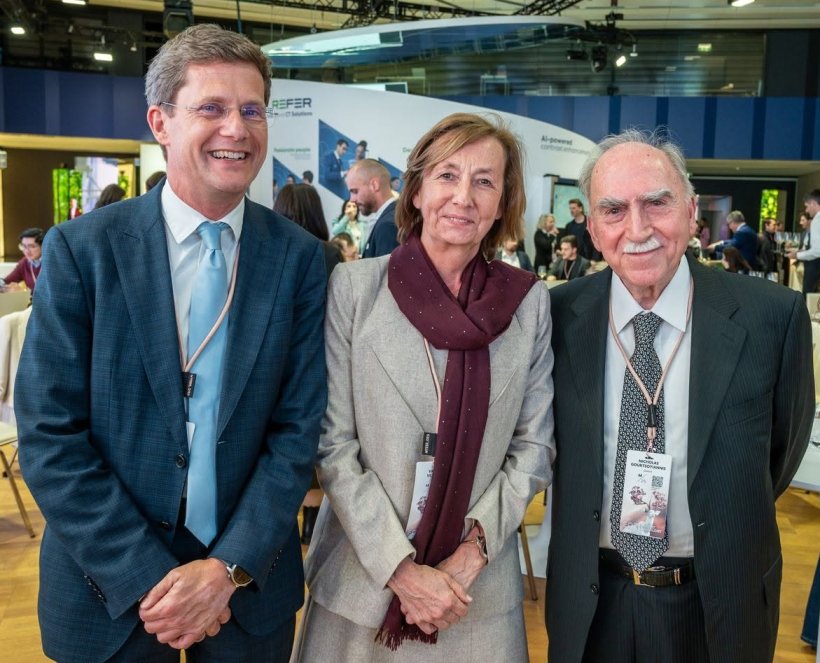
For Professor Nicholas Gourtsoyiannis, founder and former Scientific and Educational Director of ESOR, the school was initially conceived as a response to the need for a more harmonised educational structure within European radiology. ‘ESOR was the fulfilment of a common European dream towards radiological education,’ he recalled during the anniversary discussion in the ECR studio.
At the beginning of the 2000s, radiology subspecialisation was still developing unevenly across Europe, and opportunities for young radiologists to gain international experience remained limited. According to Gourtsoyiannis, one of ESOR’s early goals was therefore not only to improve educational standards, but also to create a stronger sense of professional connection between radiologists across borders.
Over time, ESOR progressively developed a model based on specialised courses, workshops, mentorship programmes, and fellowships hosted in centres of excellence. Beyond education itself, several speakers described the emergence of what many now consider an international radiology community built around the school. ‘The perception of belonging to a new informed community,’ Gourtsoyiannis explained, became one of the major benefits for young radiologists involved in the programmes.
This international dimension was also highlighted by Professor Valérie Vilgrain, former Scientific and Educational Director of ESOR, who described the diversity of backgrounds and medical cultures within the school as one of its greatest strengths. ‘We work with radiologists not only from Europe, but all over the world,’ she said during the ECR studio interview. ‘This is very different from one country to another, and it is so rich to work with people with a different environment.’
Going digital after Covid
Now ESOR is probably stronger because we have faced that
Valérie Vilgrain
Vilgrain also reflected on the impact of the Covid-19 pandemic, which forced ESOR – like many medical education organisations – to rapidly transform its teaching model. Before 2020, most educational activities were organised entirely onsite, with strong emphasis on direct interaction between faculty and trainees.
The pandemic accelerated the development of online learning and hybrid formats, changes that have since become a permanent part of the school’s activities. ‘Now ESOR is probably stronger because we have faced that,’ she noted, explaining how the crisis pushed the organisation to reassess priorities and educational structures.
Among the initiatives developed during that period were the online foundation courses covering major radiology subspecialties. According to Vilgrain, these programmes significantly broadened access to high-level radiology education. ‘These foundation courses allow a large number of young radiologists to get access to some of the best education available,’ she said.
Professor Christian Löwe, current Scientific and Educational Director of ESOR, described the combination of online education and onsite interaction as one of the key evolutions of the school over recent years. ‘Many things can be done better face to face,’ he said, while acknowledging the role digital learning now plays in improving accessibility and international participation.
Growing collaborations
We really believe that we can achieve harmonised excellence in education only through partnership
Christian Löwe
Partnerships also emerged as a central theme throughout the interviews. ESOR today collaborates with national radiological societies, academic institutions, subspecialty organisations, and industry partners to support fellowships, scholarships, and educational initiatives.
For Löwe, maintaining educational standards increasingly depends on this collaborative approach. ‘We really believe that we can achieve harmonised excellence in education only through partnership,’ he explained during a separate interview focused on cooperation between academia and industry.
The discussions further reflected the broader technological transformation affecting radiology itself. Artificial intelligence, advanced imaging technologies, and data-driven medicine are reshaping clinical practice while creating new educational demands for radiologists.
Fulvio Renoldi Bracco, CEO of Bracco Imaging, highlighted the importance of collaboration between industry and the medical community as innovation accelerates. ‘Without a strong partnership with the physician community, that would not be possible,’ he said.
Looking ahead, ESOR’s leadership outlined several priorities for the coming years, including expanding fellowship opportunities, strengthening cooperation with radiologically under-resourced countries, and developing new educational formats adapted to radiologists at different stages of their careers.
Twenty years after its creation, ESOR reflects the broader evolution of radiology itself – a specialty increasingly defined by continuous education, international collaboration, and technological adaptation.
26.06.2026