

News • Combination of complementary approaches
New dual antiviral strategy against Covid-19 pathogen
Study conducted by the University of Malaga paves the way for the development of more effective therapies against emerging viruses and new resistant variants
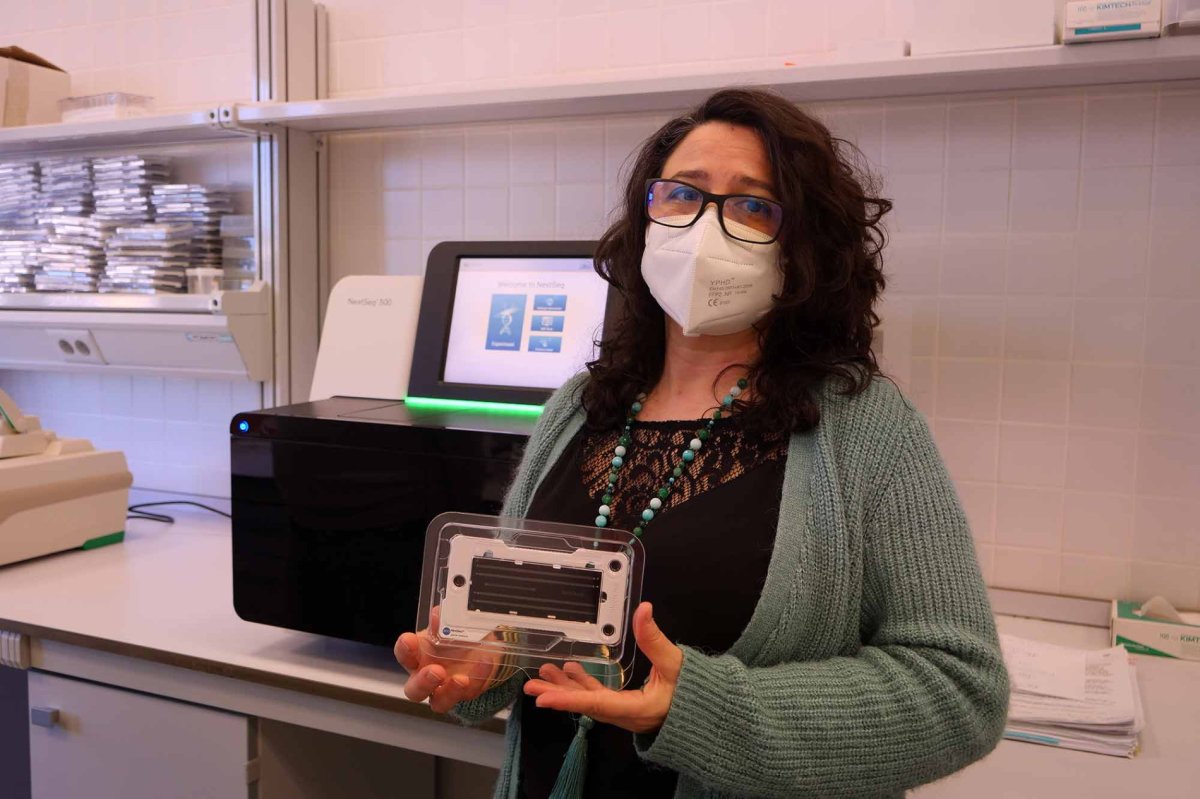
Image source: University of Malaga
A new study led by researchers at the University of Malaga (UMA) proposes a new antiviral strategy against SARS-CoV-2 – the virus responsible for causing Covid-19 disease – based on a treatment that combines two complementary approaches, capable of attacking the virus simultaneously, forcing its instability and hindering its ability to adapt.
The results of this work, published in the journal Antimicrobial Agents and Chemotherapy, and part of Sergio Ortega del Campo’s Doctoral Thesis, recently defended within the Molecular and Cellular Biology Doctoral Program of the UMA, pave the way for the development of more effective therapies against emerging viruses, as well as combating new, more resistant variants of coronavirus.
Professor at the Department of Cell Biology, Genetics and Physiology Ana Grande, one of the main authors of this research, explains that, on the one hand, they designed small peptides – protein fragments – capable of blocking key viral proteins involved in the replication of its genetic material and the immune evasion and, on the other hand, they used a compound (5-fluorouracil) that introduces errors during viral genome replication.
“Independently, both mechanisms reduce the virus’s ability to infect. However, when combined, they produce a much more powerful synergistic effect: while the peptides hinder replication, the compound increases the accumulation of mutations that leads the virus to a situation of ‘error catastrophe’ achieving near-complete loss of infectivity,” says the UMA scientist.
Recommended article
Article • Covid-19
Coronavirus update
Years after the first outbreak and spread of coronavirus SARS-CoV-2, its impact can still be felt in everyday life. Keep up-to-date with the latest research news, political developments, and background information on Covid-19.
According to Grande, this study also demonstrates that this combined treatment not only reduces the viral load but also strongly alters its genetic diversity, “destabilizing the viral population and facilitating its extinction”. This dual action causes, therefore, a synergistic effect: the virus not only replicates less efficiently but also accumulates mutations to the point of non-viability of the virus. “Moreover, since the viral proteins targeted by peptides are highly conserved among different coronaviruses, this strategy could have wider applications in the development of broad-spectrum antivirals,” she says.
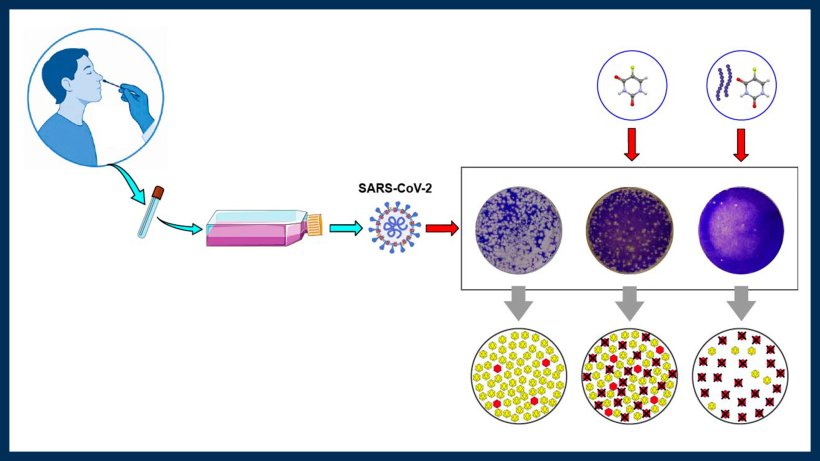
Image source: University of Malaga
‘Synergistic antiviral effects of structure-guided peptides and a mutagenic base analog on SARS-CoV-2 replication’ is the result of a multidisciplinary work in which, together with the UMA, researchers from IBIMA Platforma BIONAND, Hospital Universitario Virgen de la Victoria of Malaga, IDIBE-Universidad Miguel Hernández, from the Severo Ochoa Molecular Biology Center (CSIC-UAM), Universidad Autónoma de Madrid and Fundación Jiménez Díaz have all participated, allowing the problem to be approached from different perspectives, from computational design to experimental validation.
Although this is a laboratory study, specifically conducted in cell cultures, its developers, who continue to pursue this line of R&D, have applied for a patent to protect this therapeutic approach, with the aim of facilitating its possible transfer and future development.
This study was initiated thanks to a project funded by the Government of Andalusia within the scope of the Research Projects on SARS-CoV-2 and Covid-19 disease co-financed with ERDF funds, which has allowed progress in the development of new therapeutic approaches against the virus.
Source: University of Malaga
15.05.2026