

Image source: Moore SR, King N, Da Silva AC, Howarth C, Berwick J, Paterson TE, Minev IR, Advanced Science 2026 (CC BY 4.0)
News • Brain cooling and activity recording
3D-printed implant could help treat drug-resistant focal epilepsy
Researchers affiliated with the Leibniz Institute of Polymer Research Dresden (IPF) and the Else Kröner Fresenius Center (EKFZ) for Digital Health at TU Dresden have developed a 3D-printed implant prototype that combines the recording of brain activity with targeted cooling.
The technology could pave the way for alternative approaches to treating drug-resistant focal epilepsy. The researchers present their findings in the journal Advanced Science.
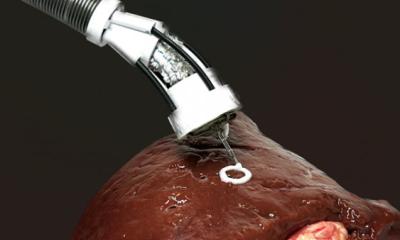
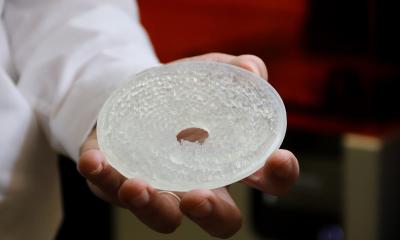
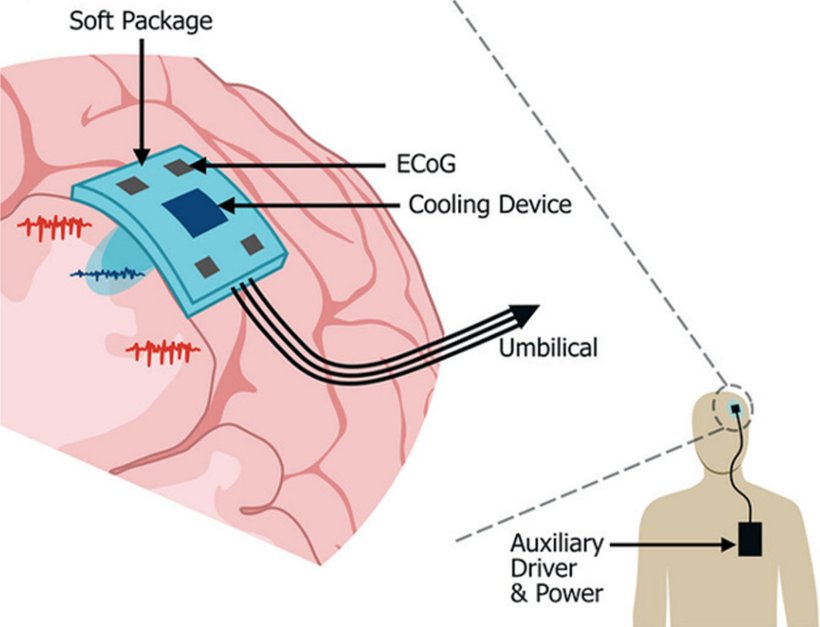
Conducted in collaboration with researchers from the University of Sheffield, the study presents a design framework for creating multimodal implants using 3D printing technologies. Based on this framework, the team developed a miniaturized implant for focal brain cooling by combining soft silicone structures, fluidic channels, and electronic components. The system also includes an auxiliary driver unit that enables autonomous monitoring and control of the implant's recording and cooling functions. Compared with previously proposed systems, this manufacturing approach could reduce implant complexity, fabrication time, and device size.
The researchers first validated the implant system through finite element simulations and agar-based tissue models, demonstrating rapid, stable, and localized cooling. In subsequent experiments using a rodent model of epilepsy, the implant’s 3D-printed composite electrodes produced electrocorticography (ECoG) recordings of comparable quality to those obtained with a commercial system. The team also demonstrated that focal cooling could suppress experimentally induced seizure-like activity.
The successful implementation of the design framework highlights the potential of 3D printing for developing compact, multifunctional medical implants and provides a promising foundation for further development toward clinical applications.
The research was funded by the European Research Council (ERC) through the ERC Starting Grant IntegraBrain.
Source: Leibniz Institute of Polymer Research Dresden
28.10.2026