


© Gorodenkoff – stock.adobe.com
News • Impact of air pollution
Study identifies ultrafine particles as major health threat
First high-resolution global exposure map shows about half of the excess deaths from ultrafine particle pollution are due to cardiovascular disease.
Ultrafine particles (UFPs) – smaller than 100 nanometres and invisible to the naked eye – contribute substantially to illness and mortality worldwide. That is the finding of an international study led by researchers at the Max Planck Institute for Chemistry in Mainz and The Cyprus Institute, with cardiologists from Mainz University Medical Center among the co-authors. The researchers estimate that around 1.99 million deaths per year worldwide are attributable to exposure to ultrafine particles. That accounts for about 5% of all deaths from non-communicable diseases. Roughly half of these are due to cardiovascular disease. The researchers therefore advocate for binding limit values. The study appears in the journal Cardiovascular Research (Oxford University Press, the journal of the European Society of Cardiology).
Ultrafine particles are literally a blind spot in air quality policy: they are not covered by any regulation, even though they are ubiquitous in our cities
Jos Lelieveld
Unlike fine particulate matter (PM2.5), which is subject to legal limit values in the EU and the US, ultrafine particles remain unregulated. Although they contribute little to particulate mass, their small size gives them a very large surface area relative to their mass, allowing them to penetrate deep into the lungs, bypass respiratory defences, and reach the bloodstream and, via the olfactory pathway through the nose, the brain directly. This makes them fundamentally different from larger particulate matter.
For the study, the team combined satellite data, land-use information and measurements from 155 locations worldwide with machine learning to map long-term exposure to ultrafine particles at a high resolution of one kilometre for the first time, covering the period from 2010 to 2019. Annual mean concentrations in cities typically range between 10,000 and 30,000 particles per cubic centimetre. The researchers present a range – referred to as a 95% confidence interval – for the estimate of 1.99 million premature deaths, indicating that there is 95% certainty that the true number of deaths falls between 0.81 million and 3.89 million.
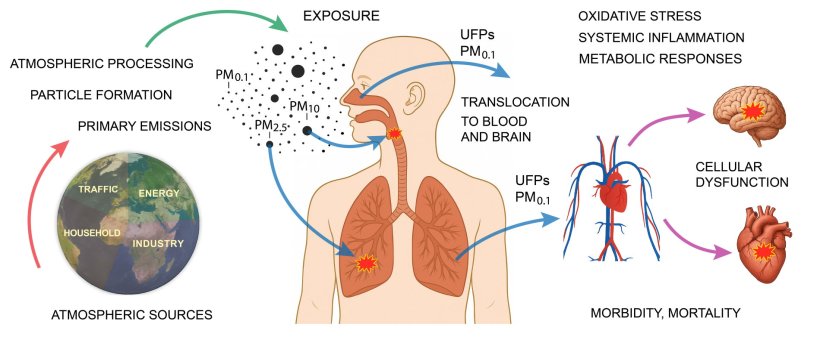
Image source: Lelieveld J, Georgiades P, Kohl M et al., Cardiovascular Research 2026 (CC BY 4.0)
Using a meta-analysis of large cohort studies from Europe and North America, the researchers also derived a mortality hazard ratio and combined it with the exposure data. The result: a mortality density of 35.7 (confidence interval: 15.8–65.5) per 100,000 people per year in Europe and 27.4 (confidence interval: 12.9–47.4) per 100,000 in North America. Exposure and mortality are particularly high in Southern and Eastern Europe. Globally, about 91% of UFP-related excess deaths occur in urban and suburban areas, with 78% in densely populated urban centres.
“Ultrafine particles are literally a blind spot in air quality policy: they are not covered by any regulation, even though they are ubiquitous in our cities,” said Prof. Dr. Jos Lelieveld, Director emeritus at the Max Planck Institute for Chemistry in Mainz and lead author of the study. “With our data, we can for the first time show worldwide where exposure is highest and which sources are responsible – above all combustion in traffic, industry and energy production. This gives policymakers a concrete tool to take targeted action.”
What is particularly alarming for us in cardiology is that ultrafine particles bypass the body’s natural protective barriers and can reach the bloodstream – and even the brain – directly
Thomas Münzel
The study highlights that ultrafine particles are an underrecognised cardiovascular risk factor. They can cross the lungs into the bloodstream, trigger systemic oxidative stress and endothelial dysfunction, promote atherosclerosis, and are linked to hypertension, diabetes, heart failure, myocardial infarction and impaired coronary microcirculation. Animal and human studies also show effects on cardiac function and cellular metabolism, extending to impaired mitochondrial function – the cell’s powerhouses.
“What is particularly alarming for us in cardiology is that ultrafine particles bypass the body’s natural protective barriers and can reach the bloodstream – and even the brain – directly,” said Univ.-Prof. Dr. Thomas Münzel, Senior professor at the Center for Cardiology at the University Medical Center Mainz. “In our own work, we see how the cardiovascular system responds to this exposure: with oxidative stress, damaged blood vessels, and an increased risk of heart attack and stroke. Roughly half of the deaths caused by ultrafine particles worldwide are due to cardiovascular disease. That makes one thing clear: clean air is heart health. We urgently need binding limit values and routine monitoring of ultrafine particles, just as we already have for fine particulate matter.”
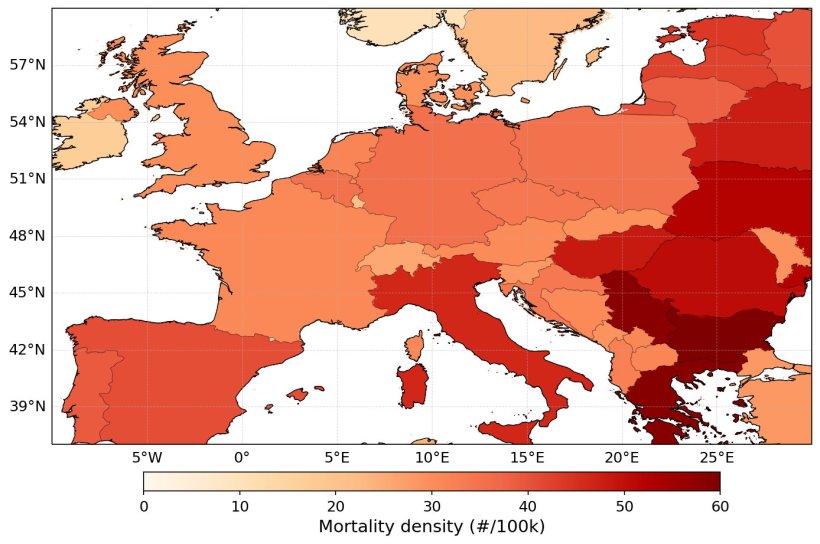
Image source: Lelieveld J, Georgiades P, Kohl M et al., Cardiovascular Research 2026 (CC BY 4.0)
According to the researchers’ analysis, ultrafine particles in polluted regions consist mainly of black and organic carbon – typical combustion products. Globally, around 75% of exposure originates from fossil fuels, rising to over 90% in high-income countries; in lower-income countries, domestic wood burning also plays a significant role. The World Health Organization (WHO) and the European Union now classify ultrafine particles as a “contaminant of emerging concern.”
The Mainz study also shows that an annual limit value of 5,000 particles per cubic centimetre could reduce global excess mortality from ultrafine particles by around 45%. The authors therefore call for a consistent reduction of combustion emissions in cities – particularly from traffic, industry and energy production – accelerated expansion of non-fossil energy sources, and the inclusion of ultrafine particles in routine air quality monitoring to better capture their long-term health impact.
Source: Max Planck Institute for Chemistry
15.07.2026