

Article • Reshaping laboratory efficiency
From bottleneck to breakthrough: a step-by-step path to lab automation
The growing demand for diagnostic testing is pushing laboratories to rethink how they operate – and automation is emerging as the answer. At the Laboratory Equipment and Technology Trade Fair – Labs Expo – held in Poznań, Poland, industry expert Mateusz Kirzyński made the case for a step-by-step approach to robotics and process automation in Life Science laboratories.
By Mark Nicholls

Kirzyński, who is Business Development Manager with Solution4Labs – a Poland-based company that supports laboratories in digital transformation and process automation – told delegates that laboratories today face a perfect storm of rising sample volumes, tighter turnaround requirements, stricter regulatory compliance, and persistent staff shortages.
The problem, he stressed, is not a lack of competence among laboratory teams. ‘Manual work has simply stopped being scalable,’ he said, describing automation and robotics as a ‘natural direction of development’ for the sector. Their value lies in increasing throughput, repeatability, and – significantly – the utilisation of existing infrastructure.
Eliminating bottlenecks through continuous operation
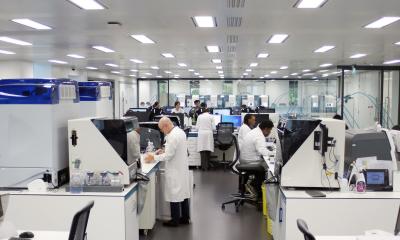
Automation and robotics can perform repetitive tasks such as sample transport, pipetting, or device handling without breaks and with high precision. ‘It is also crucial to integrate processes into a single cohesive workflow, which reduces downtime and the risk of human error,’ Kirzyński added. As a result, laboratories can perform more analyses in less time while maintaining high-quality results.
‘The most common bottlenecks include manual sample preparation, transport of materials between devices, and management of analysis queues. Equipment downtime due to shift limitations and limited staff availability is also a significant issue.’
Dispelling the myths around cost and scale
A common misconception, Kirzyński noted, is that automation is only for large companies, is prohibitively expensive, or requires automating an entire process at once. In reality, automation can be implemented step by step and scaled according to a laboratory's needs. Today it is already possible to automate activities such as pipetting, sample preparation, queue management, result reading, and workflow management using dedicated software.
For medical and hospital laboratories, the stakes are particularly high. ‘In the medical environment, time, quality, and patient safety are critical. Automation reduces turnaround times, increases result repeatability, and minimizes the risk of errors. Additionally, it enables better handling of a growing number of tests without the need to proportionally increase staffing levels.’
The best results are achieved by laboratories that start with a single problem and gradually expand the system
Mateusz Kirzyński
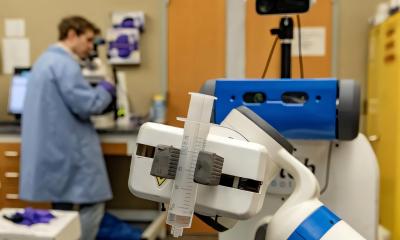
Cobots – specialised robots designed to work safely alongside humans in shared workspaces – enable automation of workstations without the need for closed safety zones, making implementation faster and less invasive. Mobile robots and intelligent transport systems automate sample logistics, eliminating the need for manual handling.
‘As a result,’ Kirzyński continued, ‘throughput increases, errors are reduced, and 24/7 operations become feasible. In healthcare, this translates into faster diagnostics and better service availability.’
Solution4Labs designs and implements integrated solutions that include robotics, Laboratory Information Management Systems (LIMS), and workflow management software. The company adopts a step-by-step approach: identify bottlenecks, pilot solutions, and scale them effectively.
‘The most important thing is to view automation not as a technology project, but as an operational transformation,’ Kirzyński concluded. ‘The best results are achieved by laboratories that start with a single problem and gradually expand the system. Robots do not replace people – they allow them to focus on higher-value tasks that require expertise and experience.’
Profile:
Mateusz Kirzyński is Business Development Manager with Solution4Labs, a Poland-based software development company founded in 2014 that designs and implements solutions for laboratories. Responsible for the Polish, French, and UK markets, he specialises in optimising laboratory operations, including LIMS-class systems and robotics. Previously, he managed a large network of Polish laboratories and has implemented proprietary laboratory workflow management software within organizations.
08.09.2026