

Image source: Ehnesh M, Valli H, Jaffery OA et al., Journal of Physiology 2026 (CC BY 4.0)
News • Patient-specific AF models
'Digital twin' hearts could help treat Atrial Fibrillation
Research suggests combining three types of data for AF heart simulations will make it trustworthy
A cross-University paper led by researchers at Queen Mary University of London, published in the Journal of Physiology, shows how better ‘digital twins’ could help doctors treating people with Atrial Fibrillation.
One of the leading causes of stroke, Atrial fibrillation (AF) is an erratic, quivering heartbeat that affects more than 1.5 million people in the UK. The most common treatment is a procedure called ablation, where doctors use heat or cold energy to destroy the small patches of heart tissue that trigger the chaotic rhythm. It works, but not for everyone, and not always the first time.
Repeat ablation is common in persistent AF partly because the condition involves complex, distributed electrical changes that are hard to map in a single procedure.
We found that MRI scans of the heart are valuable, but they don't tell the whole story
Mahmoud Ehnesh
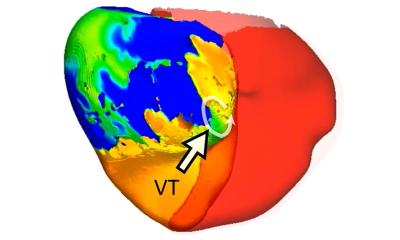
To help surgeons plan more precisely, researchers are building personalised digital models of individual patients' hearts, effectively, a "digital twin" that can simulate how AF behaves in that specific person and identify exactly where the dangerous electrical circuits are lurking before the procedure even begins and predict the outcome.
The study found that the accuracy of these personalised models depends critically on the type of clinical data used to build them.
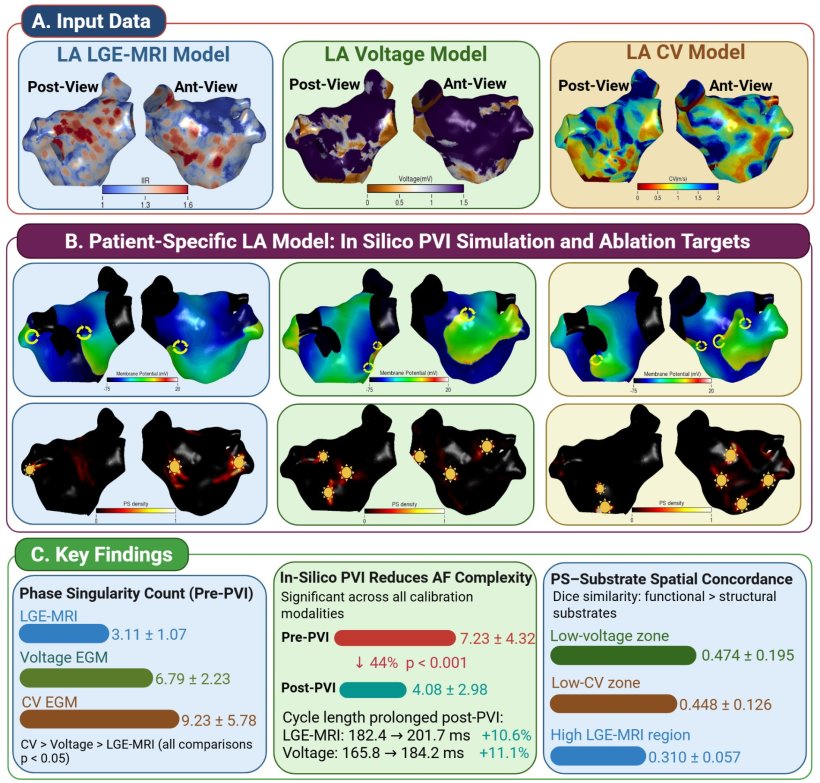
The team constructed detailed 3D digital heart models for nine patients and calibrated each model in three separate ways: using MRI scans that detect heart scarring, using electrical voltage measurements recorded during a cardiac mapping procedure, and using conduction velocity, a measure of how quickly the heart's electrical signal travels across different tissue regions.
Critically, electrical data, both voltage and conduction speed, consistently identified more and different targets than MRI data, suggesting that models relying solely on imaging may be working with an incomplete picture.
Recommended article

News • Medical computer models
Digital twin hearts succeed in arrhythmia trial
Working with “digital twins” of patients’ hearts, doctors improved cardiac ablation outcomes for patients with life-threatening arrythmias. In the first clinical trials for cardiac digital twins technology, researchers at Johns Hopkins University created digital replicas of patients’ hearts, then tested procedures on those twins before performing them on the real thing.
The findings point clearly toward combining all three data types within a single hybrid model as the most promising path forward and lay the scientific foundation for doing so.
Lead author Dr Mahmoud Ehnesh, Postdoctoral Research Assistant at Queen Mary University of London, said: "We found that MRI scans of the heart are valuable, but they don't tell the whole story. This study compared three types of clinical data, imaging and two types of electroanatomic mapping data, and found that each captures a different dimension of how Atrial Fibrillation behaves in an individual heart. Relying on any single source means missing part of the picture. Combining all three within a single personalised model is the most promising path toward more accurate, targeted ablation for persistent AF patients."
Senior author Dr Caroline Roney, Reader in Computational Medicine at Queen Mary University of London, said: “If you have a persistent irregular heartbeat (Atrial Fibrillation) and are considering ablation, personalised computer modelling may one day help surgeons plan your procedure more precisely, but this technology is still in the research phase and not yet part of routine clinical care.”
The team working on Comparative Multimodal Calibration of Patient-Specific Atrial Fibrillation models included researchers at Queen Mary University of London, Royal Brompton & Harefield Hospital (Guy’s and St Thomas’ NHS Foundation Trust), Imperial College London, King’s College London, the University of Leeds, and IHU Liryc (Bordeaux).
Source: Queen Mary University of London
23.06.2026