

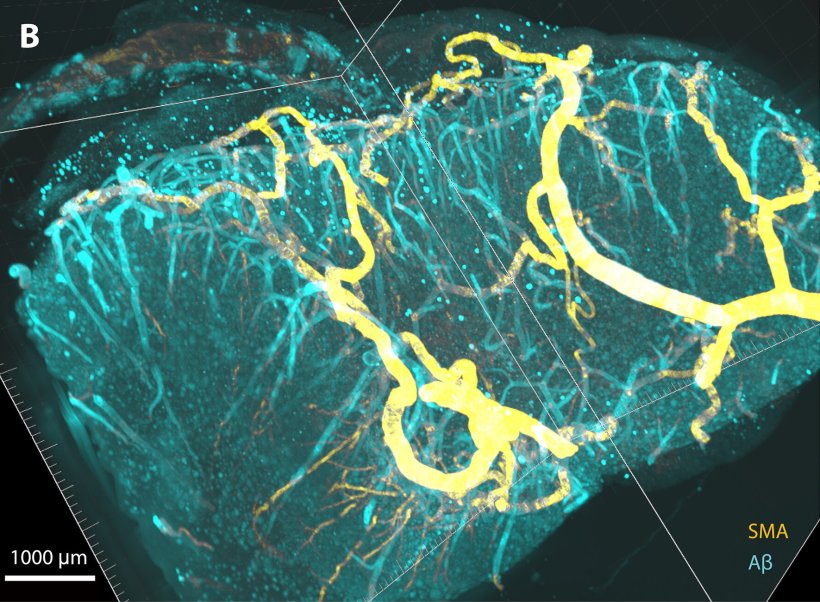
Image source: Hayashi H, Saito R, Miyashita A et al., Science Advances 2026 (CC BY 4.0)
News • Cerebrovascular disorders
3D imaging shows how amyloid beta plaques spread in the brain
Researchers at Niigata University have used advanced 3D imaging to reveal how amyloid β (Aβ) deposits spread along blood vessels in the human brain in cerebral amyloid angiopathy (CAA).
By analyzing postmortem brain tissue, the team showed that vascular amyloid deposition is most prominent in surface arteries and extends continuously toward deeper vascular branches, providing insight into the spatial organization of amyloid pathology in CAA.
Their findings are published in the journal Science Advances.
CAA is a cerebrovascular disorder characterized by Aβ deposition in cerebral small vessel walls. It is a major cause of lobar intracerebral hemorrhage and frequently coexists with Alzheimer’s disease. Although impaired clearance of Aβ along vascular pathways is thought to contribute to CAA, how vascular amyloid deposition is spatially distributed across the brain’s vascular network has remained poorly understood.
A key finding is that amyloid doesn't deposit randomly. It follows a specific pattern—starting from surface vessels and spreading inward along connected pathways
Hideki Hayashi
To address this question, researchers analyzed postmortem brain tissue from six patients with CAA using tissue-clearing techniques and light-sheet fluorescence microscopy. This approach enabled large volumes of human brain tissue to be visualized in three dimensions while preserving the continuity of the vascular network. By fluorescently labeling vascular smooth muscle cells and Aβ, the researchers reconstructed blood vessels extending from the cortical surface to the underlying white matter.
"What makes this study unique is our ability to visualize the entire vascular network in the human brain in three dimensions and at cellular resolution," explains Dr. Rie Saito, who led the research. "Our 3D approach revealed a continuous pattern of deposition that we couldn't have seen with conventional two-dimensional sections."
"A key finding is that amyloid doesn't deposit randomly," notes Hideki Hayashi, the study's first author. "It follows a specific pattern—starting from surface vessels and spreading inward along connected pathways. This supports the hypothesis that CAA develops due to impaired clearance mechanisms."
The researchers also found that the density of parenchymal amyloid plaques was lower around Aβ-positive vessels than in other areas, indicating spatially preferential distribution. "Areas with heavy vascular amyloid had fewer plaques in surrounding brain tissue," Hayashi observes. "Understanding this balance could be important for developing targeted therapies."
Together, these findings provide a 3D framework for understanding how vascular amyloid pathology is organized in the human brain. The results support the idea that impaired perivascular clearance pathways contribute to the progression of CAA and highlight the importance of spatial context in amyloid-related cerebrovascular disease.
Source: Niigata University
19.02.2026