

Photo: HiE/Behrends
Article • Dunlee Whitepaper Presentation at ECR 2026
X-ray tubes: The overlooked bottleneck in modern CT imaging
Detector technology gets most of the attention in modern CT systems – but a new whitepaper by Dunlee, presented at ECR 2026, argues that the X-ray tube is equally decisive.
Photon-counting CT (PCCT) and ultra-high resolution CT (UHRCT) have generated considerable excitement in the radiological community – and for good reason. The ability to resolve finer anatomical detail translates directly into better lesion characterisation, earlier detection, and ultimately improved patient outcomes. Yet according to a new whitepaper by Dunlee, a leading manufacturer of imaging components, a critical piece of the puzzle is being systematically overlooked: the X-ray tube.
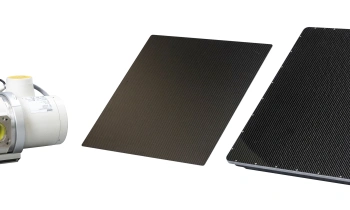
‘It’s a bit like using an expensive camera with a cheap lens,’ explained Stefanie Krämer, Strategic Business Development Manager at Dunlee, who presented the whitepaper at an exclusive pre-release event during ECR 2026. ‘You simply cannot harness the full potential of the system.’ The analogy cuts to the heart of Dunlee’s argument: as detector technology has advanced dramatically – pixel arrays have grown from 512² to 2048² pixels – tube technology has not always kept pace. Dunlee addresses this gap with its Xpert Bundle product line.
Focal spot size: Small but decisive
Spatial resolution in CT imaging is determined by a combination of factors, but the focal spot – the area on the anode where X-rays are generated – plays a central role. A smaller focal spot produces sharper images, much like a finer point of light produces a crisper shadow. For UHRCT and PCCT systems, which are designed to exploit sub-millimetre and even sub-pixel detail, focal spot size and its stability during scanning are therefore critical parameters.
The challenge is that maintaining a small, stable focal spot under clinical operating conditions is technically demanding. Modern CT tubes rotate at high velocity, and the focal spot must remain precisely controlled throughout. Any instability degrades image sharpness – undermining the very advantage these advanced systems are designed to deliver.
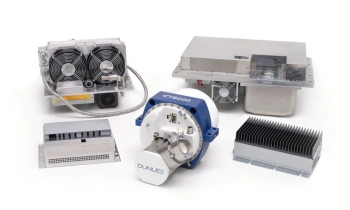
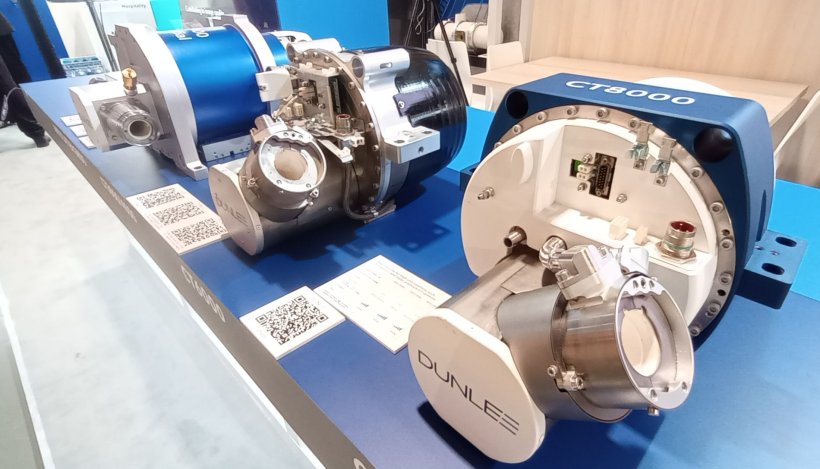
Dunlee’s Xpert Bundle tubes – available as CT6000, CT6500, and CT8000 – offer six focal spot sizes, ranging from a standard Large (1.1 × 1.2 IEC) down to an XXXS option (0.4 × 0.5 IEC), the latter roughly seven times smaller in area. This range allows operators to tailor the resolution-versus-dose trade-off to the clinical task at hand.
Clinical relevance: Where resolution translates into diagnosis
The push for higher resolution is not an engineering exercise in isolation – it has direct clinical consequences across multiple specialties. In cardiology, finer focal spots support better visualisation of coronary arteries and soft plaques. In oncology, they aid in identifying and characterising small lesions and tumours. Neurology benefits from improved detection of cerebral microbleeds, small infarcts, and fine neural structures, while pulmonology gains from detailed lung imaging and the detection of interstitial changes. In orthopaedics, high-resolution imaging assists in visualising complex bone pathologies, detecting microfractures, and assessing implant placement.
In each of these domains, the limiting factor is frequently not the detector – it is the focal spot. This is precisely the gap Dunlee’s engineering approach is designed to close.
Photo: Dunlee
‘Pushing physics to its limits’
The deeper engineering problem lies in heat. Generating X-rays is an inherently inefficient process: the vast majority of input energy is converted not into radiation but into heat. As focal spots shrink, power density – the amount of energy concentrated on an increasingly small area of the anode – rises sharply. At the extremes, this is sufficient to damage or even melt tungsten components, which have a melting point exceeding 3,400 °C.
Managing this thermal load without compromising tube performance or longevity is, as Krämer put it, a matter of ‘pushing physics to its limits.’
Engineering solutions: Bearings and heat management
Dunlee’s whitepaper outlines several engineering responses to these challenges. The tube design is specified for gantry rotation speeds of up to 250 rpm. This matters clinically: fast gantry rotation reduces motion blur, particularly in cardiac imaging where the heart’s movement would otherwise compromise image quality. Ensuring the tube maintains focal spot stability at these rotational speeds is a non-trivial engineering challenge.
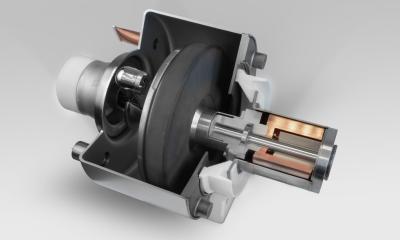
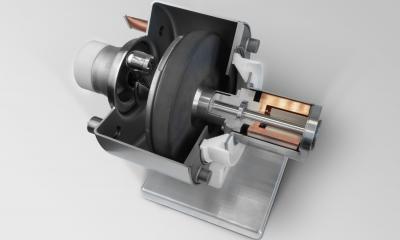
Beyond rotational dynamics, Dunlee replaces conventional ball bearings with liquid metal bearings. Traditional ball bearings impose limitations on rotational dynamics and heat transfer. Liquid metal bearings offer superior performance in both respects, enabling higher rotational speeds and more efficient thermal conduction away from the anode.
The second pillar is intelligent heat management – a systems-level approach to monitoring and controlling thermal load across the tube’s operating cycle. Together, these technologies allow Dunlee to balance the competing demands of image quality, patient throughput, and tube longevity.
A hidden part of the technology
Juli Gahi, Downstream Marketing Lead at Dunlee and moderator of the presentation, described the X-ray tube as the ‘hidden part of the technology’ – a component that rarely receives the attention of detectors or reconstruction algorithms in clinical discussions, despite its fundamental role in image formation.
That relative invisibility may be changing. As PCCT systems move from specialist centres into broader clinical deployment, the performance ceiling imposed by tube technology is becoming harder to ignore. Radiologists and procurement teams investing in next-generation CT infrastructure would do well to look beyond detector specifications and ask what the tube is capable of delivering. (WB)
23.03.2026