

Image source: Lu A, Chen WT, Dalby M et al., Nature Medicine 2026 (CC BY 4.0)
News • Key biological mechanisms identified
Finding the “tipping point” of Alzheimer's
Researchers from the Vlaams Instituut voor Biotechnologie (VIB), KU Leuven, the UK Dementia Research Institute (UK-DRI) and Muna Therapeutics, funded by, among others, the European Research Council, have uncovered a critical biological transition that may determine whether Alzheimer’s disease (AD) pathology leads to dementia.
Studying brain tissue from older adults with and without cognitive decline, as well as cognitively healthy centenarians, the team identified distinct cellular programs and immune-cell states associated with disease progression and resilience. Their findings, published in Nature Medicine, suggest that changes in microglia—the brain’s resident immune cells—could represent an important target for future Alzheimer’s therapies.
“This has been an exciting journey with many partners. The study, entirely based on human donor material, provides insight into one type of resilience mechanism in the progression of AD to dementia,” says Prof. Bart De Strooper (De Strooper Lab), ERC grantee and one of the co-senior authors of the study.
Alzheimer’s disease affects more than 55 million people worldwide and is marked by the accumulation of amyloid-β plaques and tau tangles in the brain. Yet the relationship between these hallmarks and dementia is not straightforward: some individuals remain cognitively healthy despite having plaques and tangles. Scientists increasingly believe that the answer lies in how different brain cells respond to these proteins. Among the most important players are microglia, the brain’s immune cells, whose activity changes dramatically as the disease progresses. Understanding these cellular responses could reveal why some people are resilient to Alzheimer’s disease and help identify new therapeutic targets.
Recommended article
Article • Focus topic
Alzheimer's disease: Demystifying dementia
Alzheimer's disease is probably the best-known form of neurodegenerative disease, which is usually characterised by a progressive loss of cognitive, emotional and social abilities. But what actually happens in the brain? Read more about current research and therapeutic approaches to this form of dementia.
The new study reveals that individuals who remain cognitively healthy despite Alzheimer’s pathology do so through distinct biological mechanisms. By comparing the brains of people with and without dementia, as well as cognitively healthy centenarians (people over the age of 100 years), the researchers identified unique microglial responses associated with resilience against Alzheimer’s disease, providing new insights into how the brain can resist the effects of the condition. “Understanding better how the brain resists the disease, will provide new avenues towards therapies to prevent neurodegeneration and dementia,” adds Prof. Mark Fiers (VIB-KU Leuven), co-senior author of the study.
These findings open new opportunities to target microglial states — especially pathways such as TREM2 — and extend resilience rather than simply focusing on plaque removal
Niels Plath
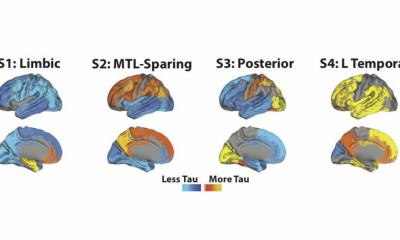
To investigate this resilience, the research team combined technologies that can analyze tissues at the level of single cells (spatial transcriptomics and single-cell sequencing), and they identified six distinct tissue domains representing different stages of Alzheimer’s disease progression. A key turning point emerged between domains associated primarily with amyloid-β plaques and those linked to tau pathology and neurodegeneration.
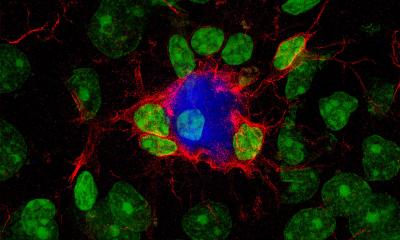
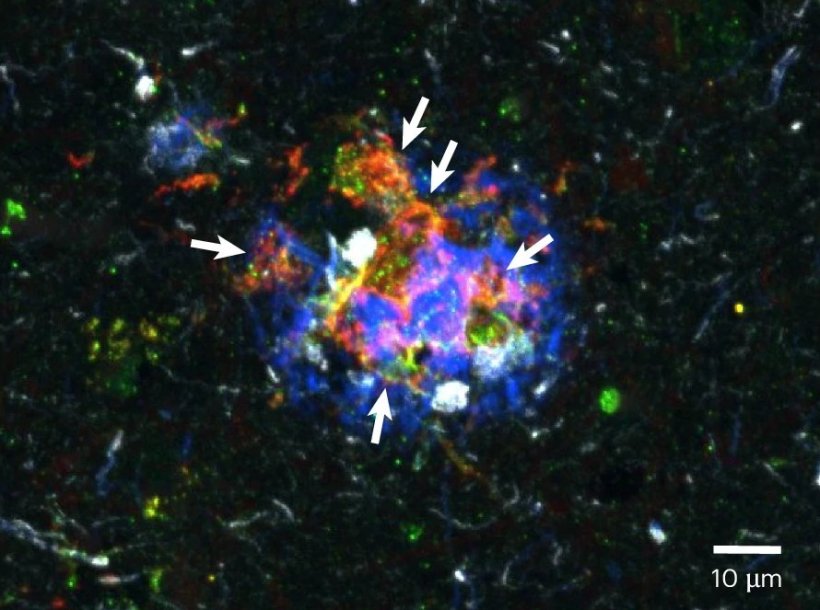
This transition was accompanied by a striking change in microglia. Early in the disease process, these cells adopted an inflammatory state associated with amyloid plaques. Later, they switched to a distinct antigen-presenting state that appeared alongside the emergence of tau pathology. The findings suggest that this cellular transition may represent a critical step determining whether Alzheimer’s pathology progresses toward dementia.
The study also revealed that resilience to Alzheimer’s disease can arise through different biological mechanisms. Octogenarians who accumulated amyloid plaques but remained free of dementia showed an early microglial response but did not transition into the later immune state associated with disease progression.
Centenarians displayed a different pattern. Although they activated the later microglial program, this response occurred largely independently of tau accumulation. In other words, a cellular state linked to neurodegeneration in some individuals appeared to be uncoupled from harmful effects in others. These findings suggest that resilience is not simply the absence of pathology, but the brain’s ability to alter how it responds to it.
These insights could help guide the development of more precise therapies. Molecules aimed at preserving beneficial early microglial responses and involved in microglial state transitions could represent valuable therapeutic targets. Moreover, interventions may be most effective when applied before the brain reaches the tipping point where inflammatory responses become linked to tau pathology and cognitive decline.
“These findings open new opportunities to target microglial states — especially pathways such as TREM2 — and extend resilience rather than simply focusing on plaque removal. We are excited to continue this journey and understand the causal role of microglial transitions leading to the identification of novel therapeutic approaches to delay or prevent disease progression,” concludes Niels Plath, CSO of Muna Therapeutics.
Source: Vlaams Instituut voor Biotechnologie
08.06.2026