

Image source: University of Cambridge
News • Dysarthria solution
Wearable device gives stroke patients their voice back
‘Revoice’ device captures heart rate and throat vibrations to reconstruct intended words and sentences in real time
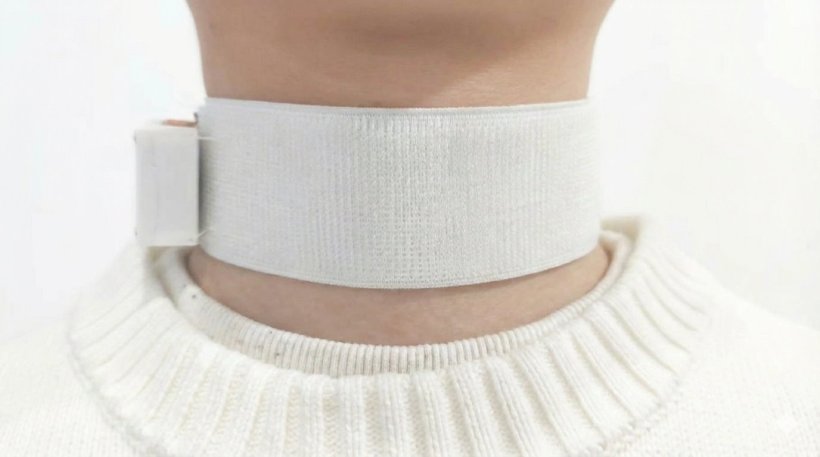
The device, called Revoice, whose development was led by researchers at the University of Cambridge, uses a combination of ultra-sensitive sensors and artificial intelligence to decode speech signals and emotional cues to allow people with post-stroke speech impairment to communicate naturally. The Revoice device, worn as a soft and flexible choker, captures the wearer’s heart rate and tiny vibrations from throat muscles, and uses those signals to reconstruct intended words and sentences in real time.
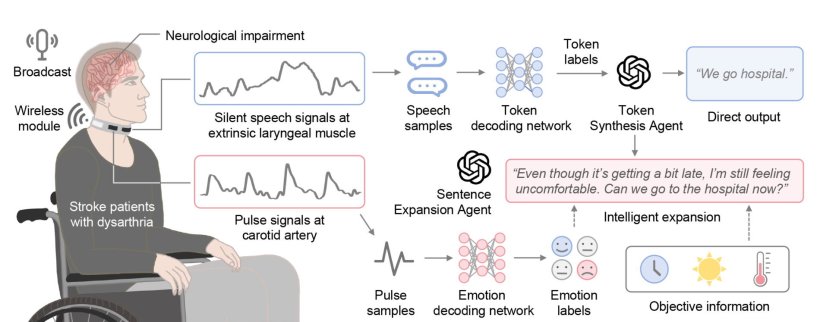
Image source: Tang C, Gao S, Li C et al., Nature Communications 2026
The signals from the device are processed by two AI agents: one reconstructs words from fragments of silently mouthed speech, while the other interprets emotional state and contextual information, such as the time of day or weather conditions, to expand short phrases into complete, expressive sentences.
In a small trial with five patients with dysarthria, a common type of post-stroke speech impairment, the device achieved a word error rate of 4.2% and a sentence error rate of just 2.9%. Unlike existing assistive speech technologies, which often require slow letter-by-letter input, eye tracking or brain implants, the Revoice device provides seamless real-time communication, turning just a few mouthed words into full, fluent sentences. Their results, reported in the journal Nature Communications, could not only have implications for stroke rehabilitation, but could also help support people with conditions such as Parkinson’s and motor neuron disease. The researchers are currently planning a clinical study in Cambridge for native English-speaking dysarthria patients to assess the viability of the system, which they are hoping to launch this year.
When people have dysarthria following a stroke, it can be extremely frustrating for them, because they know exactly what they want to say, but physically struggle to say it, because the signals between their brain and their throat have been scrambled by the stroke
Luigi Occhipinti
About half of people develop dysarthria, or dysarthria in combination with aphasia, following a stroke. Dysarthria is a physical condition that causes weakness in the muscles of the face, mouth and vocal cords. It affects people in different ways, but often causes an inability to speak clearly, slurred or slow speech, or speaking in short, disjointed bursts rather than full sentences.
“When people have dysarthria following a stroke, it can be extremely frustrating for them, because they know exactly what they want to say, but physically struggle to say it, because the signals between their brain and their throat have been scrambled by the stroke,” said Professor Luigi Occhipinti from Cambridge’s Department of Engineering, who led the research. “That frustration can be profound, not just for the patients, but for their caregivers and families as well.”
Most stroke patients with dysarthria work with a speech therapist to regain their ability to communicate, primarily through repetitive word drills, where patients repeat words or phrases back to the speech therapist. Typical recovery time varies from a few months to a year or more. “Patients can generally perform the repetitive drills after some practice, but they often struggle with open-ended questions and everyday conversation,” said Occhipinti. “And as many patients do recover most or all of their speech eventually, there is not a need for invasive brain implants, but there is a strong need for speech solutions that are more intuitive and portable.”
Occhipinti and his colleagues developed the Revoice device as such a solution. The sensors in the device capture subtle vibrations from the throat to detect speech signals and decodes emotional states from pulse signals – a simplified but effective proxy. The device also uses an embedded lightweight large language model (LLM) to predict full sentences, so only uses minimal power. Working with colleagues in China, the researchers carried out a small trial with five stroke patients with dysarthria, as well as ten healthy controls. In the study, participants wore the device and mouthed short phrases. By nodding twice, they could choose to expand those phrases into sentences using the embedded LLM.
In one example, “We go hospital” became “Even though it’s getting a bit late, I’m still feeling uncomfortable. Can we go to the hospital now?” The sensors in the Revoice device inferred that the wearer was feeling frustrated due to their elevated heart rate, and that it was getting late at night. The LLM was able to use this data to expand three mouthed words into a full sentence.
Participants in the study reported a 55% increase in satisfaction, showing that the device could be a promising development to help stroke patients regain their ability to communicate. Although extensive clinical trials will be required before the device can be made widely available, the researchers hope that future versions of the device will include multilingual capabilities, a broader range of emotional states and fully self-contained operation for everyday use. “This is about giving people their independence back,” said Occhipinti. “Communication is fundamental to dignity and recovery.”
The research was supported in part by the British Council, Haleon, and the Engineering and Physical Sciences Research Council (EPSRC), part of UK Research and Innovation (UKRI).
Source: University of Cambridge
19.01.2026